All species › Tubenoses › Petrels, shearwaters and diving petrels › Northern Giant Petrel
Northern Giant Petrel | Macronectes halli
Noordelijke reuzenstormvogel | Abanto marino subantártico
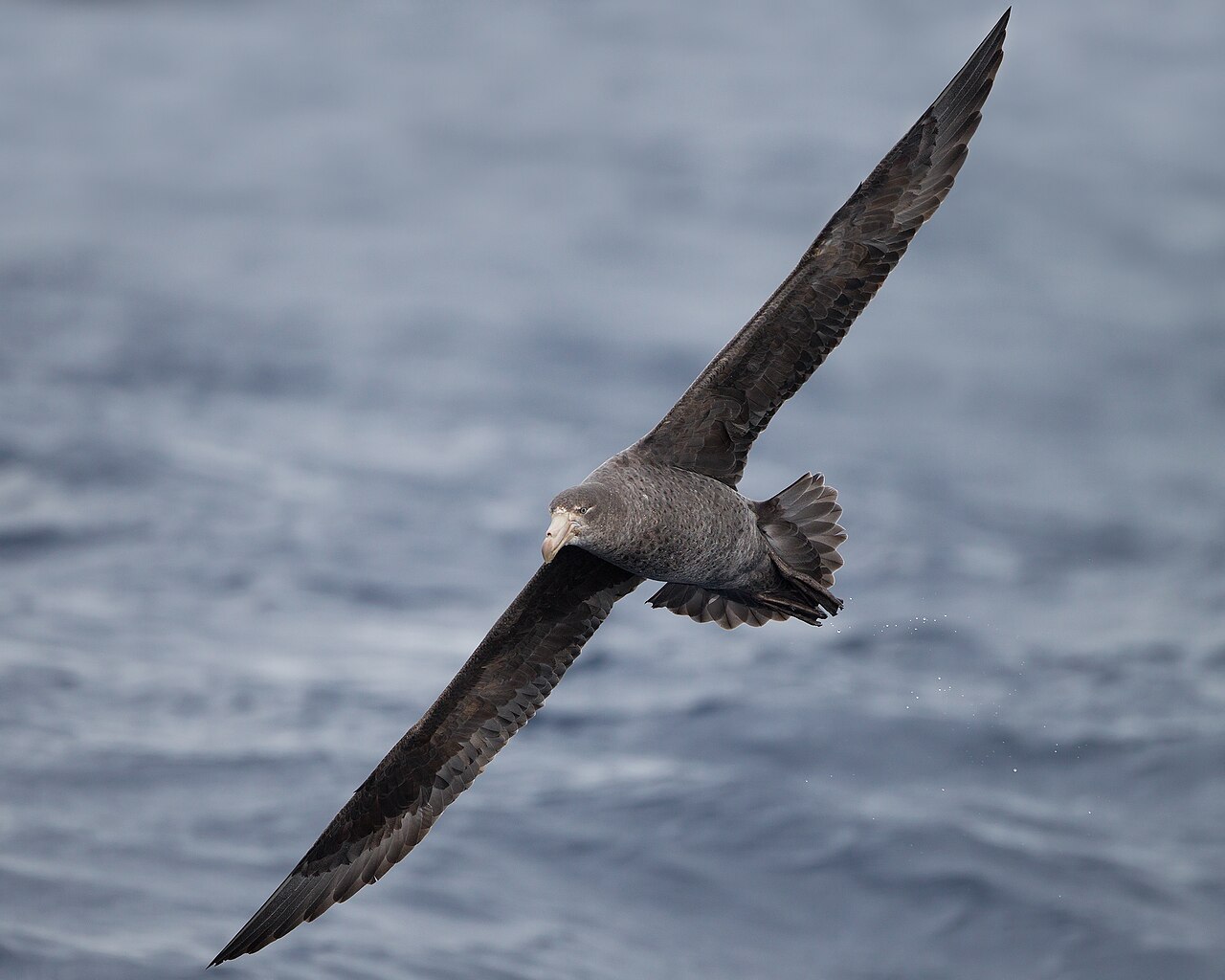
The Northern Giant Petrel is an albatross in size but a petrel in build: nearly a metre long, with a span of over two metres and a huge horn-coloured bill on which the nostril tubes sit as a separate pipe along the top. It lives on the carcasses of penguins and seals, is the terror of every young seabird at a colony, and in practice can be separated from its southern twin only on the colour of the bill tip: in this species reddish brown.
Voice
At sea it is heard mainly at carrion: a deep, guttural growling and roaring, with sharp whinnying and hissing as birds drive one another off a carcass. At the colony bill-clapping goes with it, and a braying shout given with the wings raised. Chicks defend themselves by spitting a jet of stomach oil, a silent but highly effective answer.
No freely licensed recording has been found for this species yet; what to listen for is described below.
Identification
A giant petrel of about 90 cm, with a span of one and a half to over two metres and a weight of 2.5 to 5.8 kg; males run about a fifth heavier than females. The bill is 9 to 11 cm long and pinkish yellow, with the nostril tubes forming a long pipe over the upper mandible — the mark that separates any giant petrel from an albatross at a glance. Decisive is the nail at the bill tip: in this species brick-red to reddish brown, sometimes with bluish-black flecks. Young birds are uniformly sooty black; with the years the bird becomes dark above and pale below, the white spreading from face and foreneck across the underparts while crown and nape stay brown. There is no white morph in this species. The flight is hunched and short-necked, heavy beats on stiff, slightly bowed wings.
Confusion species
Southern Giant Petrel (Macronectes giganteus) is the only real confusion, and the separation stands or falls with the bill tip: in halli the nail is brick-red to reddish brown, in giganteus horn-yellow with a green tip, ranging from bluish to apple green. In older birds plumage helps: halli becomes dark above and pale below with a crown that stays brown, while giganteus keeps a dark body with a sharply set-off whitish head and neck. Besides, giganteus has a wholly white morph — roughly one bird in ten — and halli never does. Juveniles of both are entirely sooty black and, without a view of the bill tip, all but indistinguishable; size is no help, for the overlap is broad. Albatrosses (Diomedea, Thalassarche) are slighter in head and neck and lack the tube of nostrils along the top of the bill.
Habitat
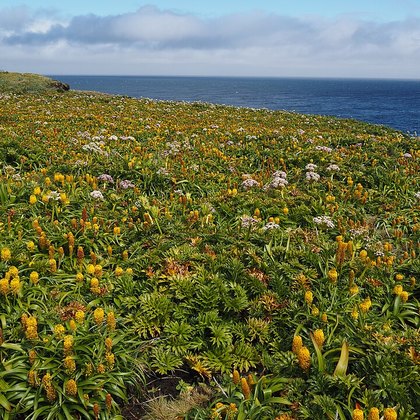
Sea over the shelf, the slope and the open subantarctic ocean, but far more than other petrels also close inshore: around seal and penguin colonies and around harbours, where carrion is to be had. It forages ashore as well, on beaches and at elephant seal wallows. To breed it takes open, gently sloping ground on subantarctic islands — tussock grassland, bare gravel and the edges of herbfield — where the nest is a low mound of plant matter, often in loose groups.
Where the bird is most often found, arranged by main group and formation.


Range and movements
Within the map window it breeds on the New Zealand islands of Chatham, Antipodes, Auckland and Campbell, in the Stewart Island area, and on Macquarie south-east of Australia; outside the window on South Georgia, Marion, Crozet and Kerguelen. It generally stays north of the Antarctic Convergence, which is precisely where it parts company with its southern relative. At sea it is present year-round in New Zealand waters, with Kaikoura the most reliable place, and along the southern coast of Australia to New South Wales and Western Australia, mainly in winter.
- Resident
- dark = core range, pale = thinly spread
Where and when to look
Off Kaikoura it comes to chum within a few metres of the boat, which is exactly what is needed: photograph the bill square-on from the side and zoom in on the nail. Red means Northern, green means Southern. Do not be led by the head, since a pale-headed bird may be either species, and certainly not by size. In the harbours of Bluff, Stewart Island or Lyttelton they sometimes hang about the fishing boats, where the same rule applies.
Conservation
Least Concern (LC), and the species was moved down from Near Threatened because numbers are rising: around 2001 the world population was put at 17,000 to 21,000 birds, increasing by about a third per decade. That recovery is credited to more food — growing seal colonies and fishery waste — and to better rules in longline fisheries. Longline bycatch remains the main cause of death at sea, and at the colonies the birds are sensitive to disturbance: a breeding giant petrel flushed by a walker will desert its egg.
Scientific name
Macronectes halli | Mathews, 1912
Mathews introduced the form in 1912 as the subspecies Macronectes giganteus halli, in The Birds of Australia; it was later recognised as a separate species, and because the genus did not change, author and year carry no parentheses. The epithet honours Robert Hall, an Australian ornithologist. The genus Macronectes was introduced by Richmond in 1905 and is formed from Greek makros, 'great', and nektes, 'swimmer'. The type locality is Kerguelen.