All species › Passerines › Munias, parrotfinches, waxbills and allies › Red-browed Finch
Red-browed Finch | Neochmia temporalis
Doornastrild | Diamante cejirrojo
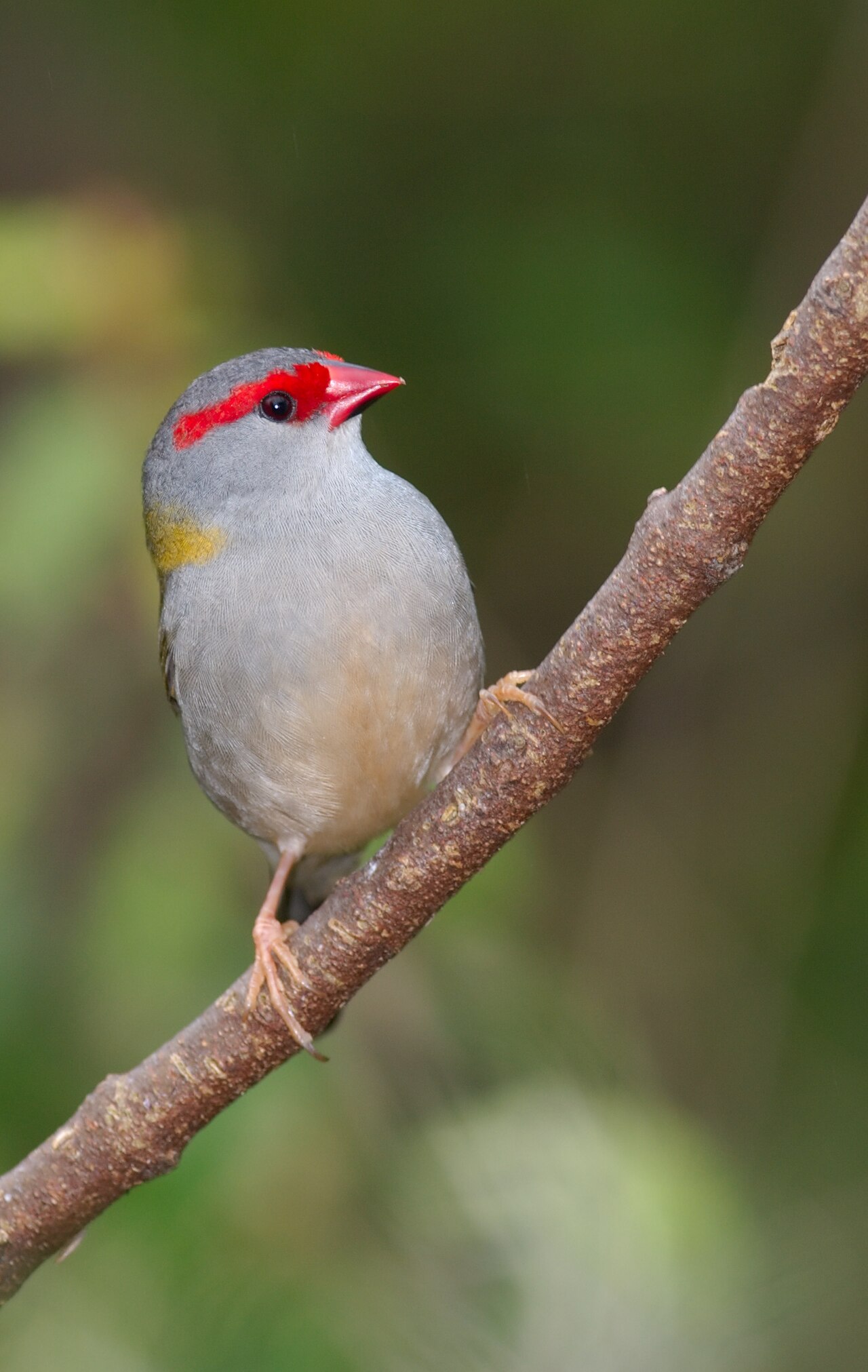
The Red-browed Finch is the small olive-green finch with a bright red brow stripe and a red rump that shuffles about on the ground in parties along woodland edges, in scrub and in gardens throughout eastern Australia. Disturbed, the whole party flies into the nearest bush with a thin high call and waits there, flicking its tail, until the coast is clear.
Voice
The contact call is a high, thin, slightly upward-drawn ssiit, repeated constantly by every member of a party and the best way of locating the species in dense scrub; it sounds sharper and more penetrating than the size of the bird suggests. On flushing it becomes a rapidly repeated sit-sit-sit. The male's song is a soft, high, slightly scratchy phrase of a few seconds built from the same notes as the call, usually delivered from a perch just above the ground. At the nest and in the communal roost there is a soft, continuous twittering.
Recording: James Lambert — CC BY-NC-SA 4.0 · Enoggera Dam, Brisbane City, Queensland, Australia · xeno-canto
Identification
A small, stocky finch of eleven to twelve centimetres with a short, thick, coral-red bill. The upperparts are olive-green, the head, throat and underparts plain blue-grey, and the rump and uppertail coverts bright crimson; the tail itself is blackish brown. Across the face, from the base of the bill back over the eye, runs a sharply defined scarlet stripe — the red brow that gives the bird its English name. The lore is black, which makes the red stand out all the more. Male and female are alike. The juvenile is the pitfall: it lacks the red brow entirely, is duller olive and grey, and has a black bill instead of a red one; only the red rump is already there and gives the species away. In flight one sees mainly a small dark bird with a glowing red rear end.
Confusion species
Crimson Finch (Neochmia phaeton) is the closest relative and also shows red on the face, but there the red is not confined to a stripe: the whole face, throat and flanks are crimson, the tail is long and red, and the bird sits almost exclusively by permanent water with pandanus in the tropical north, where the Red-browed Finch is absent. Double-barred Finch (Stizoptera bichenovii) has a white face framed in black and two black bars across the breast, and no red at all except sometimes in the rump. Diamond Firetail (Stagonopleura guttata) is heavier, with a black breast band and white-spotted black flanks. Juvenile Red-browed Finches without the red brow are easily taken for another finch: look then for the red rump, present from fledging, and for the black bill, which turns red within a few weeks.
Habitat
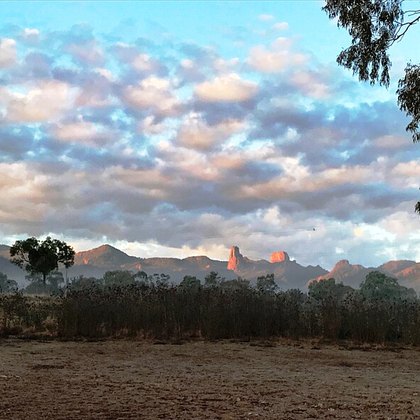
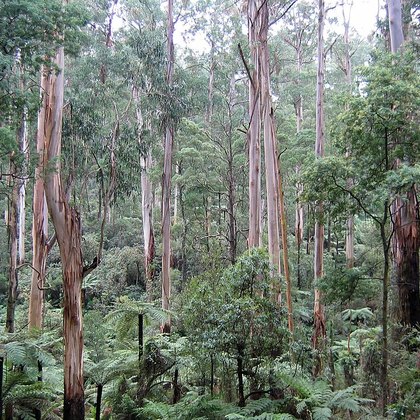
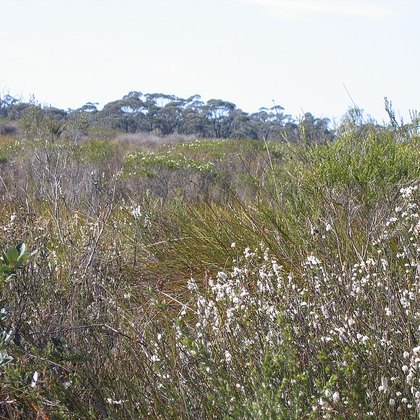
Dense scrub and the edges of forest: woodland margins and clearings in wet and dry eucalypt forest, regrowth along creeks and rivers, rainforest edges, shrubby heath, thickets of naturalised blackberry and lantana, and in settled country gardens, parks, hedges and planted roadsides. The species needs two things at once: open ground with seeding grasses to feed on, and dense cover right beside it to dive into. That makes it as much at home in a planted garden with a thick hedge as in natural edge scrub. The large domed grass nest with a side entrance sits low in a dense shrub or creeper.
Where the bird is most often found, arranged by main group and formation.



Range and movements
Eastern and south-eastern Australia, from Cape York Peninsula in northern Queensland along the coastal strip and the eastern slopes of the Great Dividing Range to south-eastern South Australia, and on Kangaroo Island as well. Inland it seldom reaches far beyond the range. Beyond that there is an established population in south-western Western Australia round Perth, founded by released or escaped birds, and a number of smaller introduced populations. The species does not occur in New Zealand.
- Resident
- dark = core range, pale = thinly spread
Where and when to look
Walk early in the morning along the line between a lawn or a path and a dense hedge and listen for soft rustling and thin high calls; the party almost always feeds on the ground and will allow an approach to within a few metres as long as cover is close. If all you get is birds flying away, watch the rear end: the bright crimson rump on an otherwise dark little bird is the most reliable distant mark and works for juveniles without the red brow as well.
Conservation
Least Concern (LC). The Red-browed Finch is common, has a large range and is one of the few Australian seed-eating songbirds that profits from people: hedges, gardens, naturalised shrubs and road verges with grass seed have actually made it more numerous in settled country. Locally, cat predation and the clearing of scrub depress numbers, and the bird is a favoured host of brood-parasitic cuckoos. For the species as a whole there is no concern; the introduced population near Perth, by contrast, counts as an exotic outside the natural range.
Scientific name
Neochmia temporalis | (Latham, 1801)
John Latham described the species in 1801 as Fringilla temporalis, from a bird taken in New Holland — the type locality is now placed at Sydney. Because it has moved to another genus, author and year stand in parentheses. The epithet temporalis means 'of the temples', after the red stripe that runs exactly across the temple; the English name Red-browed Finch and the Dutch name doornastrild refer respectively to that stripe and to the thorny scrub in which the bird hides. The genus Neochmia was erected by Gray in 1837.