All species › Parrots › Old World parrots › Scaly-breasted Lorikeet
Scaly-breasted Lorikeet | Trichoglossus chlorolepidotus
Schubbenlori | Lori escuamiverde
The Scaly-breasted Lorikeet is the green lorikeet of the Australian east coast: grass-green throughout, with a coral-red bill and fine yellow scalloping across breast and neck. It often feeds in mixed flocks with Rainbow Lorikeets and stands out in such a party at once as the only bird without a blue head.

Voice
A high rolling screech, given continuously in flight and thinner and sharper than the hard screech of the Rainbow Lorikeet it so often travels with. From a flowering canopy comes a steady shrill chatter with sharp outbursts as birds squabble over blossom. The call is the most reliable way to pick a Scaly-breasted Lorikeet out of a mixed flock.
No freely licensed recording has been found for this species yet; what to listen for is described below.
Identification
Twenty-two to twenty-four centimetres and about eighty-six grams, a little bulkier than a Musk Lorikeet and a little smaller than a Rainbow. The plumage is almost entirely grass-green — head, mantle, wings and tail — with a dense pattern of narrow yellow scales across breast and side of neck that dominates the view at close range and reads as a pale breast wash at distance. Bill and iris are red. In flight the underwing shows two-tone: an orange-red panel with a grey trailing edge. Sexes alike; juveniles duller, with a brown bill and scarcely any scaling.
Confusion species
Rainbow Lorikeet (Trichoglossus moluccanus) is the species it feeds alongside daily and is told at once by the blue-purple head, orange-red breast and blue belly; it also shows a yellow panel through the middle of the underwing, where the Scaly-breasted shows orange-red with a grey trailing edge. Musk Lorikeet (Trichoglossus concinnus) is smaller, with a black bill tipped red, a red eye-stripe and a blue crown, and no yellow scaling. Little Lorikeet (Parvipsitta pusilla) is far smaller with a black bill and a red face. In this region a lorikeet with an all-green head and a red bill can only be this one.
Habitat
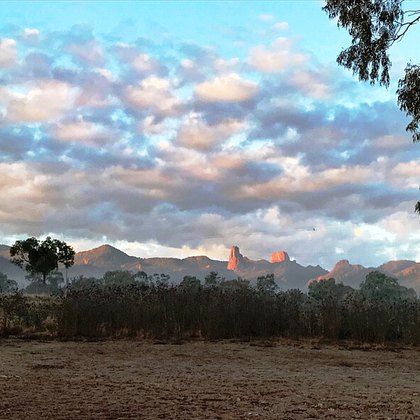
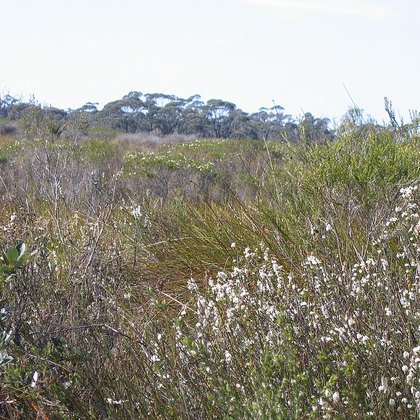
Lowland eucalypt forest and woodland carry the bulk of the population, mostly within a few tens of kilometres of the coast. It also uses flowering heathland, melaleuca swamp and banksia scrub, and it is a familiar bird of well-treed suburbs, city parks and gardens, coming to flowering grevilleas, bottlebrush and planted umbrella trees. It nests on a bed of decayed wood in a hollow limb, usually three to twenty-five metres up.
Where the bird is most often found, arranged by main group and formation.


Range and movements
The coastal belt of eastern Australia, from the tip of Cape York in Queensland south to about Wollongong in New South Wales, with the stronghold between Cairns and the Hunter. It is largely sedentary, though local numbers swing sharply with eucalypt flowering. Beyond that range the birds are introduced or escaped: established populations exist in Perth, Melbourne and Canberra, where the species is treated as an exotic.
- Resident
- dark = core range, pale = thinly spread
Where and when to look
Look for it inside a flock of Rainbow Lorikeets in a flowering tree and run your eye along the heads: the green head among the blue ones jumps out. If you only get birds overhead, check the underwing — orange-red with a grey trailing edge belongs to the Scaly-breasted, a broad yellow panel to the Rainbow. In a garden with flowering bottlebrush it is often the first species to come in on the sound of other lorikeets.
Conservation
Not threatened (LC): it is common through eastern Australia and, like the Rainbow Lorikeet, has gained from urban planting of nectar-bearing shrubs and trees. The loss of old hollow-bearing trees along the coast does limit nest sites, and on neighbouring orchards it is locally regarded as a pest of fruit. The introduced populations in Perth, Melbourne and Canberra are by contrast held to be unwanted, since there they compete with native hollow-nesters for nest sites.
Scientific name
Trichoglossus chlorolepidotus | (Kuhl, 1820)
Heinrich Kuhl described the species in 1820 as Psittacus chlorolepidotus, in the Nova Acta of the Leopoldina; the type locality is New South Wales. Author and year take parentheses because the bird later moved to Trichoglossus. The epithet is Greek: khlōros, ‘green’, and lepidōtos, ‘scaled’ — the same two marks the Dutch and English names carry. The genus Trichoglossus was introduced by Stephens in 1826, from Greek thrix, trikhos, ‘hair’, and glōssa, ‘tongue’, for the brush tip with which lorikeets lap nectar.