All species › Passerines › New World sparrows › Bell's Sparrow
Bell's Sparrow | Artemisiospiza belli
Bells gors | Chingolo de Bell
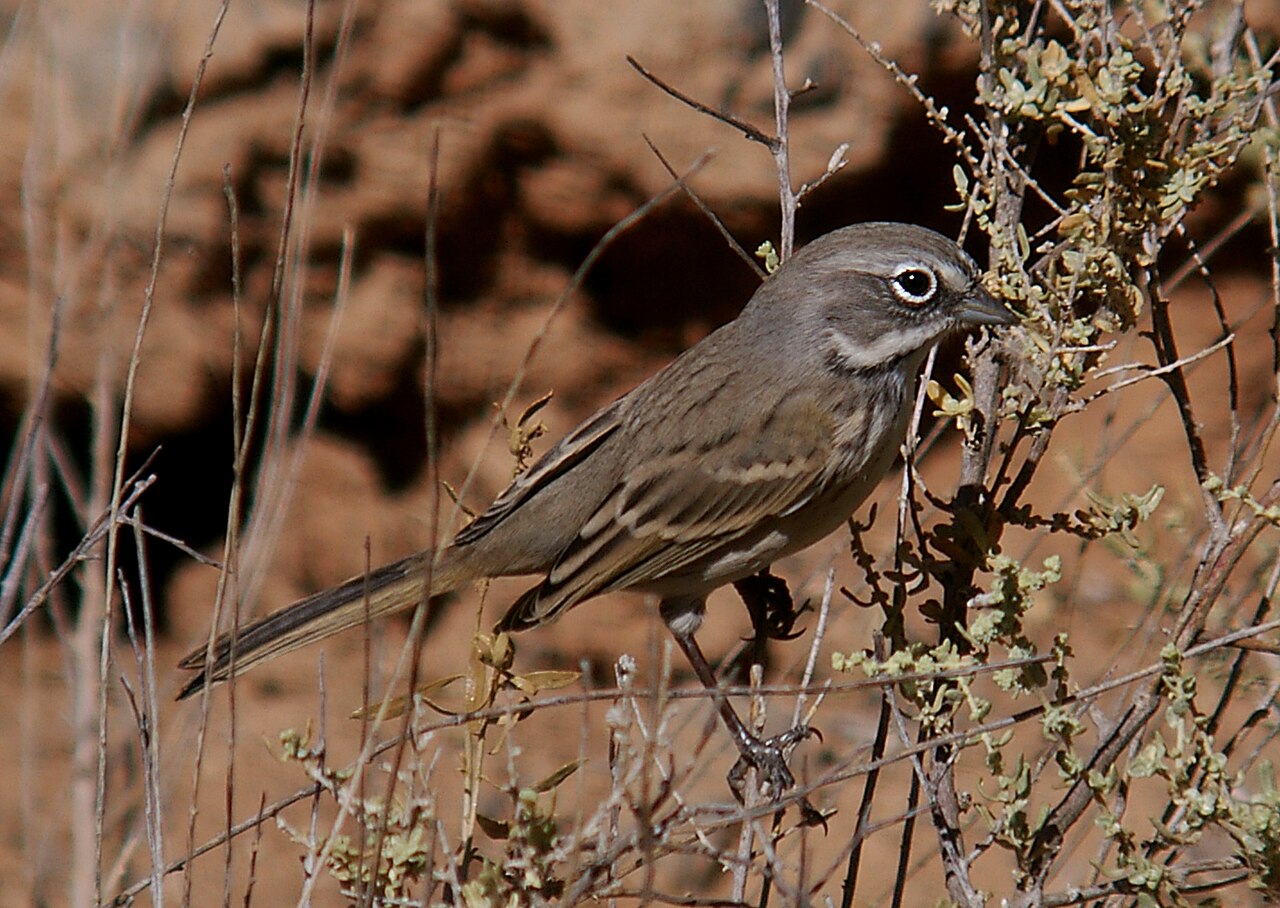
Bell's Sparrow is the dark-headed counterpart of the Sagebrush Sparrow and belongs to the coastal sage and chaparral (dense, hard-leaved scrub of California's Mediterranean climate) of California, the Mojave Desert and the Baja California peninsula. It walks over the bare ground between the shrubs with its tail raised, and unlike its relative it stays in the same area all year.
Voice
The song is a short, hurried-sounding phrase of a few clear notes with a lower, slightly buzzy run-off, over in a few seconds. Only the male sings, from a shrub top or a low wire, mainly in the first hours after sunrise, and each male varies the phrase through the season. The call is a thin, high tink.
Recording: Paul Marvin — CC BY-NC-SA 4.0 · Proctor Valley Rd, San Diego County, California, United States · xeno-canto
Identification
A small sparrow with a dark grey head and nape contrasting clearly with the brown back, a white eyering and a white spot above the dark lore. Below the eye runs a broad, sharply drawn black malar stripe. The underparts are white with a single dark breast spot; the back is nearly unstreaked to finely streaked. The tail is long and dark and is held up while walking. The forms differ strongly in tone: the coastal form is darkest, the Mojave form paler with clearer back streaking, and the peninsular form palest and sandy.
Confusion species
Sagebrush Sparrow is the standing confusion species and is paler and sandier, with a less contrasting grey head, a narrower and vaguer malar stripe and a clearly streaked back. The pale Mojave form of Bell's stands between the two and often cannot be named with certainty in winter away from the breeding range. Black-throated Sparrow has a black throat, white supercilium and cheek stripe and no breast spot. California Towhee is far larger, plain brown and without head contrast.
Habitat
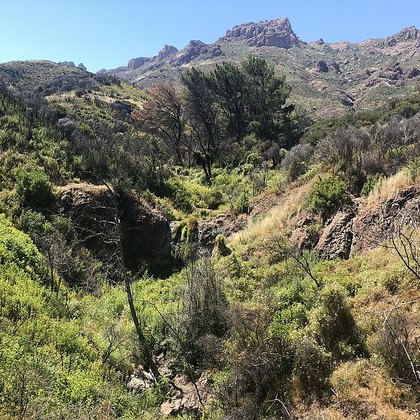
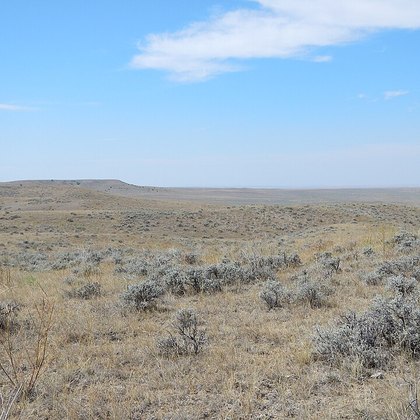
Open, low scrub with bare ground between the bushes: coastal sage and chaparral on dry slopes, sagebrush and saltbush flats in the Mojave and the Californian Great Basin, and desert scrub on the peninsula. It forages almost entirely on the ground under the shrubs, on seeds, insects and spiders. Overgrown old chaparral without open patches is avoided; after a fire it returns as soon as the scrub is low and open again.
Where the bird is most often found, arranged by the USNVC — the vegetation classification of the United States and Canada — and CMECS for sea and coast.



Range and movements
The nominate form occupies the coastal belt of California from Trinity and Shasta counties south to northwestern Baja California, with a separate population on the western flank of the Sierra Nevada. The interior form breeds from the San Joaquin Valley through the deserts of southern California and moves partly in winter to southeastern California, southern Nevada and western Arizona. The peninsular form is resident in Baja California. Away from California, Baja California and the immediate desert edge it does not occur.
- Resident
- Breeding (summer)
- Winter
- Passage
- dark = core range, pale = thinly spread
Where and when to look
Look for it from February to May in low coastal sage scrub along the Californian coast or in the Mojave, in the first two hours of the day: then the male sits singing on top of a bush instead of under it. Then check the malar stripe — broad, black and sharply bordered against a dark grey head is the deciding mark against Sagebrush Sparrow.
Conservation
The species is listed as Least Concern (LC), with an estimate of about 270,000 mature birds. The pressure is loss of coastal sage scrub to development in southern California and too short an interval between fires, which turns chaparral into grassland. The San Clemente Island form was protected under the United States Endangered Species Act; after introduced goats and pigs were removed from the island the population recovered and protection was lifted in 2023.
Scientific name
Artemisiospiza belli | (Cassin, 1850)
Cassin described the species in 1850 as Emberiza belli, from a specimen collected near Sonoma in California; the move to another genus puts author and year in parentheses. The species name honours John Graham Bell (1812–1889), an American taxidermist who accompanied Audubon on his Missouri River journey and collected the type material. The genus Artemisiospiza, introduced in 2011, joins Artemisia, the wormwood and sagebrush genus, to Greek spiza 'finch'.