All species › Passerines › Tyrant flycatchers and allies › Northern Beardless-Tyrannulet
Northern Beardless-Tyrannulet | Camptostoma imberbe
Chaparralvliegenpikker | Mosquerito Chillón
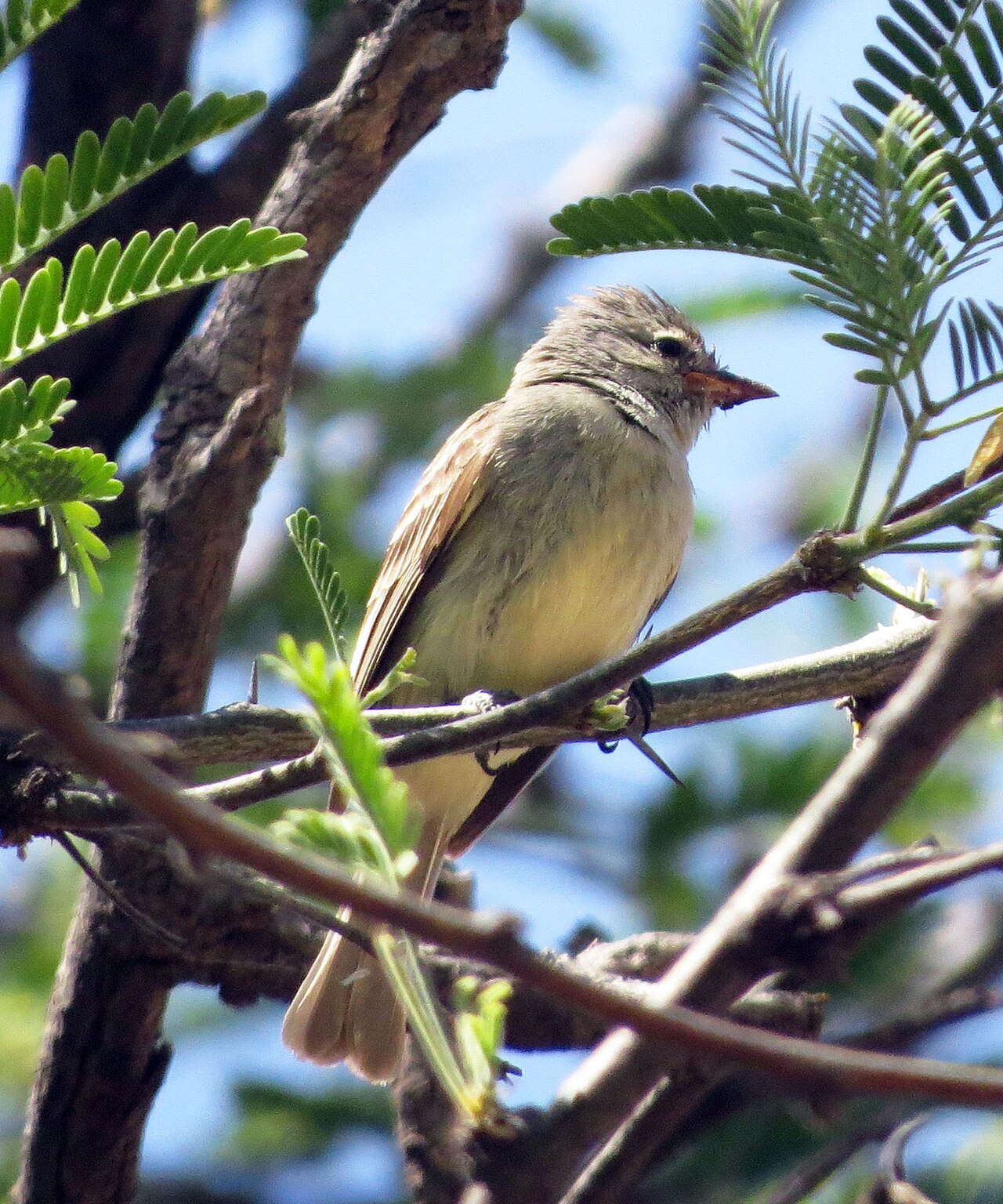
The Northern Beardless-Tyrannulet is the smallest tyrant flycatcher in North America and the only one that behaves more like a vireo or a kinglet than a flycatcher. It reaches the United States only in southeastern Arizona and the Rio Grande lowlands of southern Texas, where it is usually heard before it is seen.
Voice
The most distinctive sound is a thin whistle that starts high and slides down, pheeeeer, sometimes broken into pheeer-it. There is also a series of four to six even notes falling in pitch, pee-pee-pee-pee, often the first sign the species is present. When excited it raises its short crest and jerks its tail. The voice carries far through quiet mesquite woodland and normally gives the bird away before you find it in the foliage.
Recording: Richard E. Webster — CC BY-NC-SA 4.0 · Parque Nacional Huatulco, Oaxaca, Mexico · xeno-canto
Identification
A small greyish olive bird with a peaked crest, two dull white to buff wingbars and a pale supercilium. The underparts are dingy white to faintly yellow, the crown darker than the back. The decisive mark is the bill: short, stubby and with an orange to pink lower mandible, quite unlike the long flat bill of other flycatchers. The stiff bristles at the base of the bill are absent, which the English name refers to. It feeds by picking insects from leaves and twigs while hopping through the bush, and rarely catches prey in flight.
Confusion species
The kinglet-like impression misleads most often. Ruby-crowned Kinglet flicks its wings constantly and has a fine pointed bill and a black bar below the rear wingbar; the tyrannulet does not flick its wings and shows the stubby bill with an orange base. Verdin has a yellow head and a chestnut shoulder patch and lacks wingbars. Bell's Vireo has a longer, hooked bill, an even grey crown without a crest and a chattering song instead of a drawn-out whistle. Lucy's Warbler is paler, has a rufous rump and no wingbars.
Habitat
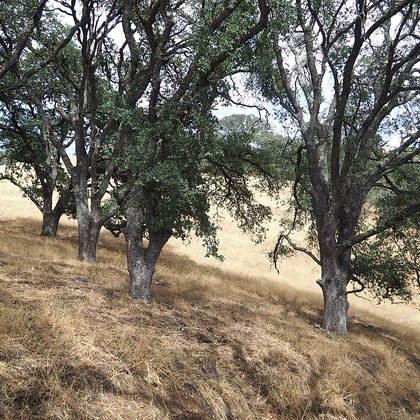
Mesquite woodland, thorn scrub and the wooded riparian strip along streams and dry washes, up to about 1500 metres. In Texas also parks and gardens with mature trees; in Mexico and Central America the edge of tropical deciduous forest, plantations and semi-open farmland. It favours the middle and upper levels of isolated trees and avoids continuous closed forest.
Where the bird is most often found, arranged by the USNVC — the vegetation classification of the United States and Canada — and CMECS for sea and coast.





Range and movements
The range runs from southeastern Arizona and southern Texas through the Mexican lowlands on both coasts to northwestern Costa Rica, and includes Cozumel. In Texas the species is resident. In Arizona part of the breeding population leaves in winter, though a few remain in mild years. The United States holds a few hundred pairs; in Mexico and Central America the species is locally common.
- Resident
- Breeding (summer)
- Winter
- Passage
- dark = core range, pale = thinly spread
Where and when to look
Go at sunrise in April and May to a mesquite stand along a wash in the Santa Cruz valley or along the lower Rio Grande and wait for the drawn-out whistle. Then look in the outer twigs for a small grey bird hopping through the leaves like a warbler; check the bill base for orange before you settle on a kinglet.
Conservation
The IUCN places the species in the Least Concern (LC) category; the world range is large and the population is estimated in the millions. In the United States the range is restricted and depends on riparian woodland and old mesquite (a thorny pod-bearing shrub of the Southwest that forms dense thickets) bosque; groundwater withdrawal, clearing of mesquite for grazing and the replacement of riparian woodland by tamarisk reduce the available area. In Texas that loss has made the species locally scarcer than it was in the nineteenth century.
Scientific name
Camptostoma imberbe | Sclater, 1857
Philip Lutley Sclater described the species in 1857 and at the same time introduced the genus Camptostoma, from Greek kamptos 'bent' and stoma 'mouth', after the curved edge of the bill. The species name imberbe is Latin for 'beardless': the stiff rictal bristles at the base of the bill, present in most tyrant flycatchers, are lacking in this genus. The type came from the vicinity of San Andrés Tuxtla in Veracruz, Mexico. The Dutch name refers to the dry scrub the species lives in.