All species › Passerines › New World warblers › Painted Redstart
Painted Redstart | Myioborus pictus
Roodbuikzanger | Candelita aliblanca
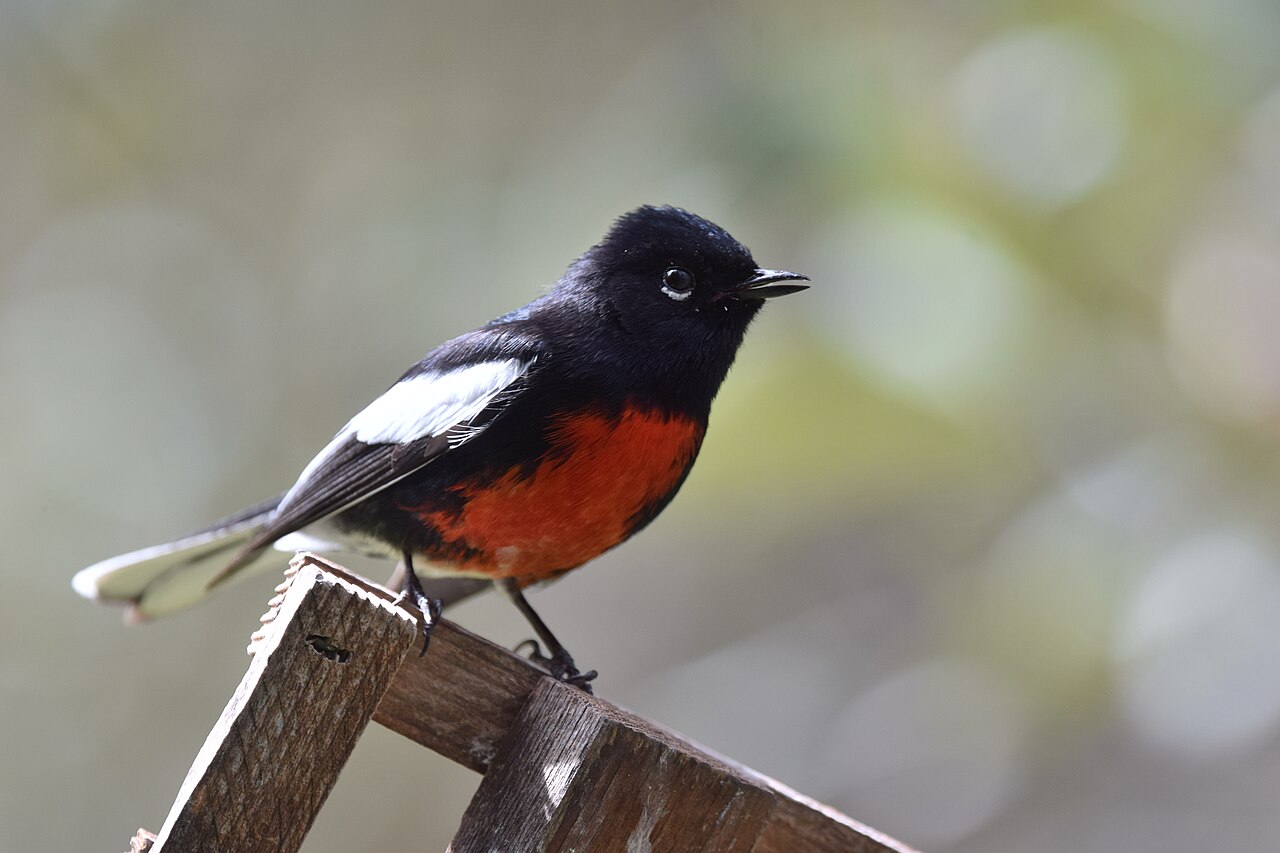
The Painted Redstart is black with a red lower breast and belly, a large white wing patch and white outer tail feathers. It forages with spread tail and half-opened wings along branches and trunks in the oak and pine woodland of the mountains, from southeastern Arizona to Nicaragua.
Voice
The song is a series of clear, two-syllable whistled phrases, roughly weeta weeta weeta wee, with a slightly husky quality, usually repeated three to five times. Unlike most warblers, the female sings too; in spring pairs regularly sing in turn from neighbouring branches. A quiet whisper song is also given. The call is a sharp, somewhat rough cheep, much fuller than the thin tsip of related warblers.
Recording: Pritam Baruah — CC BY-NC-SA 4.0 · Reserva de la Chara Pinta (Tufted Jay Preserve), Sinaloa, Mexico · xeno-canto
Identification
Head, breast, back and upper tail are deep black; the lower breast and belly are bright red, sharply set off against the black. A large white panel crosses the wing, and the outer tail feathers are largely white. A white crescent stands below the eye. The sexes are alike. Immatures lack the red and have a grey-black belly, but already carry the white wing and tail markings. The behaviour is diagnostic: the bird hops along branches and trunks, pivoting the body and continually spreading tail and wings, so that the white flashes and insects are flushed into flight.
Confusion species
Slate-throated Redstart (Myioborus miniatus), its nearest relative in Mexico, has a slate-grey throat and breast, a concealed rufous crown patch and no white wing panel; the white in its tail is more restricted. American Redstart has orange rather than red patches, and they sit on the wing base, the tail base and the flank instead of on belly and wing panel. Red-faced Warbler is grey above with a red face, not black with a red belly. The combination of black, a red belly and a large white wing panel is distinctive within North America.
Habitat
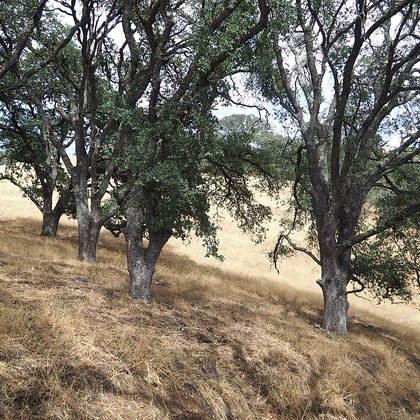
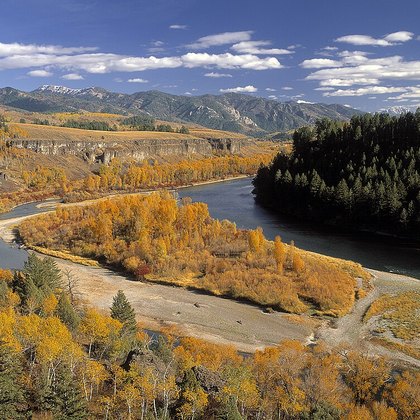
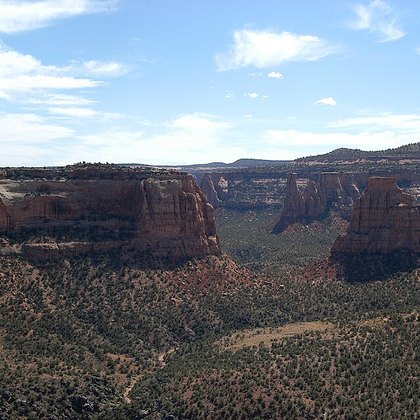
Open oak, pine-oak and oak-juniper woodland in mountains and canyons, roughly between 1500 and 2500 metres, by preference on slopes with a dense herb layer and along watercourses with sycamore and maple. The nest sits on the ground, usually in a small hollow in a slope under an overhanging grass tussock or root. Outside the breeding season northern birds drop to lower riparian woodland and canyons; in Mexico and Central America it also uses cloud forest.
Where the bird is most often found, arranged by the USNVC — the vegetation classification of the United States and Canada — and CMECS for sea and coast.



Range and movements
In the United States it breeds in the mountains of southeastern Arizona and southwestern New Mexico and in small numbers in West Texas, chiefly in the Chisos Mountains of Big Bend. From there the range runs south along the Sierra Madre Occidental and the Sierra Madre Oriental and on through the Mexican highlands to Oaxaca and Chiapas, and across Guatemala, El Salvador and Honduras to Nicaragua, where the range ends. In Mexico and Central America it is largely resident; the birds at the northern edge are migratory, arriving in March and leaving again in September. Beyond the range it turns up as a vagrant as far as California and the Gulf Coast.
- Resident
- Breeding (summer)
- Winter
- Passage
- dark = core range, pale = thinly spread
Where and when to look
The best chance is April to July in the canyons of southeastern Arizona, such as Madera or Cave Creek, where it often sings within the first hundred metres of the trail. Watch for the movement rather than the colour: the opening and closing of tail and wings against a trunk shows at greater distance than the red, which only reads well from below.
Conservation
The species is listed as Least Concern (LC); Partners in Flight puts the world population at about 600,000 birds and gives a Continental Concern Score of 13 out of 20. The share of the population in the United States is small and confined to a few sky islands and canyons, where building at the canyon mouths, logging and the failure of oak woodland to regenerate under grazing press on the breeding range. Large crown fires in the Sierra Madre and the border mountains can remove much of the forest locally, and because the nest lies on the ground, free-running dogs and cats in inhabited canyons are a further loss.
Scientific name
Myioborus pictus | (Swainson, 1829)
William Swainson described the species in 1829 as Setophaga picta, from a specimen taken at Real del Monte in Hidalgo, Mexico; because it was later placed in another genus, author and year stand in parentheses. The epithet pictus is Latin for 'painted', after the high-contrast pattern of black, red and white, which the English name also refers to; the Dutch name names the red belly. The genus Myioborus is formed from Greek muia 'fly' and -boros 'devouring', hence 'fly-eater'.