All species › Passerines › New World warblers › Yellow-rumped Warbler
Yellow-rumped Warbler | Setophaga coronata
Geelstuitzanger | Reinita coronada
The Yellow-rumped Warbler is the warbler that floods the continent during autumn migration: a compact, olive-grey warbler with a bright yellow rump that is the only member of its family to remain in large numbers north of Mexico through winter. It manages this because, unlike almost every other warbler, it can switch to berries once insects run out.
Voice
The song is a brisk, somewhat monotonous trill of clear notes that can rise or fall at the end, varying enough by region that eastern and western birds scarcely seem to recognise each other's song. The call, a hard chek, is often on migration and in winter the only clue to how many birds sit in a patch of berry bushes. For many North American birders that call in autumn is synonymous with a mixed warbler flock.
Recording: Stanislas Wroza — CC BY-NC-SA 4.0 · Isle aux Coudres, Canada · xeno-canto
Identification
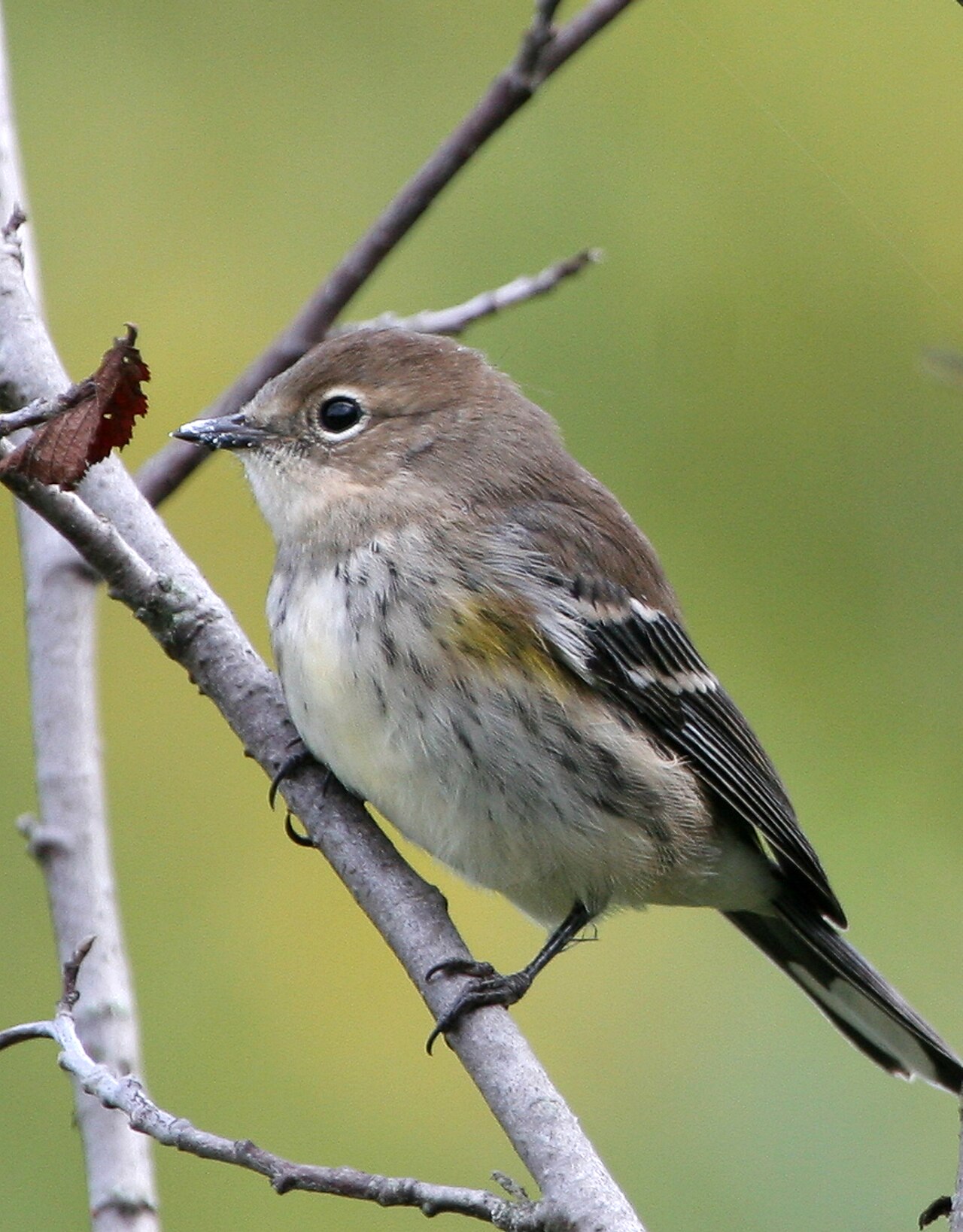
In summer the male has a blue-grey back, a black breast band and yellow patches on rump, sides and crown; the female is duller and browner with the same yellow accents. Two clearly distinguishable forms exist: the eastern Myrtle form has a white throat and a broad white eyebrow stripe, the western Audubon's form a yellow throat and less pronounced facial markings. In winter plumage both forms are much duller brown, but the yellow rump stays visible and is the best mark year-round. Young birds are dull grey-brown and streaked, with only the yellow rump as a fixed clue.
Confusion species
The Myrtle and Audubon's forms are treated here as two forms of a single species, although other checklists list them as separate species. Other yellow-marked warblers, such as a winter-plumaged Cape May Warbler, lack the fixed combination of yellow rump with yellow sides; only in the Yellow-rumped Warbler do those two marks always occur together. In winter, beginners sometimes mistake it for a sparrow because of its brown, streaked plumage, but no sparrow has a yellow rump.
Habitat
Breeds in conifer and mixed forest, from boreal spruce and pine forest to montane forest in the west. Outside the breeding season it is far less particular, using scrub, woodland edge, gardens and above all coastal dunes with wax myrtle, the berry that carries its winter presence as far north as possible. It avoids open water and bare ground; almost any tree or shrub layer with food will otherwise do.
Where the bird is most often found, arranged by the USNVC — the vegetation classification of the United States and Canada — and CMECS for sea and coast.





Range and movements
Breeds from Alaska and most of Canada south through the western mountain ranges to Mexico and Central America at high elevation; the eastern Myrtle form breeds across the northeastern United States and all of Canada. Winters from the southern United States and the Pacific coast deep into Central America and the Caribbean, migrating a shorter distance than almost any other American warbler. In the interior United States it is chiefly an abundant passage migrant, sometimes in large numbers on peak autumn days.
- Resident
- Breeding (summer)
- Winter
- Passage
- dark = core range, pale = thinly spread
Where and when to look
In autumn, seek out a patch of shrubs with ripe berries, especially near the coast, and wait — Yellow-rumped Warblers often forage in small groups and give themselves away with the sharp chek call before you see them. In winter this species is in almost every mixed warbler flock in the southern United States, and such flocks often hold other, rarer warblers as well.
Conservation
One of the most numerous warblers in North America and stable in numbers; the IUCN rates the species as Least Concern (LC); its ability to switch to berries makes it less dependent on insect supply than most relatives. Loss of conifer forest in the breeding grounds and of coastal wax-myrtle dunes in the wintering grounds are the main local threats.
Scientific name
Setophaga coronata | (Linnaeus, 1766)
Linnaeus described the species in 1766 as Motacilla coronata, among the wagtails; it has since been moved to another genus, so author and year stand in parentheses. The genus Setophaga is Greek for 'moth-eater', from ses, 'moth', and phagos, 'eating', and was introduced by Swainson in 1827. coronata is Latin for 'crowned', for the yellow crown patch visible on some birds like a small crown atop the head. The type locality was first given as 'Pennsylvania' and restricted to Philadelphia in 1910.