All species › Passerines › Finches › Common chaffinch
Common chaffinch | Fringilla coelebs
Vink | Pinzón vulgar
The Chaffinch is probably Europe's most numerous breeding bird, and from March its accelerating phrase pours out of every treeline. In the chaffinch, as in many finches, the wing pattern is an important character.

Click a thumbnail to switch the photo above.
Voice
The song is a short accelerating, descending rattle ending in a flourish, rendered chip-chip-chip-cherry-erry-chippyweeoo, given from late February into June and varying by regional dialect. Calls: a loud springy pink and, especially in damp weather, a plaintive hweet.
Recording: Hannu Varkki — CC BY-SA 4.0 · Wikimedia Commons
Identification
Both sexes show two white wingbars, white outer tail feathers and a greenish rump. The summer male has a blue-grey crown and nape, a rust-brown mantle and a brick-pink breast; in winter all of this is dulled by brown feather fringes. The female is plain olive-brown but shows the same striking wing pattern. Juveniles resemble the female.
Confusion species
Brambling is the critical species: it has orange shoulders and breast, a white rump instead of a greenish one, and a yellow-and-black bill pattern in winter. Female Chaffinches are sometimes passed off as house sparrows, but they are slimmer, unstreaked above and always show the double white wingbar.
Habitat
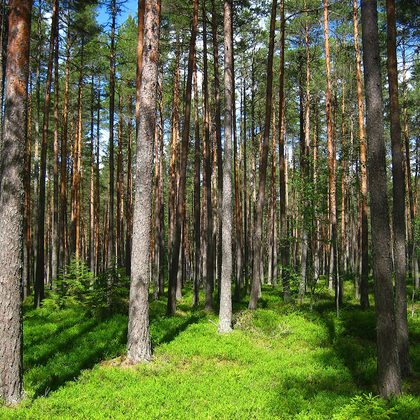
Woodland of every kind, from conifer plantation to old broadleaf forest, plus parks, avenues, orchards, gardens and hedgebanks. In winter it flocks on stubbles, in beech woods and around farm feeding places, often mixed with Bramblings and other finches.
Where the bird is most at home, classified with EUNIS — the European standard for habitats.



Range and movements
Breeds from northern Scandinavia to the Mediterranean. Northern and eastern birds move south-west in huge numbers; in October steady streams pass along the Dutch coast and through the Pyrenean passes. Spain likewise receives vast numbers of winter birds on top of its own breeders, which nest up into the montane forests of the Pyrenees and Sierra Nevada.
- Resident
- Breeding (summer)
- Winter
- Passage
- dark = core range, pale = thinly spread
How and when to look
In March and April every male sings from a fixed high perch, so half an hour of listening maps out a whole hedgerow. In October it pays to stand on a coastal dune, a seawall or a Pyrenean pass at sunrise for the visible migration. In winter flocks always check for odd wing patterns: a Brambling is often mixed in.
Conservation status
Not globally threatened (IUCN: Least Concern) and still extremely numerous. Declines have been noted in parts of north-west Europe, linked to a parasitic disease spread mainly at garden feeding stations. The loss of varied woodland and hedgerows is a further negative factor.
Scientific name
Fringilla coelebs | Linnaeus, 1758
Linnaeus described the species in 1758 and placed it straight away in the genus where it still stands. He introduced the genus Fringilla in that same work. Fringilla is the Latin word for 'finch'. coelebs is Latin for 'unmarried, single': in Sweden it was mainly the females that moved south in winter, leaving the males behind. The specimen the first description was based on came from Sweden.