All species › Tubenoses › Petrels and shearwaters › Yelkouan Shearwater
Yelkouan Shearwater | Puffinus yelkouan
Yelkouanpijlstormvogel | Pardela mediterránea | Mittelmeer-Sturmtaucher | יסעור מצוי | Puffin yelkouan
The Yelkouan Shearwater is one species in two distinct forms. The western form — the Balearic shearwater — breeds only on the Balearic Islands, is carried on other checklists as Puffinus mauretanicus, and after breeding leaves the Mediterranean almost entirely: out through the Strait of Gibraltar into the Bay of Biscay, the Irish Sea and the southern North Sea. The eastern form, yelkouan, breeds on the islands and sea cliffs of the central and eastern Mediterranean and stays within that basin almost all year. This guide treats both forms as one species, Puffinus yelkouan, while other lists carry them as two.
Click a thumbnail to switch the photo above.
Voice
Silent at sea. At the colony at night it gives a hoarse, snoring, wailing scream with a marked inhaling and exhaling rhythm, echoing out of crevices and sea caves along the cliffs. Both forms call in the same way; eastern birds average slightly higher and faster, but the difference is of little practical use. Audible from March to June on the Balearics, chiefly on Formentera, Ibiza, Cabrera and the cliffs of Mallorca, and from January to June in the east on Malta, the Aegean islands and the Anatolian coast. Away from the colony the species does not call.
Recording: Mathis Baudrin — CC BY-NC-SA 4.0 · Wikimedia Commons
Identification
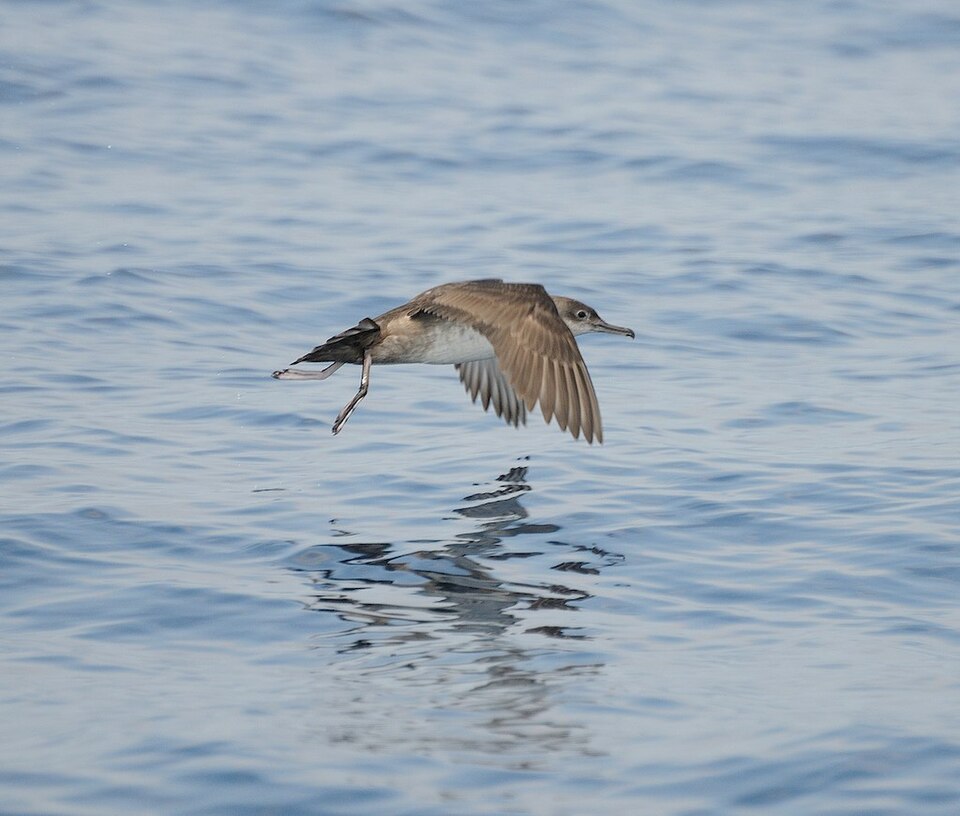
A medium-sized shearwater that looks pot-bellied and heavy beside a Manx: fuller belly, broader and more bowed wings, a bulging body behind the wing base and often slightly projecting feet. The flight has more and faster beats and shorter glides, and the bird generally stays lower to the water. Above it is dull greyish-brown, not black. The two forms differ in build and above all underneath. Balearic birds are heavier and browner: belly, breast and flanks dirty white to dingy brown, with a variable brown wash across the breast sides and flanks, a greyish-white underwing with a broad, diffuse dark border running unbroken round the wing, a clearly dark axillary bar and brown undertail coverts. The boundary between dark cap and pale throat is vague and smudged, and dark individuals can look almost wholly brown. Eastern birds are slimmer and more contrasting: cleaner white below, with a narrower and more sharply defined dark wing margin, paler axillaries, usually white undertail coverts and a better-marked cap-throat border. The characters overlap right across the range — there are pale Balearic and grubby eastern birds — and at sea, into the light and at distance, most birds cannot be assigned to form at all.
Confusion species
Manx Shearwater is the confusion species and the difference lies underneath: Manx is clean white below with a sharp border running high below the eye, has white axillaries and white undertail coverts, is slimmer with straighter wings and glides longer and more smoothly. Balearic birds are grubby, with dark axillaries, brown undertail coverts and a blurred cap-throat border, and look stockier. Eastern birds sit between the two and are the real problem against Manx: look for the broader and more diffuse dark underwing border, the warmer tone to breast sides and flanks, and the slower, heavier flight. To separate the two forms from each other, weigh bulk of build, the axillary bar and how dirty the flanks and undertail coverts are, with location as the strongest clue: birds in the Atlantic and the North Sea are Balearic, birds in the Aegean and Adriatic eastern. Sooty Shearwater is larger and wholly dark below, with a silvery underwing panel. Cory's Shearwater is much bigger, with a yellow bill and a light, sailing flight.
Habitat
Breeds in crevices, caves and burrows on coastal cliffs and uninhabited islets — on the Balearics often just above the surf, in the east on the limestone cliffs of Malta, the Aegean islands and the Adriatic coast. Feeds over the shallow continental shelf, diving after sardines, anchovies and fishery discards, and rests in dense rafts on the water. Outside the breeding season the Balearic form is on the Atlantic shelf, in the Bay of Biscay and as far as the Irish Sea and southern North Sea; the eastern form stays in the Mediterranean and moves through the Bosphorus into the Black Sea in large numbers.
Where the bird is most at home, classified with EUNIS — the European standard for habitats.


Range and movements
The Balearic form breeds only on the Balearic Islands, with a population in the order of a few thousand pairs. From May onwards most birds pass north through the Strait of Gibraltar, concentrating off western Iberia and in the Bay of Biscay from June to September, with a return passage in late autumn. This is the bird seen in the North Sea and watched from the headlands of the south-western British Isles: along the southern North Sea coast a rare but near-annual visitor, usually in August and September on south-westerly to westerly winds. The eastern form breeds from Provence and the Tyrrhenian Sea to the Adriatic, Malta, the Aegean and Anatolia, in the order of tens of thousands of pairs, and keeps almost entirely within the Mediterranean; outside the breeding season large numbers gather in the northern Aegean, the Sea of Marmara and the Black Sea. In Iberia the eastern form is recorded only very rarely. Beyond those two areas the species is a vagrant at sea, and it is absent inland.
- Resident
- Breeding (summer)
- Winter
- Passage
- dark = core range, pale = thinly spread
How and when to look
For the Balearic form the Strait of Gibraltar is the classic site: from Tarifa or Punta Carnero, westerly winds in May and June carry hundreds to thousands out into the Atlantic, with the return in October and November. Off Galicia, Estaca de Bares in August and September is a near-certainty, and along the Catalan coast the birds pass close inshore in spring; in Balearic waters themselves watch from the ferries between Barcelona, Ibiza and Mallorca, or at dusk from the headlands of Formentera, when birds gather before flying in to the colony. In north-west Europe watch during a summer or early-autumn south-westerly gale, from Porthgwarra, Cape Clear, Westkapelle or the Brouwersdam; be strict and judge the bird on axillaries, undertail coverts and flight style, because most claims turn out on review to be Manx Shearwaters. The eastern form is best seen from the ferries and shores of the Bosphorus, where long lines stream past on calm mornings, and around Malta and on the Aegean island ferries.
Conservation status
Vulnerable (IUCN: Vulnerable) when the two forms are assessed together, as is now the case. On lists that still carry the Balearic shearwater as a separate species (Puffinus mauretanicus), it is assessed separately as Critically Endangered (CR) — the last category before extinct in the wild, and so one of the most threatened seabirds in Europe. Models based on adult survival predict a decline of more than eighty percent over three generations. The causes are bycatch in longline and gillnet fisheries, predation by introduced cats, rats and martens at the colonies, disturbance and development of coastal cliffs, and the collapse of the Mediterranean discard supply. The eastern form is more numerous but runs into the same pressures and is assessed as Vulnerable where it is treated separately, with rats and bycatch the main problems. Putting the two under one species name changes none of those figures: conservation work is organised form by form and colony by colony.
Scientific name
Puffinus yelkouan | (Acerbi, 1827)
Acerbi described the species in 1827 as Procellaria yelkouan; because it was later moved to another genus, the author and year stand in brackets. The genus Puffinus was introduced in 1760 by Brisson. Puffinus comes from English puffin and its variants, the name for the cured nestling of the shearwater, once a delicacy. yelkouan is the Turkish name for this shearwater, roughly 'wind chaser'. The specimen the first description was based on came from the Bosphorus, Turkey.