All species › Waders, gulls and terns › Sandpipers and allies
Sandpipers and allies | Scolopacidae
Strandlopers en snippen | Correlimos y agachadizas | Maçaricos e afins
The bill is not only long and sensitive but mobile: the tip of the upper mandible alone can be raised, so the bird can seize a worm deep in the mud without opening the bill along its whole length. Length and curvature differ greatly from species to species, so that birds feeding side by side on the same flat reach different depths and different prey. Forty species in eleven genera occur in this guide; most are migrants from North America that winter or pass through on the mudflats of the Atlantic coast of the Guianas and Brazil, on riverbanks and sandbars in Amazonia and in the marshes of the Pantanal and the Pampa, while the snipes (Gallinago) also breed here in marshes and wet grasslands. Twelve species are vagrants, among them the Terek Sandpiper (Xenus) from Eurasia. The plumage is grey-brown and finely marked, and changes completely twice a year: a conspicuous breeding dress and a plain winter one. Four pear-shaped eggs in a scrape, chicks that find their own food from the first day, and outside the breeding season large flocks that wheel as one over the tidal flats.
Native species 27 species
Species that occur here by nature: breeding birds, winter visitors and passage migrants. They are arranged by genus, in the sequence of the list.
Bartramia 1 species


Numenius 1 species

Limosa 2 species


Limnodromus 1 species

Gallinago 5 species
-
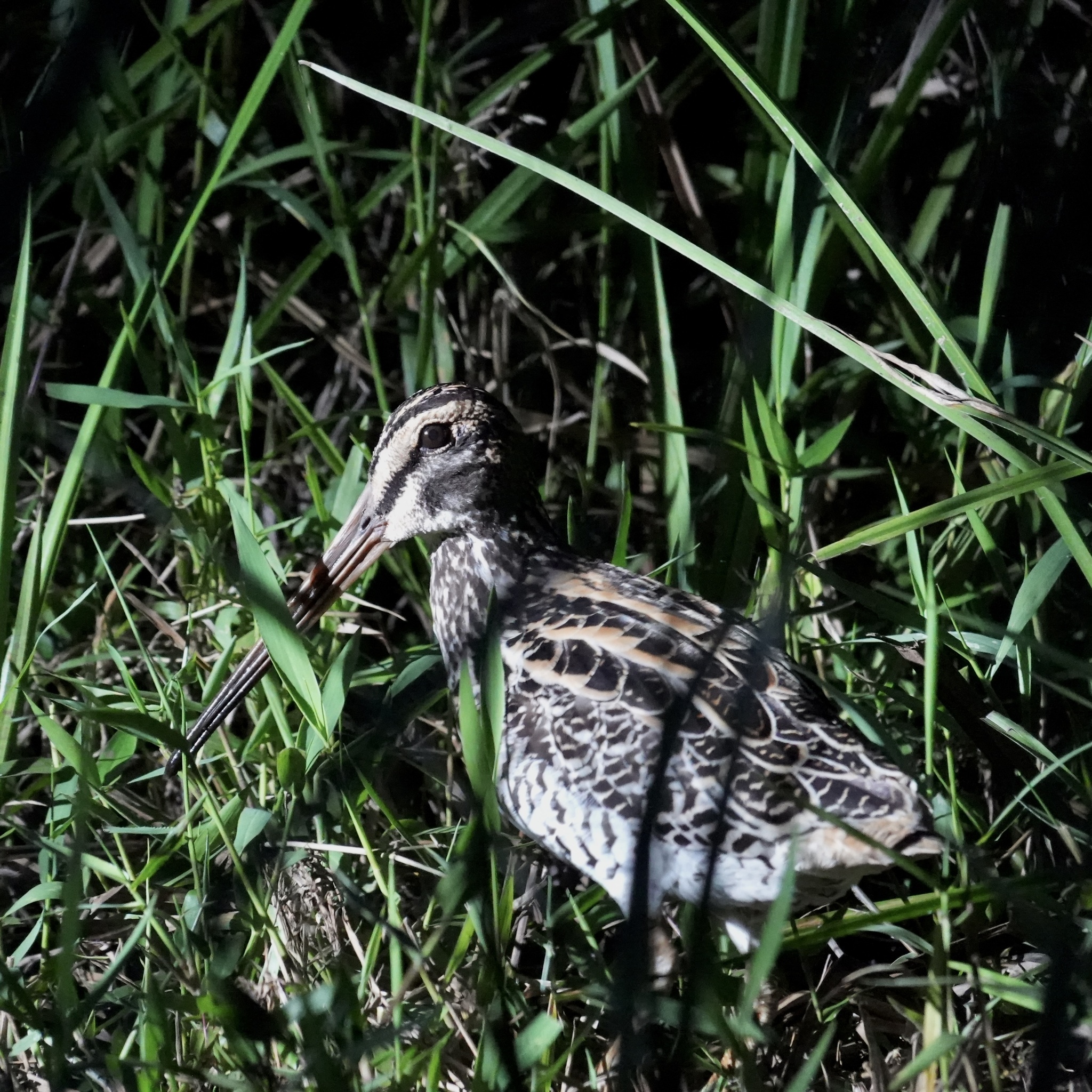
Giant Snipe
Gallinago undulata Veredas and gallery forest
 Savannas of the Guianas
 Flooded Llanos and esteros
 Campo rupestre and mountain grassland
 Southern marshes and lagoons
-

Jameson's Snipe
Gallinago jamesoni Montane forest of the Venezuelan Andes and Perijá
-

Wilson's Snipe
Gallinago delicata- Flooded Llanos and esteros
- Montane forest of the Venezuelan Andes and Perijá
 Pasture and arable land
 Lakes and reservoirs
-

Noble Snipe
Gallinago nobilis- Montane forest of the Venezuelan Andes and Perijá
-

Pantanal Snipe
Gallinago paraguaiae Seasonally flooded plain
- Flooded Llanos and esteros
- Southern marshes and lagoons
- Veredas and gallery forest
- Savannas of the Guianas
- Pasture and arable land
Actitis 1 species

Phalaropus 1 species

Tringa 4 species
-

Solitary Sandpiper
Tringa solitaria Blackwater rivers and small streams
- Lakes and reservoirs
 Floating meadows and river islands
- Seasonally flooded plain
- Flooded Llanos and esteros
- Pasture and arable land
-

Lesser Yellowlegs
Tringa flavipes Mudflats, lagoons and salt flats
- Flooded Llanos and esteros
 Large rivers and sandbars
- Seasonally flooded plain
- Pasture and arable land
- Southern marshes and lagoons
-

Willet
Tringa semipalmata- Mudflats, lagoons and salt flats
 Mangroves
 Sandy beaches and dunes
-

Greater Yellowlegs
Tringa melanoleuca- Mudflats, lagoons and salt flats
- Large rivers and sandbars
- Flooded Llanos and esteros
- Seasonally flooded plain
- Mangroves
- Southern marshes and lagoons
Arenaria 1 species

Calidris 10 species
-

Red Knot
Calidris canutus- Mudflats, lagoons and salt flats
- Sandy beaches and dunes
- Southern marshes and lagoons
-

Stilt Sandpiper
Calidris himantopus- Flooded Llanos and esteros
- Mudflats, lagoons and salt flats
- Seasonally flooded plain
- Southern marshes and lagoons
- Pasture and arable land
- Lakes and reservoirs
-

Buff-Breasted Sandpiper
Calidris subruficollis Pampa grassland
- Pasture and arable land
- Large rivers and sandbars
- Seasonally flooded plain
 Llanos savanna
-

Sanderling
Calidris alba- Sandy beaches and dunes
- Mudflats, lagoons and salt flats
 Oceanic islands and rocks
-

Baird's Sandpiper
Calidris bairdii- Lakes and reservoirs
- Southern marshes and lagoons
- Mudflats, lagoons and salt flats
 Lakes, baías and aquatic vegetation
- Large rivers and sandbars
-

Pectoral Sandpiper
Calidris melanotos- Southern marshes and lagoons
- Seasonally flooded plain
- Flooded Llanos and esteros
- Pasture and arable land
- Lakes and reservoirs
- Mudflats, lagoons and salt flats
-

Semipalmated Sandpiper
Calidris pusilla- Mudflats, lagoons and salt flats
- Mangroves
- Sandy beaches and dunes
-

Western Sandpiper
Calidris mauri- Mudflats, lagoons and salt flats
- Mangroves
- Sandy beaches and dunes
-

Least Sandpiper
Calidris minutilla- Mudflats, lagoons and salt flats
- Mangroves
- Lakes and reservoirs
- Pasture and arable land
- Flooded Llanos and esteros
-

White-Rumped Sandpiper
Calidris fuscicollis- Mudflats, lagoons and salt flats
- Southern marshes and lagoons
- Large rivers and sandbars
- Sandy beaches and dunes
- Lakes and reservoirs
Vagrants 13 species
Birds blown in from other continents. They have no range here, and so no distribution map.
-

Whimbrel
Numenius phaeopus- Mudflats, lagoons and salt flats
- Oceanic islands and rocks
- Sandy beaches and dunes
 Rocky shores and cliffs
-

Long-billed Curlew
Numenius americanus- Mudflats, lagoons and salt flats
- Sandy beaches and dunes
- Pasture and arable land
-

Bar-Tailed Godwit
Limosa lapponica- Mudflats, lagoons and salt flats
- Sandy beaches and dunes
-

Long-Billed Dowitcher
Limnodromus scolopaceus- Lakes and reservoirs
- Flooded Llanos and esteros
- Pasture and arable land
- Mudflats, lagoons and salt flats
-

Terek Sandpiper
Xenus cinereus- Mudflats, lagoons and salt flats
- Mangroves
- Sandy beaches and dunes
-

Red-Necked Phalarope
Phalaropus lobatus- Mudflats, lagoons and salt flats
 Inshore waters and continental shelf
- Lakes and reservoirs
-

Wood Sandpiper
Tringa glareola- Lakes and reservoirs
- Pasture and arable land
- Mudflats, lagoons and salt flats
-

Spotted Redshank
Tringa erythropus- Mudflats, lagoons and salt flats
- Lakes and reservoirs
-

Common Greenshank
Tringa nebularia- Mudflats, lagoons and salt flats
- Mangroves
-

Ruff
Calidris pugnax- Mudflats, lagoons and salt flats
- Pasture and arable land
- Lakes and reservoirs
-

Curlew Sandpiper
Calidris ferruginea- Mudflats, lagoons and salt flats
- Sandy beaches and dunes
-

Dunlin
Calidris alpina- Mudflats, lagoons and salt flats
- Sandy beaches and dunes
-

Little Stint
Calidris minuta- Mudflats, lagoons and salt flats
- Sandy beaches and dunes