All species › Waders, gulls and terns › Sandpipers and allies › Giant Snipe
Giant Snipe | Gallinago undulata
Reuzensnip | Becasina gigante | Narcejão
The Giant Snipe is the largest snipe in the world, a heavy, broad-winged bird of wet savannas and marshy grasslands. It is mainly active at night and by day can be flushed only when almost trodden on. Two subspecies occur in the guide area: the smaller nominate form in Venezuela, the Guianas and northern Brazil, and the larger subspecies gigantea in central and southern Brazil.
Voice
On taking off a hoarse kek-kek. In the nocturnal display flight a rasping, three-syllabled phrase, repeated over and over, mainly at dusk and by moonlight.
Recording: Nunes D´Acosta — CC BY-NC-SA 4.0 · xeno-canto
Identification
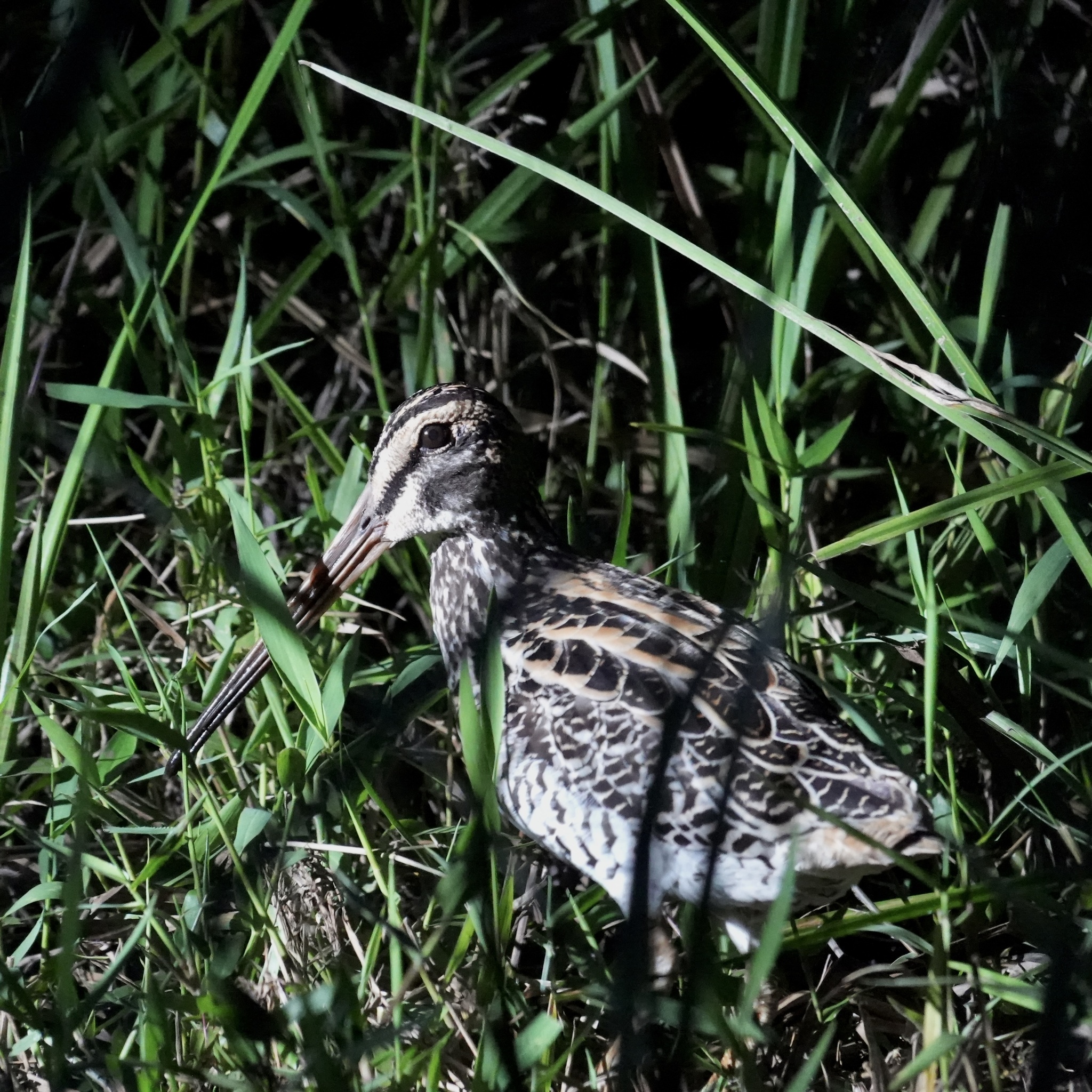
38–47 cm, with a very long bill that is thick at the base; birds of the southern subspecies are clearly larger and heavier. The head has broad black and rufous longitudinal stripes. The upperparts are barred and scaled black, rufous and buff, the breast and flanks densely barred, the centre of the belly whitish. The wings are broad and rounded, with finely barred flight feathers. The flight is slow and heavy, not zigzagging. The sexes are alike.
Confusion species
Pantanal Snipe Gallinago paraguaiae, which lives in the same marshes, is much smaller and slimmer, with plain dark flight feathers and a fast, zigzagging flight. South American Painted-Snipe Nycticryphes semicollaris has a shorter bill slightly drooped at the tip, a dark breast and pale V-shaped stripes on the back. Jameson's Snipe Gallinago jamesoni and Noble Snipe Gallinago nobilis live only high in the Venezuelan Andes.
Habitat
Tall, wet vegetation in marshes, wet and flooded grasslands and damp savannas, along veredas and in wet upland meadows, sometimes also drier savanna and pasture; from the lowlands to about 1500 m on the plateaus of central Brazil. It feeds mainly at night, probing soft ground for worms, insect larvae and also frogs. The nest is on the ground, on a tussock among grass or marsh vegetation.
Where the bird is most at home, classified by the vegetation units of Amazonia and the Guianas.





Range and movements
In Venezuela local in the Llanos and on the savannas south of the Orinoco. In Guyana, Suriname and French Guiana on the savannas of the interior and the coastal plain. In Brazil the nominate form occurs locally on the savannas of the north, such as in Roraima, Amapá and on Marajó, and the subspecies gigantea in the Cerrado of central Brazil and on the grasslands of the south-east and south to Rio Grande do Sul. Outside the guide area in Colombia, eastern Bolivia, Paraguay and north-eastern Argentina.
- Resident
- dark = core range, pale = thinly spread
How and when to look
After dark, drive or walk along wet grasslands and marsh edges, for example on the plateau of the Serra da Canastra in Minas Gerais, and listen for the display call; by day the bird sometimes flushes from tall grass right at your feet.
Conservation status
Least Concern. The species has a large range but is locally sensitive to drainage and the conversion of wet savannas and grasslands to pasture and cropland, especially in the Cerrado.
Scientific name
Gallinago undulata | (Boddaert, 1783)
Boddaert described the species in 1783 as Scolopax undulata; because it was later moved to another genus, the author and year stand in brackets. The genus Gallinago was introduced in 1760 by Brisson. Gallinago is New Latin for a snipe, from Latin gallina 'hen' and the suffix -ago 'resembling'. undulata is Latin for 'wavy, undulated', after the fine wavy barring of the plumage. The specimen the first description was based on came from Cayenne, French Guiana.