All species › Passerines › Antbirds › Alagoas Antwren
Alagoas Antwren | Myrmotherula snowi
Alagoasmiersluiper | Hormiguerito de Alagoas | Choquinha-de-alagoas
The Alagoas Antwren is a small, grey antwren of the hill forest of the Atlantic Forest in north-eastern Brazil and one of the most threatened birds of the guide area. It was described in 1985 as a subspecies of Unicolored Antwren and later recognised as a separate species. At the most recent counts only six adults were found, all in the forest of Murici in Alagoas.

Voice
The song is a series of high, drawn-out, descending whistles with pauses, peeyu … peeyu, similar to that of Unicolored Antwren. The call is a short, nasal note.
Recording: Dante Buzzetti — CC BY-NC-SA 4.0 · shortened to the first 60 s, mono · xeno-canto
Identification
9–10 cm, small and short-tailed, with a thin bill. The male is grey, slightly paler below, with a black throat patch; the wings show little or no white. The female is olive-brown above with a greyish head, has a whitish throat and is pale buff below, with rufous tones on wings and tail. It closely resembles Unicolored Antwren of the south-east, but the male has a more distinctly black throat.
Confusion species
White-flanked Antwren Myrmotherula axillaris has white flank plumes and white wing spots. Orange-bellied Antwren Terenura sicki, which inhabits the same forest, is streaked black and white (male) or orange below (female) and forages higher in the canopy. Plain Antvireo Dysithamnus mentalis is larger, with a heavier bill. Unicolored Antwren Myrmotherula unicolor occurs only far to the south, from Rio de Janeiro to Rio Grande do Sul.
Habitat
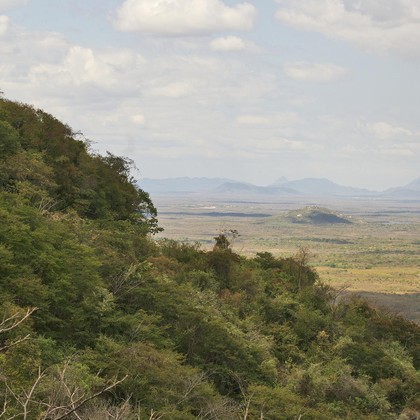
The lower and middle levels of humid hill forest and tall secondary forest in the hills of the north-eastern Atlantic Forest, roughly between 400 and 650 m. It forages in pairs for insects among leaves and vines, often in mixed understorey flocks. The nest is a suspended cup in the understorey; of five nests studied, four failed, mainly through predation by snakes and opossums.
Where the bird is most at home, classified by the vegetation units of Amazonia and the Guianas.

Range and movements
Brazil: only in the Atlantic Forest of the north-east. Formerly known from Murici in Alagoas and from a few forests in southern Pernambuco, including Frei Caneca; a recent survey of all known sites and fifteen other suitable sites found it only at Murici. Absent elsewhere in the guide area and beyond.
- Resident
- dark = core range, pale = thinly spread
How and when to look
The species survives at only one site, in the protected forest of Murici in Alagoas. Visit only with a local guide and under the reserve's rules; do not use playback, as every breeding pair counts.
Conservation status
Critically Endangered. The world population probably numbers fewer than ten birds and declined by about two thirds in seven years. Causes are the almost complete loss of forest in north-eastern Brazil and very low breeding success due to nest predation. Nest protection and forest restoration are being applied; captive breeding is being studied.
Scientific name
Myrmotherula snowi | Teixeira & Gonzaga, 1985
Teixeira & Gonzaga described the species in 1985 and placed it straight away in the genus where it still stands. The genus Myrmotherula was introduced in 1858 by Sclater. Myrmotherula is a diminutive of Myrmothera, Greek for 'ant-hunter' (murmos 'ant', -thēras 'hunter'): 'little ant-hunter'. snowi honours the British ornithologist David William Snow (1924–2009), a pioneer of life-history studies of Neotropical birds. The specimen the first description was based on came from Pedra Branca above Murici, Alagoas, Brazil.