All species › Passerines › Antbirds › Plain-winged Antwren
Plain-winged Antwren | Myrmotherula behni
Behns miersluiper | Hormiguerito alillano | Choquinha-de-asa-lisa
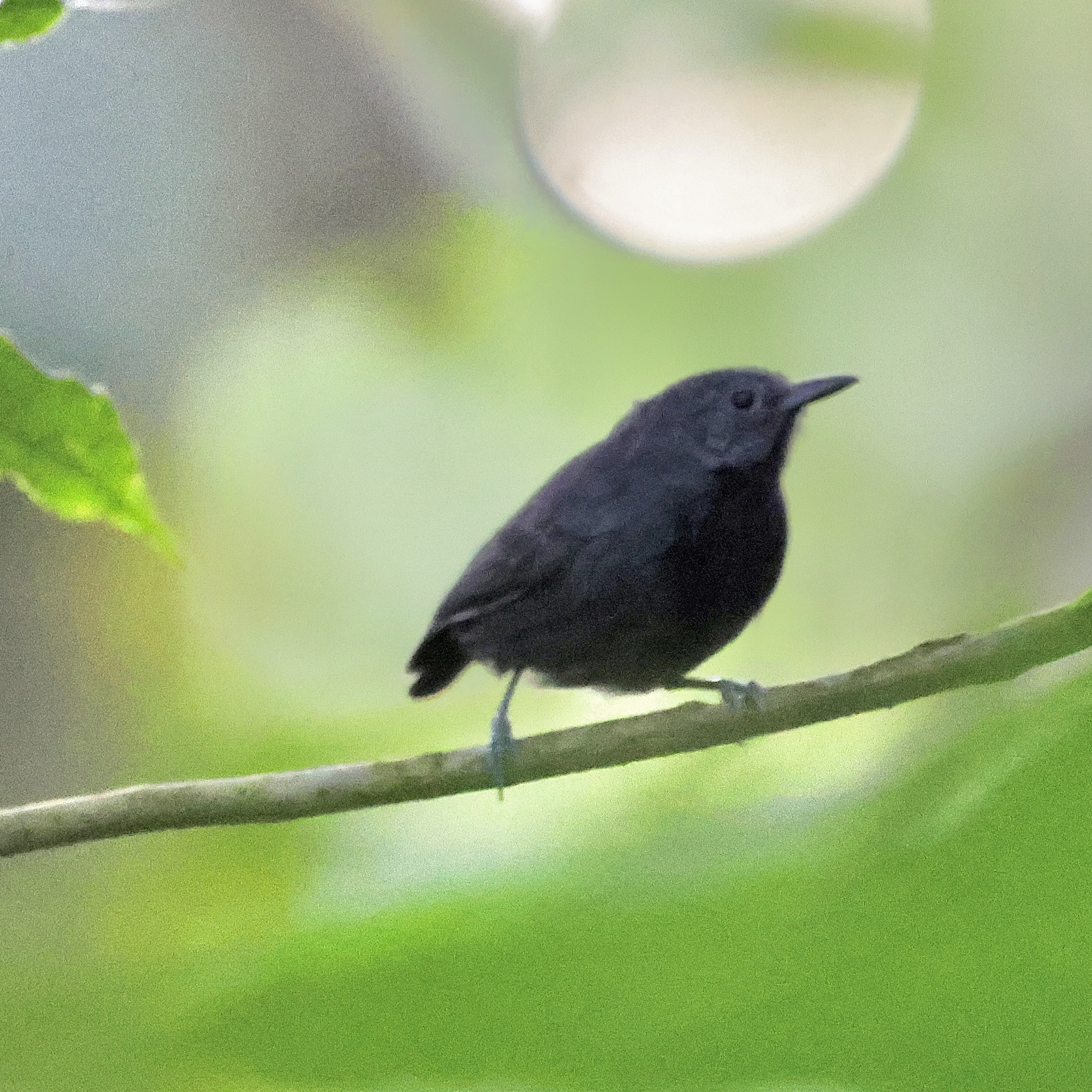
The Plain-winged Antwren is a small, grey antwren of montane forest on the tepuis of the Guiana Shield and, outside the guide area, on the eastern slope of the Andes. Unlike most related antwrens, the male has wings without white spots or fringes, which gives the species its English name. In the guide area it is restricted to higher slopes in southern Venezuela, western Guyana and the far north of Brazil.
Voice
The song is a series of a few clear, slightly descending whistles, peeyu-peeyu-peeyu. The call is a short, soft chip.
Recording: Mitch Lysinger — CC BY-NC-SA 4.0 · xeno-canto
Identification
About 9 cm, small and short-tailed, with a thin bill. The male is uniform slate-grey with a black throat and upper breast; wings and tail are grey, with no white markings on the coverts. The female is olive-brown above and buff to tawny below, with a paler throat and likewise unmarked wings.
Confusion species
Grey Antwren Myrmotherula menetriesii lives mostly lower, in lowland forest, and has white-fringed wing coverts; the female is grey above. Long-winged Antwren Myrmotherula longipennis has white spots on the wing coverts. Slaty Antwren Myrmotherula schisticolor, which lives in montane forest in northern and western Venezuela, has white fringes on the wing coverts.
Habitat
The lower and middle levels of humid montane forest on the slopes and plateaus of the tepuis, roughly between 900 and 1800 m. It forages in pairs for insects among leaves, often in mixed understorey flocks. Little is known about the nest.
Where the bird is most at home, classified by the vegetation units of Amazonia and the Guianas.

Range and movements
Venezuela: on the tepuis of Amazonas and Bolívar. Guyana: on the slopes of the Pakaraima Mountains in the west. Brazil: locally on the tepuis and mountains along the border in Roraima and northern Amazonas. There are a few reports from French Guiana that need confirmation; there are no data from Suriname. Outside the guide area on the eastern slope of the Andes in Colombia and Ecuador.
- Resident
- Winter visitor (c. Oct–Mar)
- dark = core range, pale = thinly spread
How and when to look
Search the accessible slopes of the tepuis, such as along the road to the Gran Sabana in Bolívar, for mixed understorey flocks in montane forest. With a grey antwren above 900 m, look for the absence of white markings on the wings.
Conservation status
Least Concern. The montane forest on the tepuis is largely intact and mostly lies far from roads; locally mining and fire are threats.
Scientific name
Myrmotherula behni | Berlepsch & Leverkühn, PGHMR, 1890
Berlepsch & Leverkühn, PGHMR described the species in 1890 and placed it straight away in the genus where it still stands. The genus Myrmotherula was introduced in 1858 by Sclater. Myrmotherula is a diminutive of Myrmothera, Greek for 'ant-hunter' (murmos 'ant', -thēras 'hunter'): 'little ant-hunter'. behni honours the German zoologist and explorer Wilhelm Friedrich Georg Behn (1808–1878), who crossed South America in 1847. The specimen the first description was based on came from Bogotá, Colombia (trade skin).