All species › Passerines › Tyrant flycatchers and allies › Amazonian Elaenia
Amazonian Elaenia | Myiopagis cinerea
Amazone-elenia | Elenita amazónica | Guaracava-amazônica
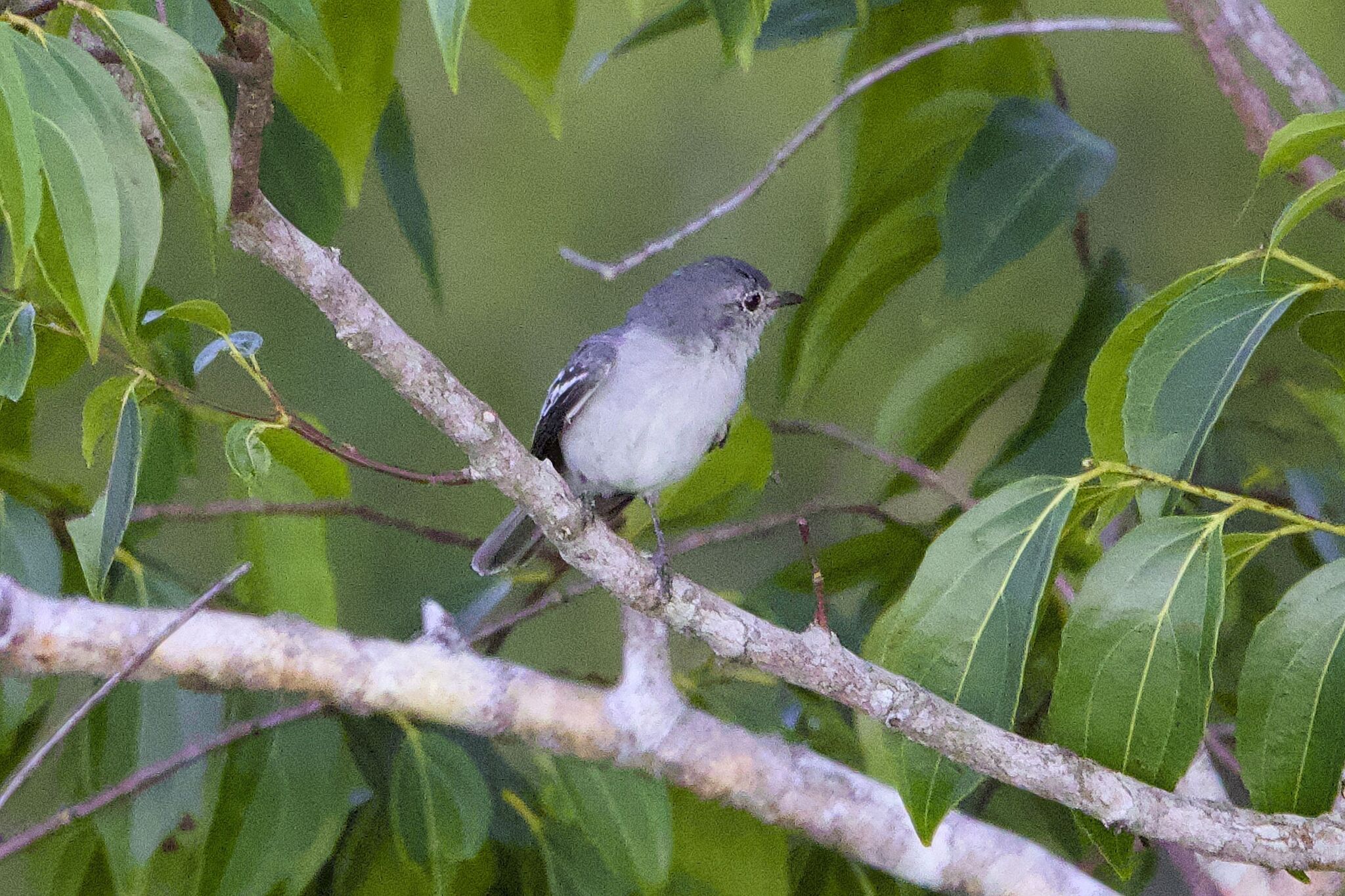
Amazonian Elaenia is a small canopy tyrant of humid lowland forest in which male and female differ clearly: the male is grey and white with black-and-white wings, the female olive-green and yellow. It was long included in Grey-headed Elaenia Myiopagis caniceps of the Atlantic Forest. It usually stays high in the crowns and often joins mixed flocks.
Voice
Two main calls: a musical, descending, springy phrase and a sneezy tsee tsee TSEW-tsee-TSEW. It calls mainly in the early morning from the canopy.
No recording with a suitable Creative Commons licence is available for this species yet.
Identification
12–13 cm, with a small, dark bill. Male: crown dark grey with a partly hidden white central stripe, upperparts blue-grey, a greyish white loral spot; wings black with two broad white wing-bars and white edges to the secondaries; underparts greyish white, whiter on the belly. Female: crown greyish with a yellow crown stripe, upperparts bright olive-green; wings black with yellow wing-bars and edges; underparts greenish yellow, belly yellow. Juveniles resemble the female.
Confusion species
Forest Elaenia Myiopagis gaimardii resembles the female, but has browner black wings with less contrasting wing-bars and a streaked head. Yellow-crowned Elaenia Myiopagis flavivertex is browner, with duller wing-bars, and lives in flooded forest. Grey-headed Elaenia Myiopagis caniceps is very similar, but lives in the Atlantic Forest and the adjacent interior. White-lored Tyrannulet Ornithion inerme is smaller, with a short tail, a white brow and wing-bars formed by white spots.
Habitat
The canopy and edges of humid, evergreen lowland forest, both terra firme and várzea, primary and secondary forest of all ages; in Venezuela mostly below 300 m, locally up to about 1200 m. It searches for insects in the high foliage, usually with mixed flocks. The nest is a small cup high in a tree.
Where the bird is most at home, classified by the vegetation units of Amazonia and the Guianas.



Range and movements
Brazil: in roughly the northwestern half of the country, over large parts of Amazonia. Venezuela: in the south, in Amazonas and Bolívar, with few records. Guyana and French Guiana: scattered in the interior. Only one unconfirmed sight record is known from Suriname. Outside the guide area in eastern Colombia, in Ecuador and Peru, and in northern Bolivia, where it occurs only in the austral winter.
- Resident
- dark = core range, pale = thinly spread
How and when to look
Search the canopy of lowland forest from a tower or along tall forest edges, for example around Manaus. In mixed flocks, watch for a small grey-and-white bird with black-and-white wings and listen for the sneezy call.
Conservation status
Least Concern. Widespread, but seldom recorded because it lives high in the canopy. Deforestation in Amazonia reduces its habitat, but the species also occurs in secondary forest.
Scientific name
Myiopagis cinerea | (Pelzeln, 1868) (GBIF: Myiopagis caniceps)
Pelzeln described the species in 1868 as Elainea cinerea; because it was later moved to another genus, the author and year stand in brackets. The genus Myiopagis was introduced in 1888 by Salvin & Godman. Myiopagis is Greek, from muia 'fly' and pagis 'trap, snare': 'fly-trap'. cinerea is Latin for 'ash-grey', from cinis 'ashes', after the grey plumage. The specimen the first description was based on came from Marabitanas, Rio Negro, Brazil.