All species › Passerines › Ovenbirds and woodcreepers › Amazonian Plain Xenops
Amazonian Plain Xenops | Xenops genibarbis
Amazonische effen xenops | Picolezna liso amazónico | Bico-virado-amazônico
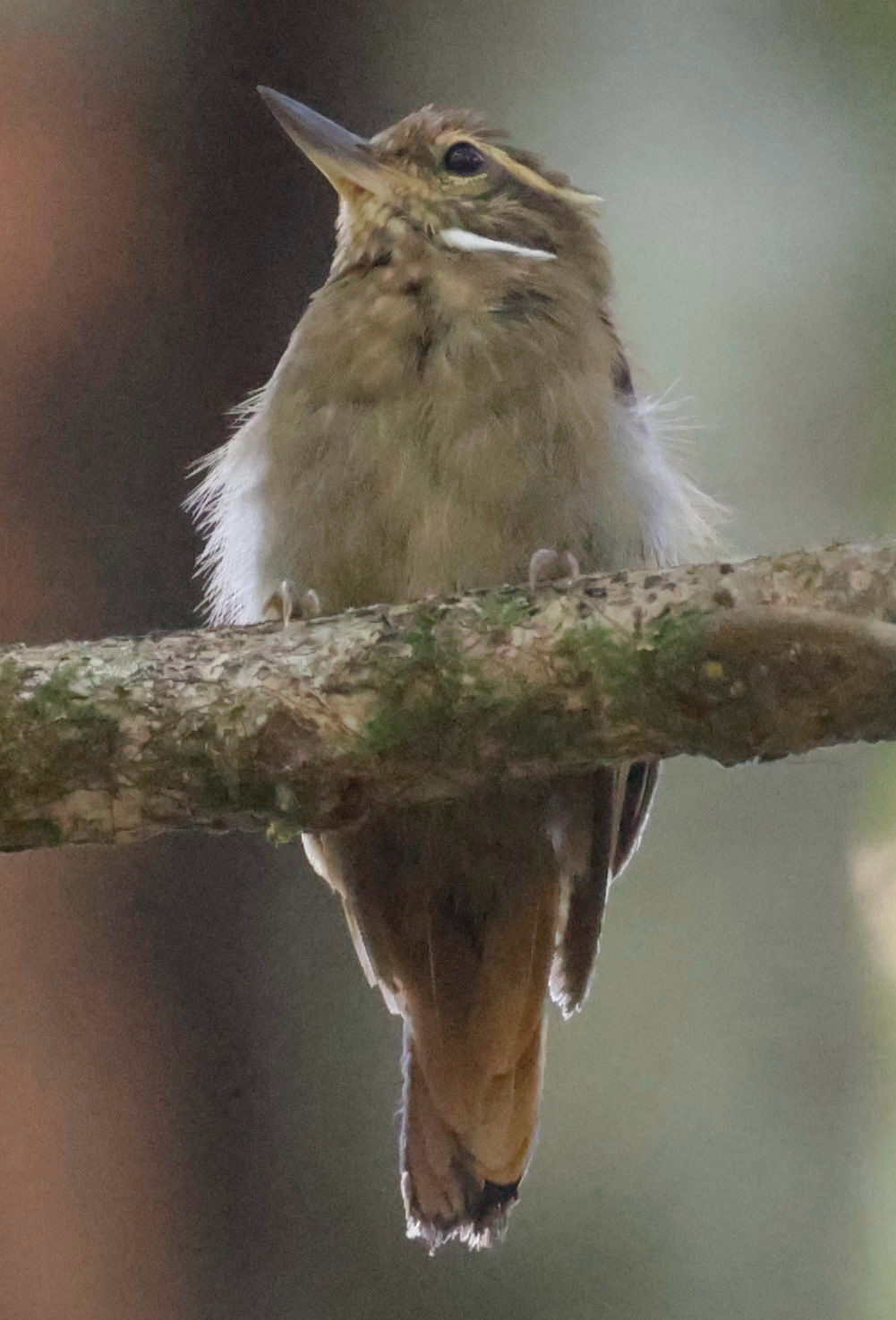
Amazonian Plain Xenops is a small brown ovenbird with a short, wedge-shaped bill whose lower mandible is clearly upturned, and a silvery white crescent on the cheek. It works thin dead twigs and vines like a tit, often hanging upside down, and is a regular member of mixed flocks. It was formerly treated as one species together with the Atlantic and northern forms.
Voice
The song is a fast series of five to eight high, sharp notes that first rise and then fall, tsi-tsi-tsi-tsi-tsi. The call is a short, sharp tseet.
No recording with a suitable Creative Commons licence is available for this species yet.
Identification
11–12 cm, with a short, wedge-shaped, upturned bill. Crown and back are plain brown, the crown sometimes with fine pale streaks; rump and tail are rufous, the tail with black inner webs. The supercilium is pale buff and the silvery white malar stripe below the eye stands out. The underparts are olive-brown, the breast at most with faint pale streaks. The wings show a cinnamon band in flight. The sexes are alike.
Confusion species
Streaked Xenops Xenops rutilans and Slender-billed Xenops Xenops tenuirostris are clearly streaked on the back and underparts. Atlantic Plain Xenops Xenops minutus lives in the Atlantic Forest of southeastern Brazil and is separated in the field mainly by range and song. In northern Venezuela, north of the Orinoco, live plain xenops now assigned to Xenops mexicanus (Northern Plain Xenops). Wedge-billed Woodcreeper Glyphorynchus spirurus has a similar bill, but climbs trunks and props itself on its tail.
Habitat
Humid lowland forest, forest edges, secondary forest, gallery forest and shade plantations, mainly in the middle storey; up to about 1200 m. It works along thin dead twigs and vines and taps and splits dead wood to find insect larvae. The nest is in a self-excavated cavity in soft, rotting wood.
Where the bird is most at home, classified by the vegetation units of Amazonia and the Guianas.





Range and movements
Brazil: throughout Amazonia, south to Mato Grosso and Goiás and east to Maranhão and Piauí, and in an isolated area in the Atlantic Forest from Paraíba to Alagoas. Venezuela: south of the Orinoco in Amazonas, Bolívar and Delta Amacuro. Guyana, Suriname and French Guiana: common in the forested region. Outside the guide area in eastern Colombia, Ecuador, Peru and northern Bolivia.
- Resident
- dark = core range, pale = thinly spread
How and when to look
Almost every mixed flock in lowland forest is likely to carry an Amazonian Plain Xenops. Look for a small brown bird hanging upside down from a thin twig and tapping; the white malar stripe and upturned bill then show well.
Conservation status
Least Concern (IUCN). The species is widespread and tolerates forest edges and secondary forest. The isolated form in northeastern Brazil lives in heavily fragmented forest.
Scientific name
Xenops genibarbis | Illiger, 1811
Illiger described the species in 1811 and placed it straight away in the genus where it still stands. He introduced the genus Xenops in that same work. Xenops is Greek, from xenos 'strange' and ōps 'face', after the odd, upturned bill. genibarbis is Latin, from gena 'cheek' and barba 'beard', after the white cheek stripe. The specimen the first description was based on came from Cametá, Rio Tocantins, Pará, Brazil.