All species › Passerines › Ovenbirds and woodcreepers › Bahia Spinetail
Bahia Spinetail | Synallaxis cinerea
Bahiastekelstaart | Pijuí de Bahía | João-baiano
The Bahia Spinetail is a spinetail of the Rufous-capped Spinetail group found only in montane forests of southern Bahia and north-eastern Minas Gerais. It was long included in Rufous-capped Spinetail and has also been described under the name Synallaxis whitneyi. Pairs often sing together.

Voice
The song is a double phrase, di-réét, di-réét, given by both members of a pair. The call is a high, dry rattle.
Recording: GABRIEL LEITE — CC BY-NC-SA 4.0 · shortened to the first 60 s, mono · xeno-canto
Identification
15–17 cm, with a long, chestnut-brown tail with spiny feather tips. Crown and nape are bright orange-rufous, the supercilium is cinnamon-buff, face and ear coverts are brownish grey. The wings are chestnut-brown. The throat is whitish with faint grey streaks, the rest of the underparts dark grey. The sexes are alike.
Confusion species
Rufous-capped Spinetail Synallaxis ruficapilla occurs further south and is paler and more olive-brown below. Spix's Spinetail Synallaxis spixi has a grey face, a black-speckled throat, a greyish-brown tail and lives in open scrub. Sooty-fronted Spinetail Synallaxis frontalis has a greyish forehead, paler underparts and lives in drier scrub.
Habitat
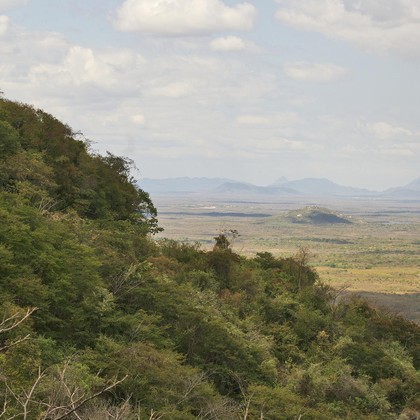
Undergrowth of montane evergreen forest, especially forest edges with many vines, ferns and bamboo, at about 500–1000 m. It forages low in dense vegetation for insects and spiders. Almost nothing is known about its breeding.
Where the bird is most at home, classified by the vegetation units of Amazonia and the Guianas.

Range and movements
Brazil: only in a small area of southern and central Bahia, including the Chapada Diamantina and the hills around Boa Nova, and in north-eastern Minas Gerais. Not in Venezuela and the Guianas. Does not occur outside the guide area.
- Resident
- dark = core range, pale = thinly spread
How and when to look
In montane forest with dense edges in southern Bahia, for example around Boa Nova or in the Chapada Diamantina. Listen for the double di-réét of a pair; the birds usually stay low among vines and ferns.
Conservation status
Near Threatened (IUCN); formerly assessed as Endangered and later as Vulnerable. The population is probably declining through forest clearance for agriculture, ranching and logging, also within protected areas.
Scientific name
Synallaxis cinerea | Wied-Neuwied, 1831
Wied-Neuwied described the species in 1831 and placed it straight away in the genus where it still stands. The genus Synallaxis was introduced in 1818 by Vieillot. Synallaxis is Greek, from sunallaxis 'exchange'; why Vieillot chose the name is unclear. cinerea is Latin for 'ash-grey', from cinis 'ashes', after the grey plumage of head and underparts. The specimen the first description was based on came from eastern Brazil (Wied's area of travel; his series matches birds from Bahia); the Chilean locality given earlier is erroneous.