All species › Passerines › Antbirds › Bamboo Antshrike
Bamboo Antshrike | Cymbilaimus sanctaemariae
Bamboemierklauwier | Batará de bambú | Choca-do-bambu
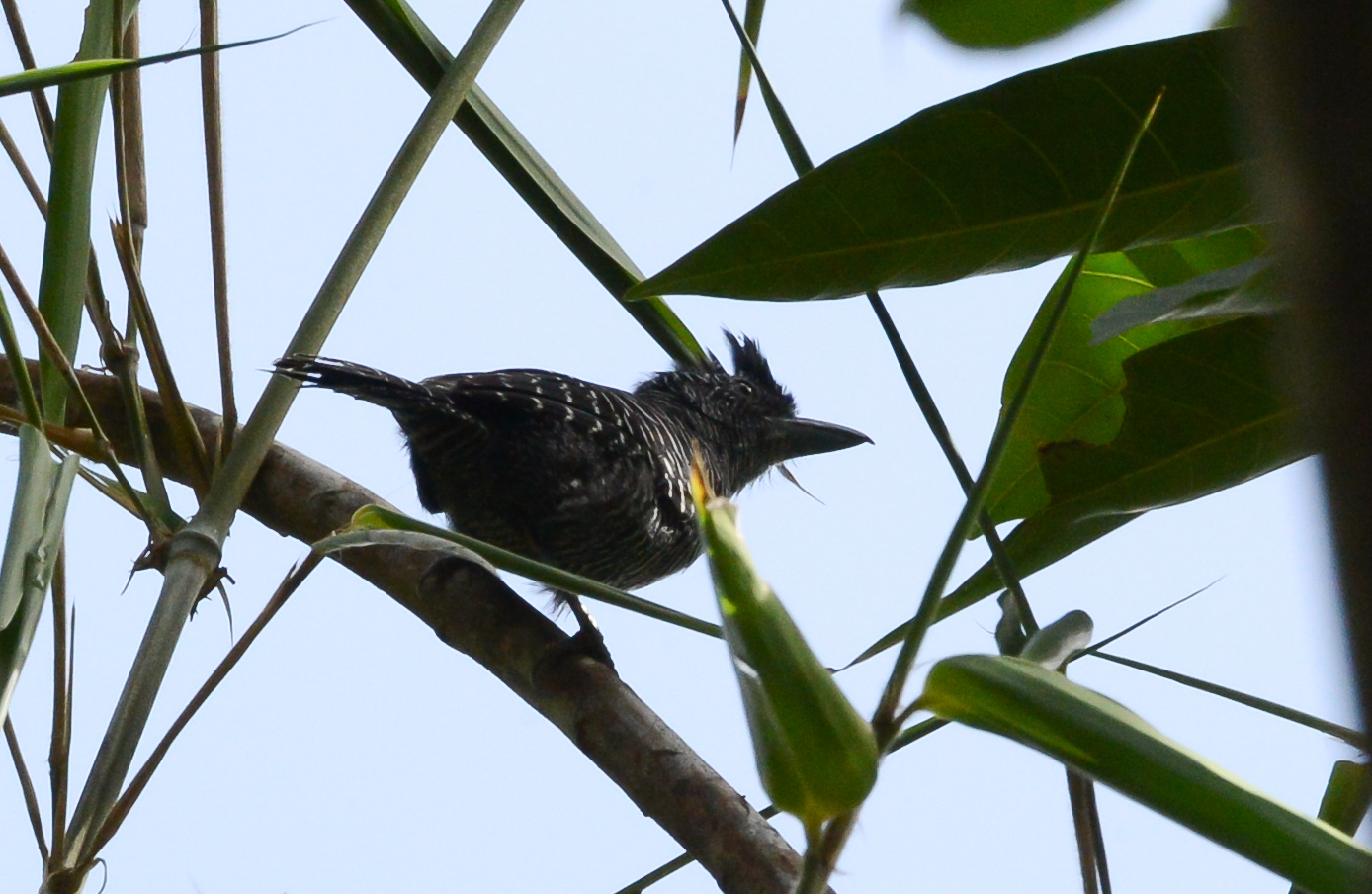
The Bamboo Antshrike is a finely barred antshrike of south-western Amazonia that lives almost exclusively in bamboo stands of the genus Guadua. It closely resembles Fasciated Antshrike, but has a dark iris and a black crown. In the guide area it occurs only in western Brazil.
Voice
The song is a loud, slightly descending series of 8–15 ringing, metallic notes. Calls: a sharp tchew, often in series, a thin, dry rattle and a whining ewwee?.
Recording: Kenny Uéslei — CC BY-NC-SA 4.0 · shortened to the first 60 s, mono · xeno-canto
Identification
16–17 cm, with a heavy, hooked bill, a bushy crest and a dark brown iris. The male has a black forehead and crown; the rest of the plumage is finely barred black and white. The female has a rufous crown with black tips to the crest feathers; the upperparts and tail are finely barred dark brown and pale yellowish brown, the throat is plain buffy white and the underparts are mostly plain cinnamon-buff, with dark barring on the sides and flanks.
Confusion species
Fasciated Antshrike Cymbilaimus lineatus has a red iris and is more coarsely barred; the male lacks a plain black crown and the female is clearly barred below as well. Undulated Antshrike Frederickena unduliger is larger and heavier, with a longer tail. The female Barred Antshrike Thamnophilus doliatus is smaller, with a pale iris and a streaked head.
Habitat
Humid lowland and foothill forest up to about 1450 m, almost exclusively in stands of Guadua bamboo, especially in their upper levels; also in dense vine tangles in floodplain forest, sometimes without bamboo, from the middle storey to the canopy. It forages in pairs, gleaning insects and other invertebrates from leaves and stems. Little is known about the nest.
Where the bird is most at home, classified by the vegetation units of Amazonia and the Guianas.



Range and movements
Brazil: only in south-western Amazonia, in Acre, Rondônia and adjacent parts of south-western Amazonas, tied to bamboo forest. Not in Venezuela, Guyana, Suriname or French Guiana. Outside the guide area in south-eastern Peru and northern Bolivia.
- Resident
- dark = core range, pale = thinly spread
How and when to look
In Acre and Rondônia, visit dense bamboo forest and listen for the ringing, slightly descending series of metallic notes. The bird often stays high in the bamboo; wait at an opening until it moves.
Conservation status
Least Concern. The species is tied to bamboo forest, which covers large areas in south-western Amazonia; deforestation in Acre and Rondônia reduces its habitat locally.
Scientific name
Cymbilaimus sanctaemariae | Gyldenstolpe, 1941
Gyldenstolpe described the species in 1941 and placed it straight away in the genus where it still stands. The genus Cymbilaimus was introduced in 1840 by Gray. Cymbilaimus combines Latin cymba 'small boat' with the shrike genus Lanius; Cabanis and Heine themselves derived the ending from Greek laimos 'throat'. sanctaemariae is Medieval Latin for 'of St Mary', Mother of God: a reference to the Madre de Dios, where it was discovered. The specimen the first description was based on came from Victoria, confluence of the Madre de Dios and Beni rivers, Bolivia.