All species › Passerines › Antbirds › Banded Antbird
Banded Antbird | Dichrozona cincta
Bandrugmiervogel | Hormiguero bandeado | Tovaquinha
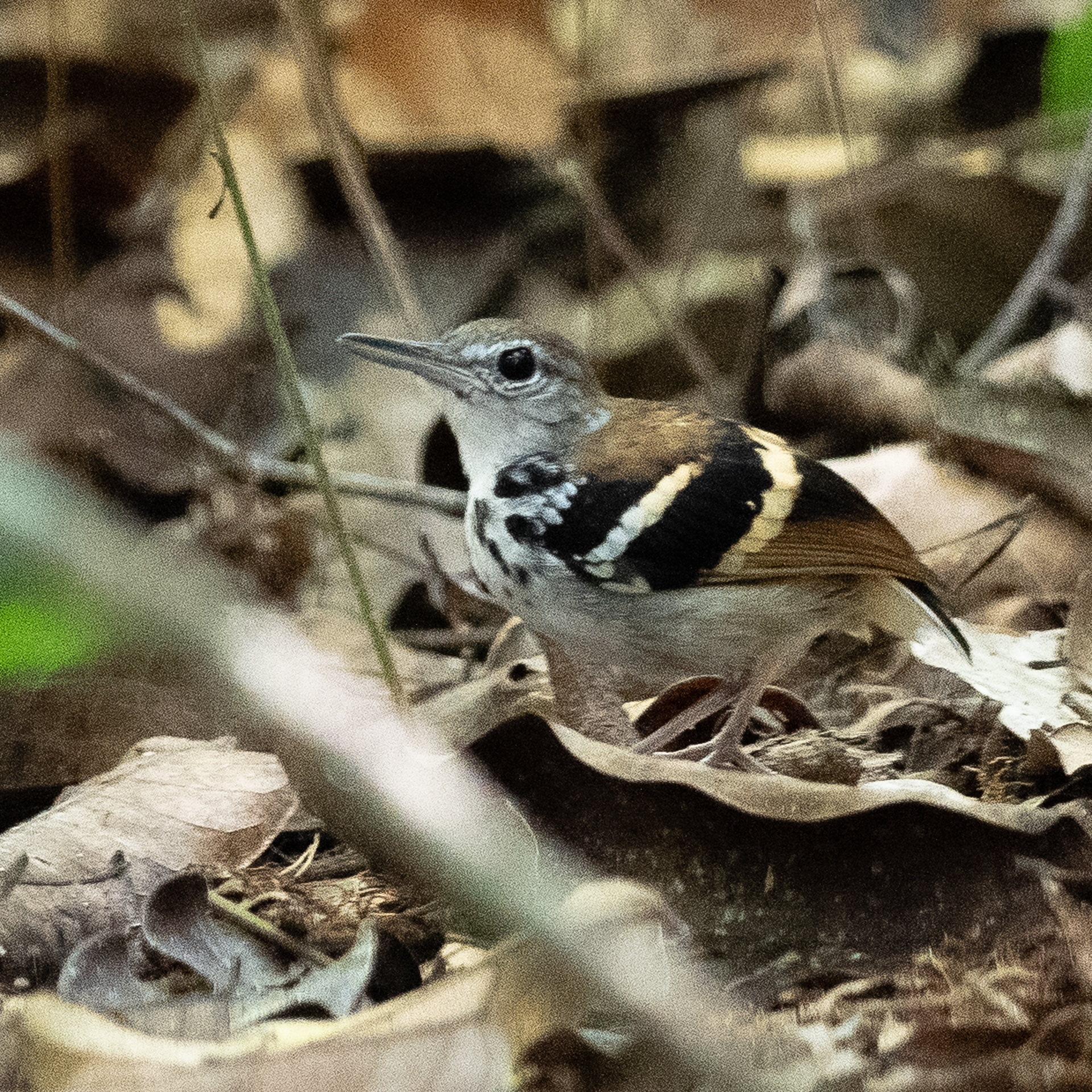
The Banded Antbird is a small, short-tailed antbird of the forest floor in western and central Amazonia, with a long bill and a strongly banded lower back. It is the only species in the genus Dichrozona. It walks over the leaf litter of terra firme forest, swinging its rear body from side to side.
Voice
The song is a slow, gradually rising series of 15–20 loud, sharp notes, given from or near the ground, often from a stump or fallen log. Calls: a short whistle and a rattle lasting about half a second to a second.
Recording: Jacob Wijpkema — CC BY-NC-SA 4.0 · converted to mono · xeno-canto
Identification
9–10 cm, with a long, thin bill, long legs and a short tail. The male has a greyish face with a thin white supercilium and a dark eye-line, a cinnamon-brown crown, nape and upper back and a white patch between the scapulars. The lower back, rump and uppertail coverts are banded black, white and grey; the wings are black with cinnamon to chestnut edges, the tail is black with white outer feathers. The throat, breast and belly are white, with a band of black spots across the breast. The female has a buff band on the lower back, buff-tinged underparts and fewer breast spots.
Confusion species
Spot-backed Antbird Hylophylax naevius and Common Scale-backed Antbird Willisornis poecilinotus also have a spotted or scaled back, but have a shorter bill, lack the white rump band and perch low on stems rather than walking on the ground.
Habitat
Evergreen lowland forest, mainly terra firme forest away from rivers, with an open understorey and plenty of leaf litter; up to about 800 m. It forages alone or in pairs and does not join mixed flocks. It feeds almost entirely on the ground, probing the litter and flipping leaves, and sometimes jumps up to glean from leaves and stems; it eats arthropods. The only nest described was a cup in a shrub fork just above the ground.
Where the bird is most at home, classified by the vegetation units of Amazonia and the Guianas.


Range and movements
Brazil: in western and central Amazonia, with different subspecies in the upper Rio Negro drainage, the west and the west-centre of Brazilian Amazonia. Venezuela: only in the extreme south-west, in Amazonas. Not in Guyana, Suriname or French Guiana. Outside the guide area in Colombia, Ecuador, Peru and Bolivia.
- Resident
- dark = core range, pale = thinly spread
How and when to look
In terra firme forest with an open understorey, listen for the slow, rising series of sharp notes. Then search low near the ground, on stumps and fallen trunks; the bird walks over the litter and sometimes pauses for a moment.
Conservation status
Least Concern. The species has a large range in extensive lowland forest; it depends on undisturbed forest with a well-developed litter layer.
Scientific name
Dichrozona cincta | (Pelzeln, 1868)
Pelzeln described the species in 1868 as Cyphorhinus (Microcerculus) cinctus; because it was later moved to another genus, the author and year stand in brackets. The genus Dichrozona was introduced in 1888 by Ridgway. Dichrozona is Greek, from dikhroos 'two-coloured' and zōnē 'band, girdle', after the pale bands on wings and rump. cincta is Latin for 'girdled, banded', after the pale bands across wings and rump. The specimen the first description was based on came from São Joaquim, Rio Negro, Amazonas, Brazil.