All species › Passerines › New World blackbirds, troupials and allies › Band-tailed Cacique
Band-tailed Cacique | Cacicus latirostris
Bandstaartbuidelspreeuw | Cacique colifajeado | Japu-de-rabo-verde
The Band-tailed Cacique is a large, oropendola-like cacique of river islands and flooded forest along the large rivers of western Amazonia. It was formerly placed in a genus of its own. It breeds in colonies, often in or next to colonies of oropendolas.
Voice
Liquid, hollow and bubbling song phrases, accompanied by a bowing display like that of oropendolas. Also short, grating calls.
Recording: GABRIEL LEITE — CC BY-NC-SA 4.0 · shortened to the first 60 s, mono · xeno-canto
Identification
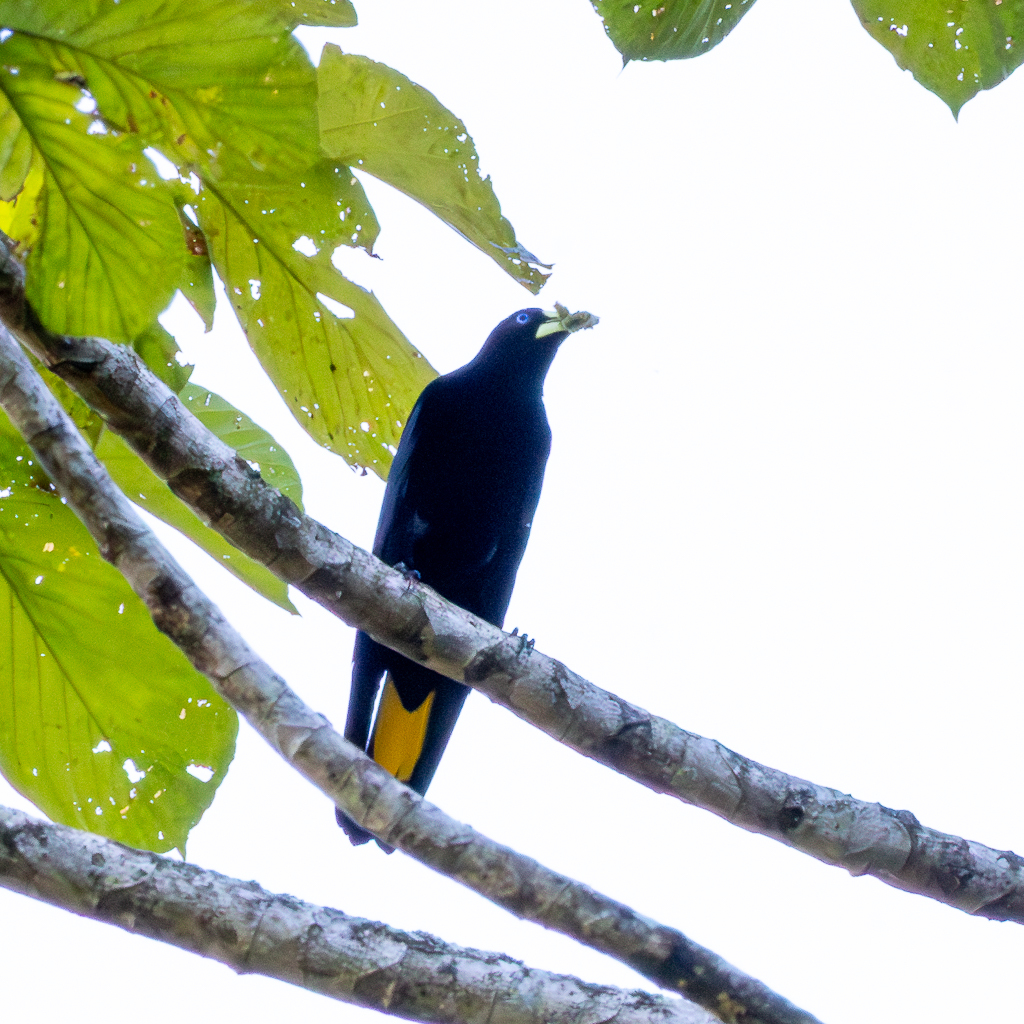
25–34 cm; the male is much larger than the female. Black, with a chestnut tinge on the head, neck and mantle. The bill is black, with a broadened, shield-like base on the forehead, largest in the male. The tail is largely yellow from below, with black central feathers and a broad black terminal band, which gives the species its name. The eye is dark. Juveniles are duller, with a smaller frontal shield.
Confusion species
The Russet-backed Oropendola Psarocolius angustifrons is larger and olive-brown, with a yellow tail without a black terminal band. The Crested Oropendola Psarocolius decumanus is larger, with an ivory bill and a pale blue iris. The Casqued Cacique Cacicus oseryi is olive-brown, with a yellow bill, and lives in terra firme forest. The Yellow-rumped Cacique Cacicus cela has a yellow rump and wing patch and a pale bill.
Habitat
River islands, várzea, riverine forest and young growth along large whitewater rivers in the lowlands, mostly below 200 m. Forages in groups in the treetops for insects and fruit. Breeds in colonies of hanging woven nests, often in the same tree as oropendolas.
Where the bird is most at home, classified by the vegetation units of Amazonia and the Guianas.



Range and movements
Brazil: local in western Amazonia, along the Solimões (the upper Amazon) and the lower reaches of its large tributaries, mainly on river islands, east to about the mouth of the Rio Negro. Absent from Venezuela, Guyana, Suriname and French Guiana. Outside the guide area in the far south-east of Colombia, locally in eastern Ecuador and in north-eastern Peru.
- Resident
- dark = core range, pale = thinly spread
How and when to look
From a boat along the banks of the Solimões and on its river islands, look for oropendola colonies; the Band-tailed Cacique often nests among them, and in flight the black terminal band of the yellow tail shows.
Conservation status
Least Concern. Its riverine habitat changes naturally all the time and is still largely intact, but in the guide area the species is confined to a narrow strip along the large rivers.
Scientific name
Cacicus latirostris | Swainson, 1838 (GBIF: Ocyalus latirostris)
Swainson described the species in 1838 and placed it straight away in the genus where it still stands. The genus Cacicus was introduced in 1799 by De Lacépède. Cacicus comes from Spanish cacique 'chief', a Taíno word, after the striking, 'lordly' appearance. latirostris is Latin for 'broad-billed', from latus 'broad' and rostrum 'bill', after the broad bill base. The specimen the first description was based on came from Peru (not further specified).