All species › Nightjars › Nightjars and nighthawks › Band-winged Nightjar
Band-winged Nightjar | Systellura longirostris
Vleugelbandnachtzwaluw | Chotacabras alifajeado | Bacurau-da-telha
Band-winged Nightjar is a nightjar of open terrain in the mountains, with separate populations in the guide area in the mountains of south-eastern and southern Brazil, in the Andes of western Venezuela and on the tepuis of the Guiana Shield. By day it rests on the ground among stones or low vegetation; at dusk it hunts over open terrain and along roads. In Brazil it also roosts on roofs, to which the Portuguese name bacurau-da-telha refers.

Voice
The territorial sound is a high, sharp whistle, repeated every one to three seconds, mainly at dusk and dawn. In flight, especially in the breeding season, a high cheet. A flushed female gives a nasal tchree.
Recording: Juan Freile — CC BY-NC-SA 4.0 · converted to mono · xeno-canto
Identification
21–25 cm. Greyish brown, heavily spotted and streaked with black and buff, with a rufous nuchal collar. The male has a white band across the outer primaries, a white band in the tail and often a white patch on the lower throat. In the female the wing band is buff, the white in the tail is lacking and the throat is tawny.
Confusion species
Pauraque Nyctidromus albicollis usually lives lower, is larger and has a longer tail and no rufous nuchal collar. Roraiman Nightjar Tepuiornis whitelyi on the tepuis is darker and lacks the rufous nuchal collar. The female Lyre-tailed Nightjar Uropsalis lyra in the Venezuelan Andes has no pale wing band and lives in montane forest. Little Nightjar Setopagis parvula is smaller and lives in lower, drier savanna and open woodland.
Habitat
Open terrain in the mountains: forest edges, scrub, rocky slopes, campo rupestre and montane grassland, páramo, fields and villages; in south-eastern Brazil also in cities, where it roosts on roofs. In Venezuela mostly above 1500 m, on the tepuis on plateaus and summits, in Brazil mainly in the mountains, in the south also lower. It hunts flying insects at dusk and at night. No nest is built; the one or two eggs lie in a scrape on bare ground, sometimes beside a road.
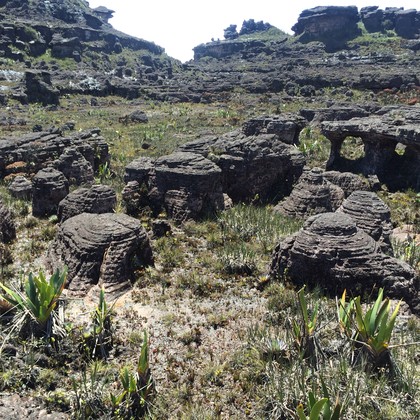
Where the bird is most at home, classified by the vegetation units of Amazonia and the Guianas.





Range and movements
In Brazil in the mountains and highlands of the east and south, from Bahia and Minas Gerais through the Serra da Mantiqueira and Serra do Mar to Rio Grande do Sul, also in cities such as São Paulo. In Venezuela in the Andes from Táchira to Trujillo and on the tepuis of Bolívar and Amazonas. From Guyana only a single report from the highlands. Absent from the Amazonian lowlands, Suriname and French Guiana. Outside the guide area along the Andes from Colombia to Argentina and Chile, south to Tierra del Fuego.
- Resident
- dark = core range, pale = thinly spread
How and when to look
At dusk, walk or drive along roads through montane grassland and forest edges, as in Itatiaia, the Serra da Canastra or the Venezuelan Andes; birds sit on the road or on stones and flush in the beam of light. The high whistle carries far.
Conservation status
Least Concern. The species is widespread and also occurs in open, man-made landscapes, even in cities.
Scientific name
Systellura longirostris | (Bonaparte, 1825)
Bonaparte described the species in 1825 as Caprimulgus longirostris; because it was later moved to another genus, the author and year stand in brackets. The genus Systellura was introduced in 1912 by Ridgway. Systellura is Greek, from sustellō 'to shorten' and oura 'tail': 'short-tail'. longirostris is Latin, from longus 'long' and rostrum 'bill': 'long-billed' — curious, as the bill is short like that of all nightjars. The specimen the first description was based on came from South America (not further specified).