All species › Passerines › Tyrant flycatchers and allies › Bay-ringed Tyrannulet
Bay-ringed Tyrannulet | Phylloscartes sylviolus
Bruinringlooftiran | Orejerito ojirrojo | Maria-pequena
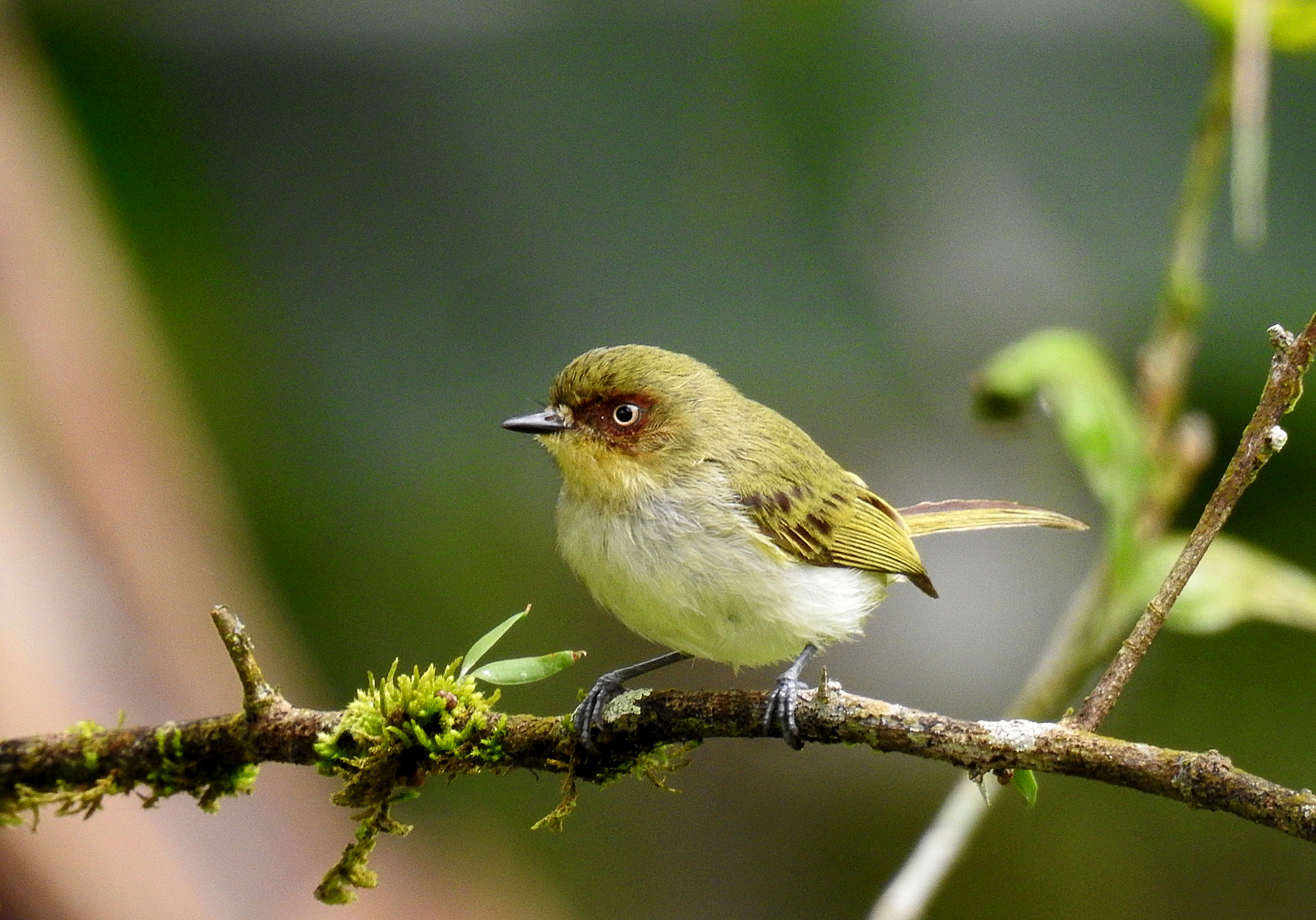
The Bay-ringed Tyrannulet is a small tyrant flycatcher of the Atlantic Forest canopy, recognised by the rufous lores and broad eye-ring around a white eye. It forages high in the crowns and often holds its tail cocked. Its range extends from south-eastern Brazil to Paraguay and Misiones in Argentina.
Voice
The song is a rapid, nearly level twitter of very high notes, ending in a low, descending note.
Recording: GABRIEL LEITE — CC BY-NC-SA 4.0 · xeno-canto
Identification
11.5 cm, with a black bill. The lores are rufous and run into a broad rufous eye-ring; the eye is white. The crown and upperparts are olive-green. The wings have pale yellow tips to the coverts, forming a wing-bar. Chin and throat are yellowish, the rest of the underparts largely whitish, with a greenish wash on breast and flanks and yellow undertail coverts. The sexes are alike.
Confusion species
Oustalet's Tyrannulet Phylloscartes oustaleti has a yellow face with a dark crescent on the ear-coverts, a dark eye and yellow underparts. Mottle-cheeked Tyrannulet Phylloscartes ventralis has a dark patch on the ear-coverts, no rufous on the face and a yellow belly. Eye-ringed Tody-Tyrant Hemitriccus orbitatus has a white eye-ring and lores and keeps to the understorey, not the canopy.
Habitat
Interior and edges of humid evergreen forest in lowlands and foothills, from sea level to about 600 m. It forages mainly in the canopy on insects and some small fruit, perching crosswise, and makes short sallies or briefly hovers at the leaves. Alone, in pairs or family groups, often in mixed flocks. The nest is a bag of moss with a side entrance, 10–25 m up on a horizontal branch.
Where the bird is most at home, classified by the vegetation units of Amazonia and the Guianas.



Range and movements
Brazil: from southern Minas Gerais and Espírito Santo through Rio de Janeiro, São Paulo and Paraná to Santa Catarina, mainly along the Serra do Mar. Not in Venezuela or the Guianas. Outside the guide area in eastern Paraguay and Misiones (Argentina).
- Resident
- dark = core range, pale = thinly spread
How and when to look
Look in mixed flocks in the canopy of lowland forest at the foot of the Serra do Mar, for example in São Paulo or Paraná; look for the rufous ring around the white eye.
Conservation status
Least Concern since 2023; previously Near Threatened. The population size is unknown and declining, and the species has disappeared from parts of its range through urbanisation, industry, agriculture and road-building. In Brazil the Serra do Mar is its main stronghold; it occurs in several protected areas.
Scientific name
Phylloscartes sylviolus | (Cabanis & Heine, 1860)
Cabanis & Heine described the species in 1860 as L[eptotriccus] sylviolus; because it was later moved to another genus, the author and year stand in brackets. The genus Phylloscartes was introduced in 1860 by Cabanis & Heine. Phylloscartes is Greek, from phullon 'leaf' and skairō 'to skip, to dance', after its restless foraging among foliage. sylviolus is Modern Latin for 'little warbler', a diminutive of sylvia 'warbler' (from Latin silva 'wood'). The specimen the first description was based on came from Rio de Janeiro, Brazil.