All species › Passerines › Tyrant flycatchers and allies › Bearded Tachuri
Bearded Tachuri | Polystictus pectoralis
Baardtiran | Tachurí barbado | Papa-moscas-canela
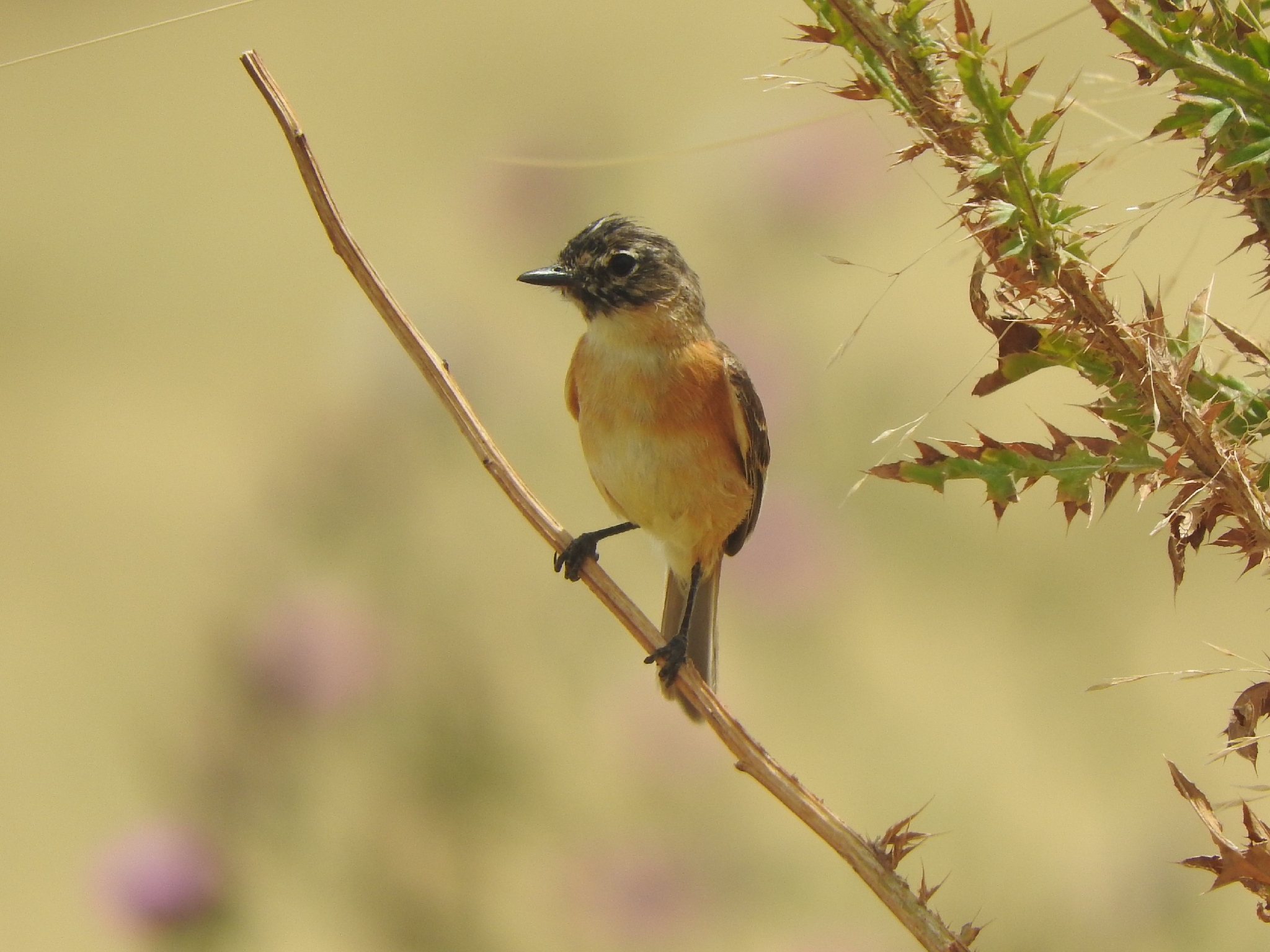
The Bearded Tachuri is a very small tyrant flycatcher of natural grassland and savanna. The male has a blackish, bushy crest and a streaked "beard" on the chin. The species is widespread in South America but occurs only locally everywhere, as it is tied to tall, natural grass.
Voice
From a grass stem or in a short display flight the male sings a high, thin series of short notes, ending in a brief, low, toneless note. The contact call is a weak, rising whistle.
Recording: Jeremy Minns — CC BY-NC-SA 3.0 · xeno-canto
Identification
10 cm, with a short black bill and a fairly short tail. The male has a dark grey to blackish crown with a bushy, usually flattened crest, a short white supercilium, a thin black eye-stripe and a black-and-white streaked chin. The upperparts are buffy brown, the rump rufous; the wings are dusky, with cinnamon edges and two wing bars. The underparts are pale yellowish white, with a cinnamon wash on the breast and flanks. The female is duller, without a beard, with a brown crown and a whitish throat.
Confusion species
Sharp-tailed Grass Tyrant Culicivora caudacuta has a long, pointed tail and a striped head. Fulvous-crowned Scrub Tyrant Euscarthmus meloryphus has an orange-brown crown patch, no beard and lives in scrub. Rufous-sided Scrub Tyrant Euscarthmus rufomarginatus has yellower underparts and rufous flanks. Grey-backed Tachuri Polystictus superciliaris is greyer, with a white supercilium, and lives on rocky mountain slopes in eastern Brazil.
Habitat
Natural grassland and savanna with scattered shrubs and tall grass, often near wet spots, streams or marsh edges; also open cerrado. Mainly in the lowlands, locally up onto the Gran Sabana. It searches for insects low in the grass and in small shrubs. The nest is a small cup low in a shrub or among grasses.
Where the bird is most at home, classified by the vegetation units of Amazonia and the Guianas.





Range and movements
Very local. Venezuela: scattered sites in the Llanos (Apure, Barinas) and especially in Bolívar, including along the Caura and on the Gran Sabana; also in Amazonas. Guyana: the Rupununi savannas and a few sites further north. Suriname: the Sipaliwini savanna. French Guiana: coastal savannas around Sinnamary. Brazil: the savannas of Roraima, Amapá and northern Pará, and the cerrado and grasslands of Goiás, Mato Grosso, Mato Grosso do Sul, São Paulo and Rio Grande do Sul. Records in central Brazil fall mainly in the austral winter; southern birds are summer visitors. Outside the guide area in Colombia, Bolivia, Paraguay, Uruguay and Argentina.
- Resident
- dark = core range, pale = thinly spread
How and when to look
Search the Rupununi savannas, the area around Boa Vista or Emas National Park for small birds in tall grass along streams; singing males perch on top of a grass stem or make a short song flight.
Conservation status
Near Threatened. The population is declining through the conversion of natural grassland to fields, pasture and plantations, overgrazing and frequent fires; reservoirs and urban expansion have also eliminated sites.
Scientific name
Polystictus pectoralis | (Vieillot, 1817)
Vieillot described the species in 1817 as Sylvia pectoralis; because it was later moved to another genus, the author and year stand in brackets. The genus Polystictus was introduced in 1850 by Reichenbach. Polystictus is Greek polustiktos 'much-spotted', from polus 'much' and stiktos 'spotted', after the heavily streaked head. pectoralis is Latin for 'of the breast', from pectus 'breast', after the male's dark-streaked breast and throat. The specimen the first description was based on came from Paraguay.