All species › Tubenoses › Petrels, shearwaters and diving petrels › Black-capped Petrel
Black-capped Petrel | Pterodroma hasitata
Zwartkapstormvogel | Petrel antillano | Grazina-de-coroa-preta
Black-Capped Petrel, known in the Caribbean as diablotin, is the only Pterodroma still known with certainty to breed in the Caribbean, in burrows on steep mountain slopes of Hispaniola and Dominica. It forages mainly in the Gulf Stream and the Caribbean Sea. In the guide area it is a rare vagrant at sea in the north.
Voice
Usually silent at sea. Over the breeding sites at night long, drawn-out, rasping, crow-like calls, rendered as aaa-aw, eek, and a softer, swelling oooow-uk.
No recording with a suitable Creative Commons licence is available for this species yet.
Identification
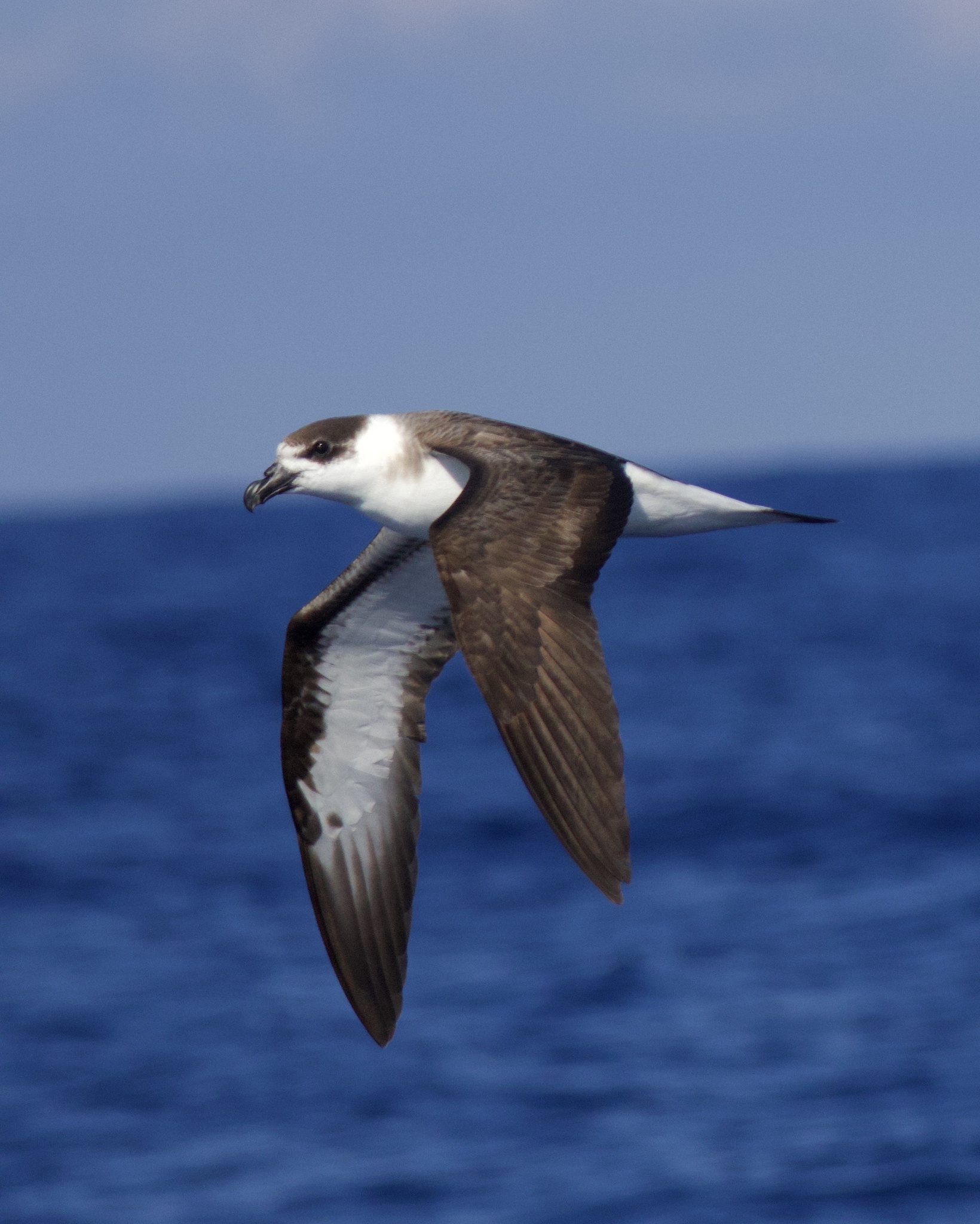
35–40 cm. A medium-sized, powerfully built petrel with long wings angled at the wrist and a short, thick black bill. The upperside is dark grey-brown with a blackish cap, which in pale birds contrasts with a white forehead, white hindneck and broad white rump. The underparts are white. The underwing is white, with a dark trailing edge and a dark bar running diagonally from the wrist across the wing. In the dark morph cap and neck are more extensively dark and there is less white on hindneck and rump. Sexes and ages are alike. It flies in high, swinging arcs with few wingbeats.
Confusion species
Great Shearwater Ardenna gravis also has a dark cap and a white band on the rump, but is larger, with a slender bill, a dark belly patch, a narrow white rump band and a flatter flight. Pale Trindade Petrels Pterodroma arminjoniana have a dark head, breast band and rump. Bermuda Petrel Pterodroma cahow (outside this area) has little or no white on hindneck and rump.
Habitat
Open sea over deep water and along the edges of warm currents and upwelling areas. It eats squid, fish and crustaceans, caught at the surface mainly at dusk and at night. It does not breed in the guide area; outside it, it nests in burrows and crevices on steep forested slopes high in the mountains of Hispaniola and Dominica.
Where the bird is most at home, classified by the vegetation units of Amazonia and the Guianas.

Range and movements
In the guide area only a few records at sea off the Caribbean coast of Venezuela and off Guyana. Tracking shows that birds from Hispaniola also forage in the southern Caribbean Sea, as far as off the coast of Colombia; the species may therefore occur off northern Venezuela more often than the records suggest. Not known from Brazil, Suriname or French Guiana. Outside the guide area it breeds on Hispaniola and Dominica and forages mainly in the Gulf Stream between Florida and North Carolina.
How and when to look
There is no site where this species can be expected. On pelagic trips or ferries over deep water in the Caribbean Sea off Venezuela, every petrel with a dark cap and a white rump deserves a series of photographs of the upper- and underside.
Conservation status
Endangered. The world population is estimated at a few thousand birds. Deforestation, fires and agriculture on the breeding slopes, introduced predators, hunting for food and light pollution have caused a steep decline. At sea, oil and gas extraction pose a possible risk.
Scientific name
Pterodroma hasitata | (Kuhl, 1820)
Kuhl described the species in 1820 as Procellaria hasitata; because it was later moved to another genus, the author and year stand in brackets. The genus Pterodroma was introduced in 1856 by Bonaparte. Pterodroma is Greek, from pteron 'wing' and dromos 'runner', after the fast, sweeping flight. hasitata is probably a misspelling of Latin haesitata 'hesitating', as Kuhl was unsure of the species' status. The specimen the first description was based on came from unknown (no locality given).