All species › Passerines › New World sparrows › Black-fronted Brushfinch
Black-fronted Brushfinch | Atlapetes nigrifrons
Zwartvoorhoofdstruikgors | Atlapetes frentinegro | Tico-tico-de-testa-preta
The Black-fronted Brushfinch is a yellow-bellied brushfinch found only in the Serranía de Perijá, the mountain range on the border of Venezuela and Colombia. It was long regarded as a subspecies within the Rufous-naped and Yellow-breasted Brushfinch group and has only recently been treated as a separate species by most authorities. It lives in pairs or family groups in scrub at forest edges.
Voice
The dawn song starts with a series of chip or tink notes, followed by faster, usually lower trills. During the day a short, simple song of a few descending notes. Calls chip, seet and swit.
Recording: Ross Gallardy — CC BY-NC-SA 4.0 · xeno-canto
Identification
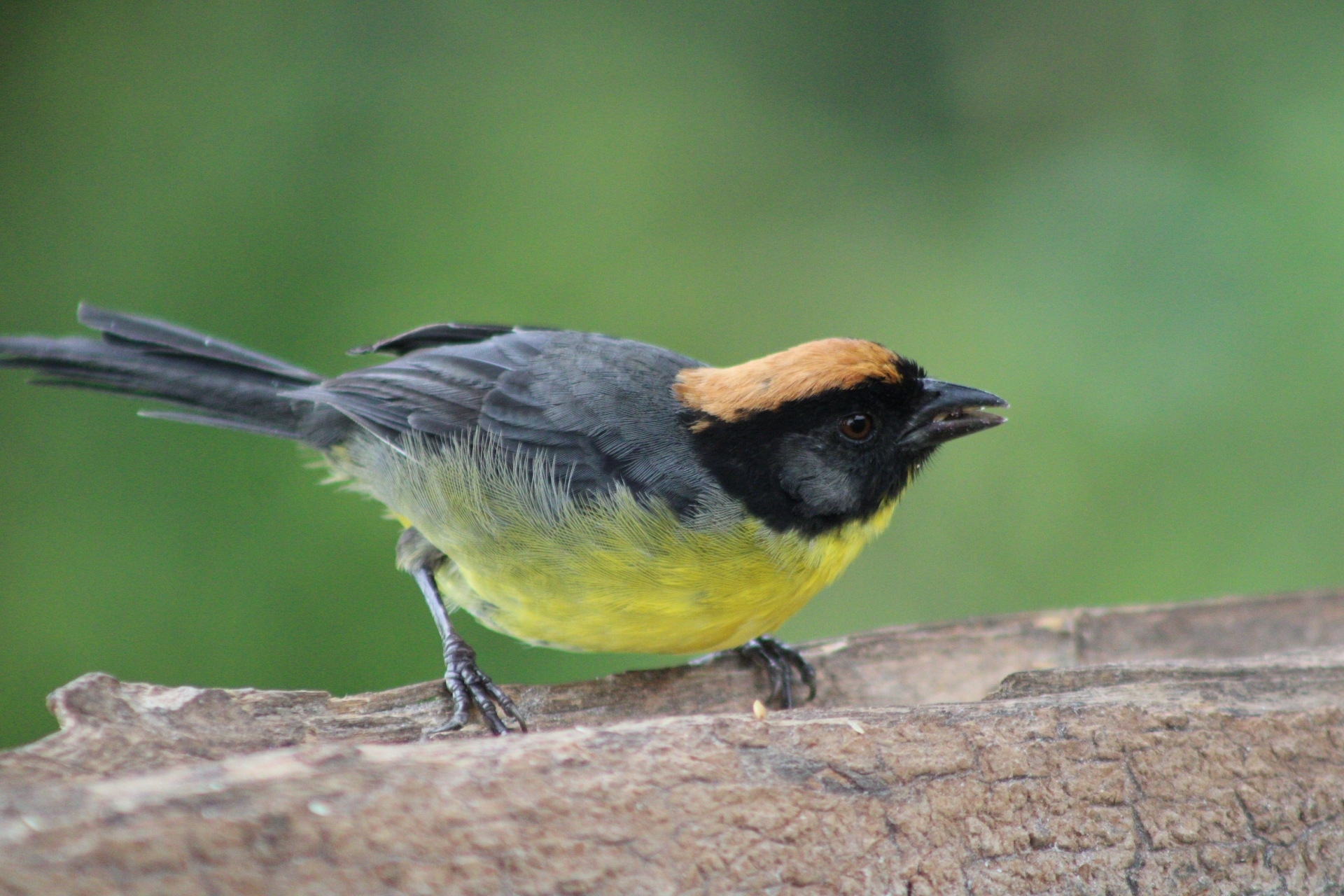
17 cm, with a black bill. The forehead is black, crown and nape are rufous to orange-brown and the face is mostly black, with a dark grey wash on the cheeks. The upperparts are dark slate, wings and tail slightly darker; the outer primaries have narrow white edges. Throat, breast, belly and undertail coverts are yellow, with an olive or grey wash on the breast sides and flanks. The iris is deep reddish brown. The sexes are alike. Young birds have an olive-grey head with grey cheeks and no rufous.
Confusion species
Perija Brushfinch Arremon perijanus lives in the same mountains, but has a black-and-grey striped head and a white throat, without yellow. Yellow-breasted Brushfinch Atlapetes latinuchus is very similar, but lacks the black forehead and does not occur in the Perijá. Slaty Brushfinch Atlapetes schistaceus has a white moustachial stripe and grey underparts and lives higher. Chestnut-capped Brushfinch Arremon brunneinucha has a white throat with a black breast band and an olive-green back.
Habitat
Humid montane forest, especially shrubby forest edges and secondary forest; it tolerates disturbed habitat. On the Venezuelan side roughly between 1100 and 2200 m. It forages in pairs or small groups low in scrub and on the ground for insects, seeds and fruit. Little is known about the nest.
Where the bird is most at home, classified by the vegetation units of Amazonia and the Guianas.

Range and movements
Only in the Serranía de Perijá: in Venezuela on the western edge of Zulia, on the eastern slope of the range. It does not occur in Brazil, Guyana, Suriname or French Guiana. Outside the guide area only on the Colombian side of the Perijá. There are very few recent records; the map is based on a single square, and its seasonal category says nothing about migration, as the species is resident.
- Resident
- dark = core range, pale = thinly spread
How and when to look
The Venezuelan side of the Perijá is rarely visited and hard to reach. Anyone who gets there should search forest edges and scrub above about 1100 m.
Conservation status
Least Concern under the current assessment, but its range is small. Montane forest in the Perijá is cleared and burned in many places for farming and cattle.
Scientific name
Atlapetes nigrifrons | Phelps & Gilliard, 1940
Phelps & Gilliard described the species in 1940 and placed it straight away in the genus where it still stands. The genus Atlapetes was introduced in 1831 by Wagler. Atlapetes combines the Titan Atlas of Greek myth, who was turned into a mountain, with Greek petēs 'flier': a 'mountain flier', after the montane habitat. nigrifrons is Latin, from niger 'black' and frons 'forehead', after the black forehead. The specimen the first description was based on came from La Sabana (1,300 m), Sierra de Perijá, Zulia, Venezuela.