All species › Passerines › Tanagers and allies › Black-hooded Tanager
Black-hooded Tanager | Stilpnia whitelyi
Zwartkaptangare | Tangara capirotada | Saíra-de-cabeça-preta
The Black-hooded Tanager is a tanager of the tepui region, found only in south-eastern Venezuela, western Guyana and the far north of Brazil. It was long treated as a subspecies of Black-headed Tanager of the mountains of northern Venezuela, but differs in plumage and calls. It lives mainly at forest edges and in scrubby terrain on the edges of the upland savannas.
No photograph of a living wild bird of this species with a suitable Creative Commons licence exists. Do you have one that meets the rules? Send it in.
Voice
Calls are a short, rising, crisp spik! and a slightly longer pseeuw, often given together. The song is a fast series of high notes at an even pitch.
No recording with a suitable Creative Commons licence is available for this species yet.
Identification
13 cm, compact, with a short, pointed bill. The male has a black hood extending over the nape and upper breast; back and underparts are pale straw to greyish yellow with a slight gloss, the underparts mottled grey. Wings and tail black, without the blue edges of Black-headed Tanager. The female is dull greyish green, with a greyer head and finely streaked underparts. Juveniles resemble the female.
Confusion species
Black-headed Tanager Stilpnia cyanoptera of the coastal range and the Andes of Venezuela is brighter, with a smaller black hood and blue wing edges; the two do not occur together. Burnished-buff Tanager Stilpnia cayana of the savannas is pale buff, with a rufous crown and only a black mask. The female resembles those of other tanagers, but can be told by its structure and streaked underparts.
Habitat
Edges of montane and lower humid forest, scrub and scattered trees on the edges of the upland savannas, and clearings on the slopes of the tepuis, roughly between 600 and 2000 m. It eats small fruits and insects. It travels in pairs or small groups, sometimes with mixed flocks. Little is known about the nest.
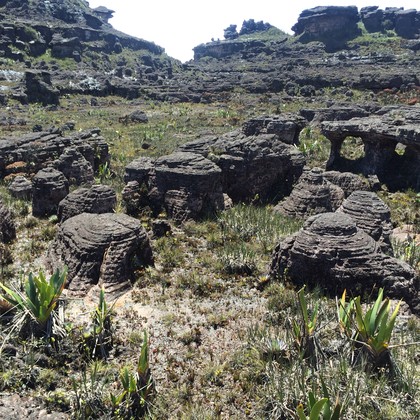
Where the bird is most at home, classified by the vegetation units of Amazonia and the Guianas.



Range and movements
Venezuela: in the tepui region of Bolívar, among others in the Gran Sabana and the Sierra de Lema, and of Amazonas. Guyana: in the west, in the Pakaraima Mountains. Brazil: only in the far north of Roraima, on the border with Venezuela and Guyana. Absent from Suriname and French Guiana. It does not occur outside the guide area.
How and when to look
Forest edges and scrub along the road through the Sierra de Lema and in the Gran Sabana, for example around Kavanayén, where the birds sit in scattered trees and fruiting shrubs. The short spik! often gives away a pair in the canopy.
Conservation status
Least Concern (IUCN). The species has a small range, but it lies largely in remote country, and it tolerates forest edges and scrubby terrain. Fires in the savannas of the Gran Sabana can locally damage forest edges.
Scientific name
Stilpnia whitelyi | (Salvin & Godman, 1884)
Salvin & Godman described the species in 1884 as Calliste whitelyi; because it was later moved to another genus, the author and year stand in brackets. The genus Stilpnia was introduced in 2016 by Burns, Unitt & Mason. Stilpnia comes from Greek stilpnos 'glittering, glistening', after the glossy plumage. whitelyi honours the English collector Henry Whitely Jr. (1844–1892), who collected in Japan and tropical America. The specimen the first description was based on came from Roraima, Bolívar, Venezuela.