All species › Nightjars › Nightjars and nighthawks › Blackish Nightjar
Blackish Nightjar | Nyctipolus nigrescens
Roetnachtzwaluw | Chotacabras negruzco | Bacurau-de-lajeado
Blackish Nightjar is a small, very dark nightjar of Amazonia and the Guiana Shield, tied to bare rock outcrops, inselbergs and gravel and sand bars along rivers. Its blackish, finely spotted plumage merges with dark rock. The egg is laid in a hollow on bare rock.

Voice
A short, soft, purring trill, roughly pu'r'r'r'r't or qu'r'r'r'rt, mainly at dusk from a rock; both sexes sing in display. Also a clucking ptink as an alarm call and a guttural hiss when threatened.
Recording: JAYRSON ARAUJO DE OLIVEIRA — CC BY-NC-SA 4.0 · converted to mono · xeno-canto
Identification
19–22 cm, small, with a fairly short tail. The upperparts are blackish brown with small ochre, greyish-white and cinnamon spots; overall it looks much darker than other lowland nightjars. The underparts are also dark, finely barred. Males have small white spots on the throat and on a few primaries and a white tip to the outer tail feathers, shown in display; females have less or no white.
Confusion species
Pygmy Nightjar Nyctipolus hirundinaceus of the Caatinga and eastern Brazil is smaller and paler greyish brown; it also rests on rocks, but in dry, open country. Ladder-tailed Nightjar Hydropsalis climacocerca also lives along rivers, but is paler and more rufous, and the male has much white in the long tail. Band-tailed Nighthawk Nyctiprogne leucopyga has a white band across the middle of the tail and hunts in small groups over the water.
Habitat
Evergreen lowland forest and savanna areas, but almost always at open rock slabs, granite inselbergs or sand and gravel bars along rivers, also at rapids and bare patches; up to about 1200 m. It hunts flying insects in short sallies from the ground or a rock. The single egg usually lies in a hollow on bare rock, sometimes on sand or bare ground; birds breed alone or in small, loose colonies, mainly in the dry season.
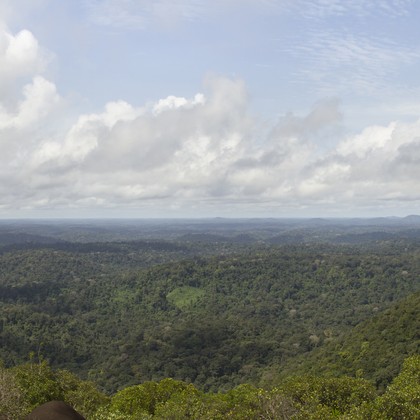
Where the bird is most at home, classified by the vegetation units of Amazonia and the Guianas.



Range and movements
In Brazil in Amazonia, mainly where rock comes to the surface: on the Guiana Shield north of the Amazon and on the Brazilian Shield south of it, south to Rondônia and Mato Grosso and east to eastern Pará. In Venezuela south of the Orinoco, in Amazonas and Bolívar. In Guyana, Suriname and French Guiana widespread on rock slabs and inselbergs in the interior. Outside the guide area in eastern Colombia, Ecuador and Peru and in northern Bolivia.
- Resident
- dark = core range, pale = thinly spread
How and when to look
At dusk, search inselbergs and rock slabs in the interior of the Guianas or granite outcrops along rivers in Amazonia; by day the birds rest on the rock and flush only at your feet.
Conservation status
Least Concern. The species is locally common where suitable rocks and gravel bars occur.
Scientific name
Nyctipolus nigrescens | (Cabanis, 1849)
Cabanis described the species in 1849 as Caprimulgus nigrescens; because it was later moved to another genus, the author and year stand in brackets. The genus Nyctipolus was introduced in 1912 by Ridgway. Nyctipolus is Greek nuktipolos 'roaming by night', from nux 'night' and poleō 'to haunt'. nigrescens is Latin for 'blackish', after the very dark plumage. The specimen the first description was based on came from lower Essequibo River, Guyana.