All species › Passerines › Tyrant flycatchers and allies › Blackish Pewee
Blackish Pewee | Contopus nigrescens
Zwarte piewie | Pibí negruzco | Piui-preto
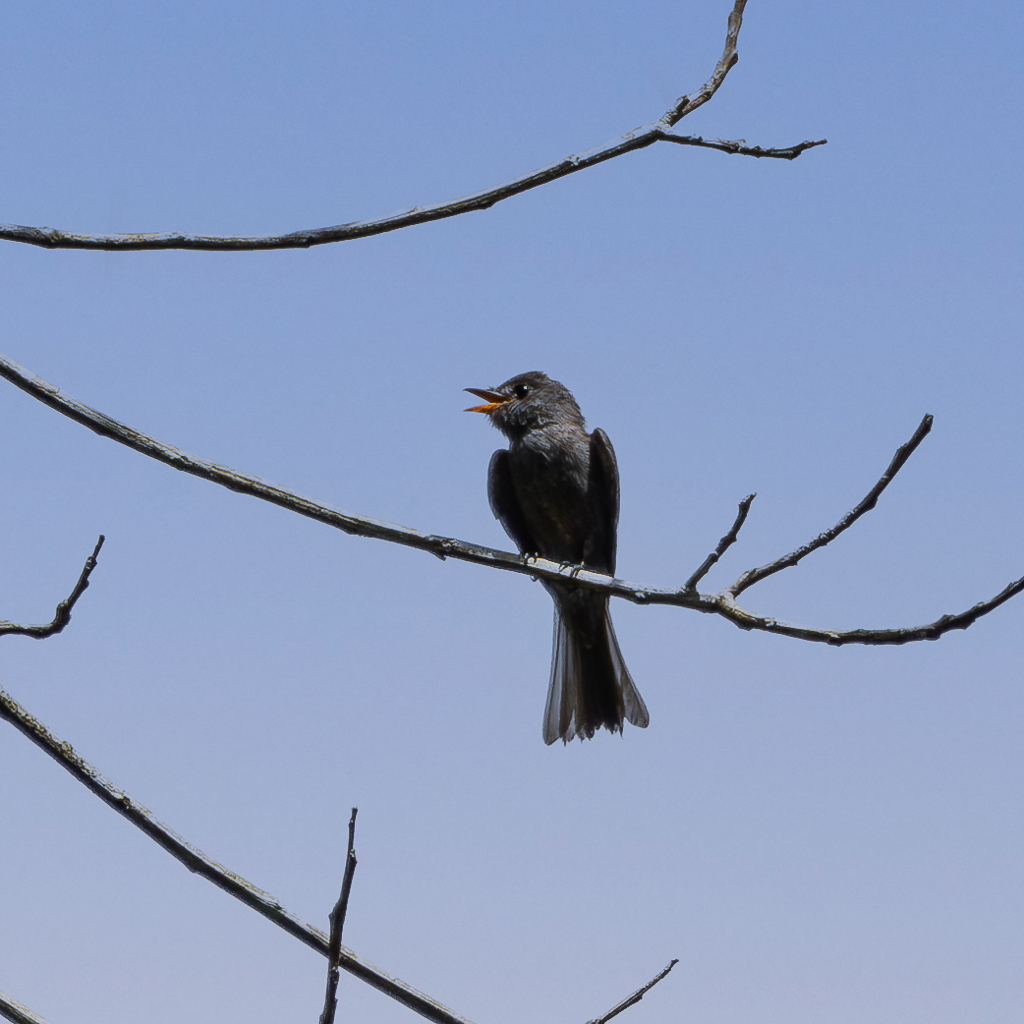
The Blackish Pewee is a small, almost uniformly dark grey pewee with a highly fragmented range. In the guide area it lives in the eastern Brazilian Amazon and in southern Guyana, far from the populations on the eastern slope of the Andes. It perches upright on a bare, protruding branch high at the forest edge.
Voice
The song is a short, slightly hoarse, two-note chee-bew, repeated at intervals of a few seconds. The call is a sharp, repeated pip. The song varies regionally.
Recording: Juan Freile — CC BY-NC-SA 4.0 · converted to mono · xeno-canto
Identification
13 cm, with a slight crest and a broad, flat bill. The crown is blackish grey, the rest of the plumage dark sooty grey, the throat slightly paler. The lores are paler grey. The wings are blackish brown, without distinct wing bars. The upper mandible is black, the lower mandible pale greyish-buff. The sexes are alike. Juveniles have pale wing bars and pale feather edges.
Confusion species
Southern Tropical Pewee Contopus cinereus is paler greyish-olive, with a whitish throat and belly and often pale wing bars. Eastern Wood Pewee Contopus virens and Olive-sided Flycatcher Contopus cooperi, winter visitors from the north, are olive-grey; Olive-sided Flycatcher is larger and has a dark 'vest' with a white central stripe down breast and belly. White-throated Pewee Contopus albogularis, in Suriname, French Guiana and Amapá, has a white throat.
Habitat
Canopy and edges of humid terra firme forest, often along clearings, roads, streams and on hills, in the guide area from the lowlands up to about 900 m. It lives alone or in pairs, sallies from a high, open perch for flying insects and often returns to the same branch, where it shivers its tail. The nest is a small, lichen-covered cup on a branch.
Where the bird is most at home, classified by the vegetation units of Amazonia and the Guianas.



Range and movements
Brazil: scattered in the eastern and southern Amazon, mainly in Pará, including the Serra dos Carajás; elsewhere local and poorly known. Guyana: local in the south, in hilly forest. Venezuela, Suriname and French Guiana: not known. Outside the guide area locally on the eastern slope of the Andes in Ecuador and Peru.
- Resident
- dark = core range, pale = thinly spread
How and when to look
In the Serra dos Carajás and similar hilly forest in Pará, look along roads for dead branches above the canopy. A small dark bird that keeps returning to the same branch and shivers its tail may be this species; the song is heard in the morning.
Conservation status
Least Concern. The species is local and uncommon but has a large range; deforestation in the eastern Amazon is a local threat.
Scientific name
Contopus nigrescens | (Sclater & Salvin, 1880)
Sclater & Salvin described the species in 1880 as Myiochanes nigrescens; because it was later moved to another genus, the author and year stand in brackets. The genus Contopus was introduced in 1855 by Cabanis. Contopus is Greek, from kontos 'pole, shaft' and pous 'foot', after the short legs. nigrescens is Latin for 'blackish', after the very dark slaty plumage. The specimen the first description was based on came from Sarayacu, Pastaza, Ecuador.