All species › Tubenoses › Petrels, shearwaters and diving petrels › Boyd's Shearwater
Boyd's Shearwater | Puffinus boydi
Kaapverdische kleine pijlstormvogel | Pardela chica de Cabo Verde | Pardela-pequena-de-cabo-verde
Boyd's Shearwater is a small black-and-white shearwater that breeds only on the Cape Verde Islands. In the guide area it is a rare vagrant at sea. It was long treated as a subspecies of Sargasso Shearwater or of Barolo Shearwater.
Voice
Silent at sea. In the colony at night cooing and panting calls.
Recording: Magnus Robb — CC BY-NC-SA 4.0 · shortened to the first 60 s, mono · xeno-canto
Identification
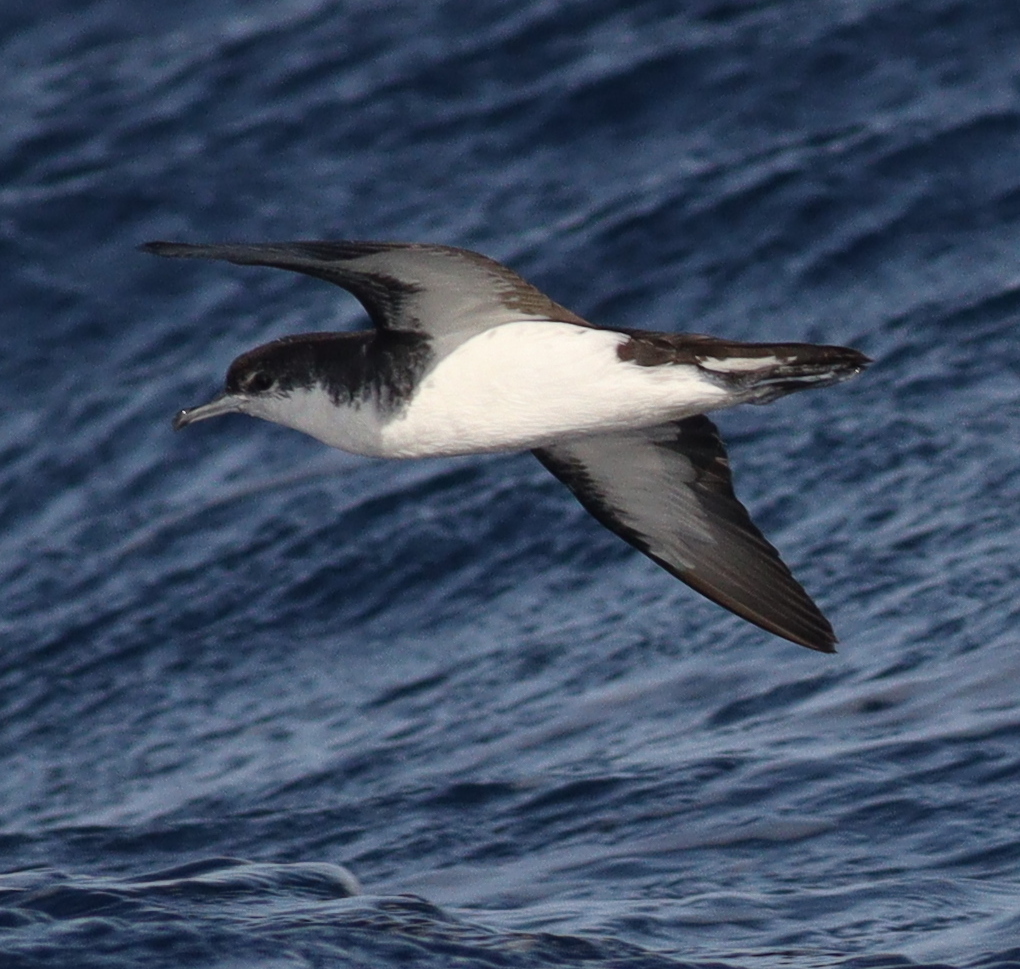
27–30 cm. A small shearwater with short, rounded wings and a fast flight of short series of wingbeats and short glides. The upperparts are brownish black; the dark cap extends below the eye, leaving little white around it. The underparts are white, the undertail coverts dark. The underwing is white with broad dark margins. Bill dark, legs pink with a dark outer side. Sexes alike; juveniles like adults.
Confusion species
Sargasso Shearwater Puffinus lherminieri can hardly be told apart in the field; it is on average slightly larger and longer-tailed, and the two are separated mainly by origin and measurements. Manx Shearwater Puffinus puffinus is larger, with longer wings, blacker upperparts, white undertail coverts and longer glides.
Habitat
Warm, open ocean, far from the coast outside the breeding season. It eats small fish and squid, caught by diving and swimming underwater. It breeds in burrows and rock crevices on the Cape Verde Islands; one egg, in the northern winter and spring.
Where the bird is most at home, classified by the vegetation units of Amazonia and the Guianas.

Range and movements
In the guide area known only as a rare vagrant at sea, with very few records; the distribution outside the breeding season is poorly known. Because of the similarity to Sargasso Shearwater, single sightings can rarely be identified to species. Outside the guide area it breeds on the Cape Verde Islands and ranges in the tropical Atlantic, mainly off West Africa.
How and when to look
There is no site where this species can be expected. On pelagic trips in tropical waters photograph every small black-and-white shearwater from above and below, paying attention to the head, the undertail coverts and the underwing.
Conservation status
Least Concern. In the colonies on the Cape Verde Islands introduced predators and the taking of birds for food are local threats.
Scientific name
Puffinus boydi | Mathews, 1912
Mathews described the species in 1912 and placed it straight away in the genus where it still stands. The genus Puffinus was introduced in 1760 by Brisson. Puffinus comes from English puffin and its variants, the name for the cured nestling of the shearwater, once a delicacy. boydi honours the British army officer, explorer and ornithologist Boyd Alexander (1873–1910), who collected in the Cape Verde Islands. The specimen the first description was based on came from Cape Verde Islands.