All species › Swifts › Hummingbirds › Broad-tipped Hermit
Broad-tipped Hermit | Anopetia gounellei
Oranjestuitheremietkolibrie | Ermitaño coliancho | Rabo-branco-de-cauda-larga
Broad-tipped Hermit is a small hermit of the caatinga and dry forest of north-eastern Brazil, the only species of the genus Anopetia. It resembles the small hermits of the genus Phaethornis, but has a shorter tail with broad, rounded feathers. Unlike most hermits it lives mainly in dry vegetation.

Voice
A high, thin tseep, often in flight. The song is a short, repeated phrase of high, squeaky notes.
Recording: Ciro Albano — CC BY-NC-SA 4.0 · shortened to the first 60 s, mono · xeno-canto
Identification
11–12 cm, with a long, slightly decurved bill. The upperparts are bronzy green, the rump bright orange-rufous. The face has a dark mask with a pale supercilium and malar stripe. The underparts are ochre to cinnamon. The tail is graduated, with broad, rounded feathers; the central ones are slightly elongated and have white tips, the outer ones are dark with pale tips. The sexes are similar.
Confusion species
Planalto Hermit Phaethornis pretrei is larger, with a much longer, pointed tail with long white central feathers. Cinnamon-throated Hermit Phaethornis nattereri of the north-western caatinga and the cerrado has a cinnamon throat and narrower, more pointed tail feathers. Reddish Hermit Phaethornis ruber is smaller, strongly rufous below and lives in humid forest.
Habitat
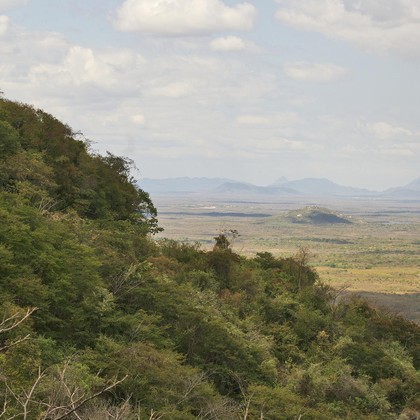
Caatinga, from open scrub to tall, closed dry forest, also gallery forest, the humid upland forests (brejos) and the edges of seasonal forest; less often cerrado and rocky slopes. From about 50 m to over 1000 m. It visits flowers in the understorey and shrub layer. The nest hangs from a leaf or twig; breeding takes place mainly in December–February.
Where the bird is most at home, classified by the vegetation units of Amazonia and the Guianas.



Range and movements
Only in Brazil, in the north-east: in Piauí, Ceará, Rio Grande do Norte, Paraíba, Pernambuco, Alagoas, Sergipe and Bahia, south to northern Minas Gerais. The known range has grown through recent records, especially on the margins of the caatinga. Absent from Amazonia, Venezuela and the Guianas. Does not occur outside the guide area.
- Resident
- dark = core range, pale = thinly spread
How and when to look
Search flowering shrubs in tall caatinga and dry forest, for example on the Chapada do Araripe, in the Serra de Baturité or around the Chapada Diamantina. Look for the short, broad tail and the orange-rufous rump.
Conservation status
Least Concern. The species is partly dependent on forest and suffers locally from the clearing of caatinga and dry forest for farming and charcoal.
Scientific name
Anopetia gounellei | (Boucard, 1891)
Boucard described the species in 1891 as Phaetornis gounellei; because it was later moved to another genus, the author and year stand in brackets. The genus Anopetia was introduced in 1918 by Simon. Anopetia is Greek, from an- 'without, not' and opeas, opeatos 'awl': 'not awl-like', probably after the broad bill tip. gounellei honours the French entomologist Pierre Émile Gounelle (1850–1914), who collected in Brazil. The specimen the first description was based on came from Santo Antônio da Barra, Bahia, Brazil.