All species › Passerines › Tyrant flycatchers and allies › Brown-breasted Bamboo Tyrant
Brown-breasted Bamboo Tyrant | Hemitriccus obsoletus
Bruinborsttodietiran | Titirijí pechipardo | Catraca
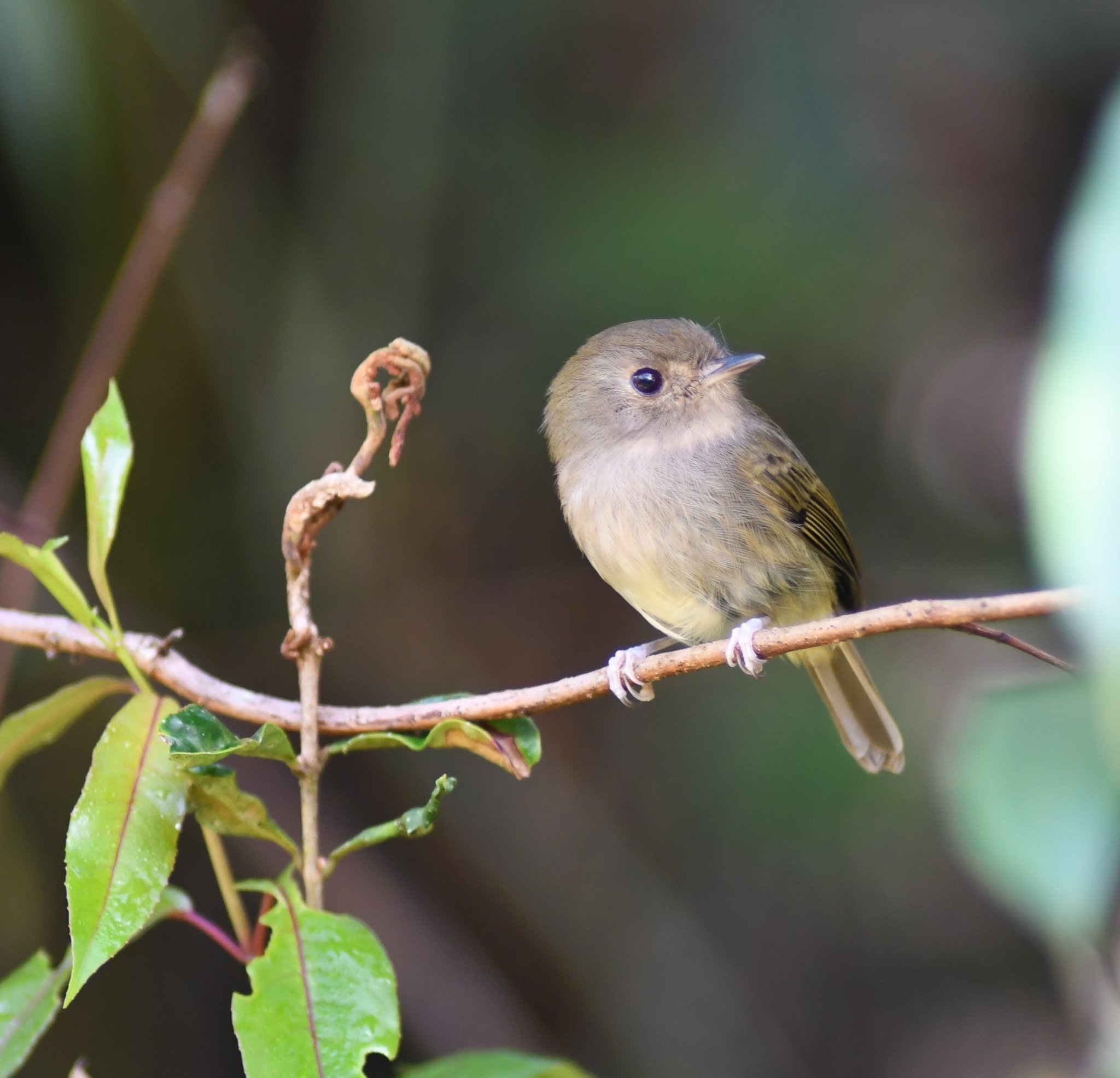
The Brown-breasted Bamboo Tyrant is a small, brownish olive-green flycatcher of bamboo in the montane forests of south-eastern Brazil. It lives higher up than the related Drab-breasted Bamboo Tyrant and reaches into Araucaria forest. The dry rattle to which the Portuguese name catraca refers is often the first clue.
Voice
A dry, fast rattle trrrrr and short ticking notes, low in the bamboo.
Recording: Luiz C. Silva — CC BY-NC-SA 4.0 · xeno-canto
Identification
11 cm, with a flat bill and a long tail. The upperparts are olive-brown to brownish olive-green, the wings dark with narrow pale edges. The side of the head is plain, without a distinct loral spot. The throat is dirty white, the breast warm grey-brown, the belly yellowish white. The eye is dark. The sexes are alike; juveniles are duller.
Confusion species
Drab-breasted Bamboo Tyrant Hemitriccus diops has a whitish loral spot and a cooler, greyer breast, and usually lives lower down. Kaempfer's Tody-Tyrant Hemitriccus kaempferi lives in the lowlands of Santa Catarina and Paraná, outside the mountain belt of this species. Eared Pygmy Tyrant Myiornis auricularis is smaller, with a short tail, a black ear spot and a yellow belly.
Habitat
Bamboo-rich understorey, especially Chusquea, in humid montane forest and Araucaria forest, mostly from about 700 to 2200 m, lower in the south. It forages singly or in pairs low in the bamboo and takes insects from leaves with short sallies. The nest is, as in related species, a closed hanging nest.
Where the bird is most at home, classified by the vegetation units of Amazonia and the Guianas.



Range and movements
Brazil: in the mountains of the south-east and south, from southern Minas Gerais and Rio de Janeiro through São Paulo, Paraná and Santa Catarina to Rio Grande do Sul. Absent from Venezuela and the Guianas. Outside the guide area in north-eastern Argentina (Misiones).
- Resident
- dark = core range, pale = thinly spread
How and when to look
Search the bamboo understorey of montane forest in the Serra da Mantiqueira and the Serra do Mar and Araucaria forest in the south; listen for the dry rattle and wait until the bird perches briefly in the open.
Conservation status
Least Concern. The species is tied to montane forest with bamboo; loss and fragmentation of forest in south-eastern Brazil may locally affect its population.
Scientific name
Hemitriccus obsoletus | (Miranda-Ribeiro, 1905)
Miranda-Ribeiro described the species in 1905 as Musciphaga obsoleta; because it was later moved to another genus, the author and year stand in brackets. The genus Hemitriccus was introduced in 1860 by Cabanis & Heine. Hemitriccus is Greek, from hēmi- 'half, small' and trikkos, an unidentified small bird; in ornithology triccus denotes a tyrant flycatcher: 'small tyrant'. obsoletus is Latin for 'indistinct, plain', after the plain, sparsely marked plumage. The specimen the first description was based on came from Itatiaia, Rio de Janeiro, Brazil.