All species › Passerines › Tanagers and allies › Brown Tanager
Brown Tanager | Orchesticus abeillei
Vostangare | Tangara parda | Sanhaço-pardo
The Brown Tanager is a brown and cinnamon tanager of the montane Atlantic Forest of south-east Brazil and the only species in its genus. In colour and behaviour it closely resembles a foliage-gleaner, and it often forages with them in the same mixed flocks in the canopy. It occurs only in Brazil.
Voice
The dawn song is a series of very high sis notes ending in a weak hiss. The call is a high, twittering sound.
Recording: JAYRSON ARAUJO DE OLIVEIRA — CC BY-NC-SA 4.0 · xeno-canto
Identification
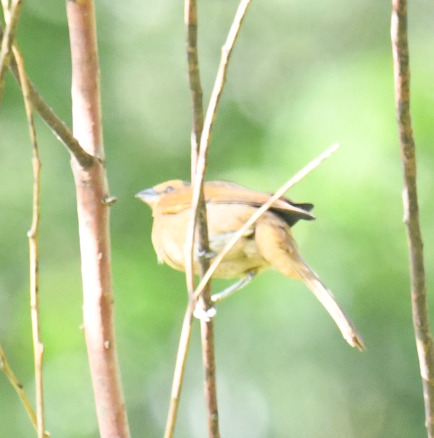
17–18 cm, with a thick, blackish bill and a fairly long tail. The face is cinnamon with a thin blackish line through the eye; back and crown are mid-brown, the wing coverts cinnamon-rufous and the tail has a rusty tinge. The underparts are cinnamon-buff. The iris is dark red. The sexes are alike; juveniles are duller.
Confusion species
Buff-fronted Foliage-gleaner Dendroma rufa has almost the same colours and searches for insects in the same mixed flocks, but has a thinner, straight bill, climbs more along branches and has a different call. Cinnamon Tanager Schistochlamys ruficapillus is blue-grey above, with only the head and breast cinnamon. Females of other Atlantic Forest tanagers are olive-green or grey, not brown.
Habitat
Canopy and upper levels of humid montane and cloud forest, also araucaria forest, mostly between 750 and 1500 m. It forages in pairs or small groups, often in mixed flocks, picking and probing among leaves, mosses and bromeliads for insects; it also eats some fruit. One nest has been described, in a bromeliad against a trunk, with two pinkish-white eggs with reddish blotches.
Where the bird is most at home, classified by the vegetation units of Amazonia and the Guianas.



Range and movements
Brazil: in the south-east, from southern Bahia through Minas Gerais, Espírito Santo, Rio de Janeiro and São Paulo to eastern Paraná and Santa Catarina, mainly in the Serra do Mar and the Serra da Mantiqueira. Not in Venezuela, Guyana, Suriname or French Guiana. It does not occur outside the guide area.
- Resident
- dark = core range, pale = thinly spread
How and when to look
Look in mixed flocks in the canopy of montane forest, for example in Itatiaia and Serra dos Órgãos national parks. Check every foliage-gleaner in the canopy for the thick bill.
Conservation status
Near Threatened (IUCN). The species is scarce and probably declining slowly through the loss of montane forest; protected areas are isolated and most unprotected forest is under pressure from clearing.
Scientific name
Orchesticus abeillei | (Lesson, 1839)
Lesson described the species in 1839 as Pyrrhula Abeillei; because it was later moved to another genus, the author and year stand in brackets. The genus Orchesticus was introduced in 1851 by Cabanis. Orchesticus is Greek orkhēstikos 'good at dancing', from orkheomai 'to dance', a nod to the related Saltator ('dancer'). abeillei honours the French physician and ornithologist Grégoire Abeillé (1798–1848), a collector in Bordeaux. The specimen the first description was based on came from Brazil (Rio de Janeiro proposed).