All species › Passerines › Shrike-babblers, Erpornis and vireos › Buff-cheeked Greenlet
Buff-cheeked Greenlet | Pachysylvia muscicapina
Bruinwangvireo | Verdillo atrapamoscas | Vite-vite-camurça
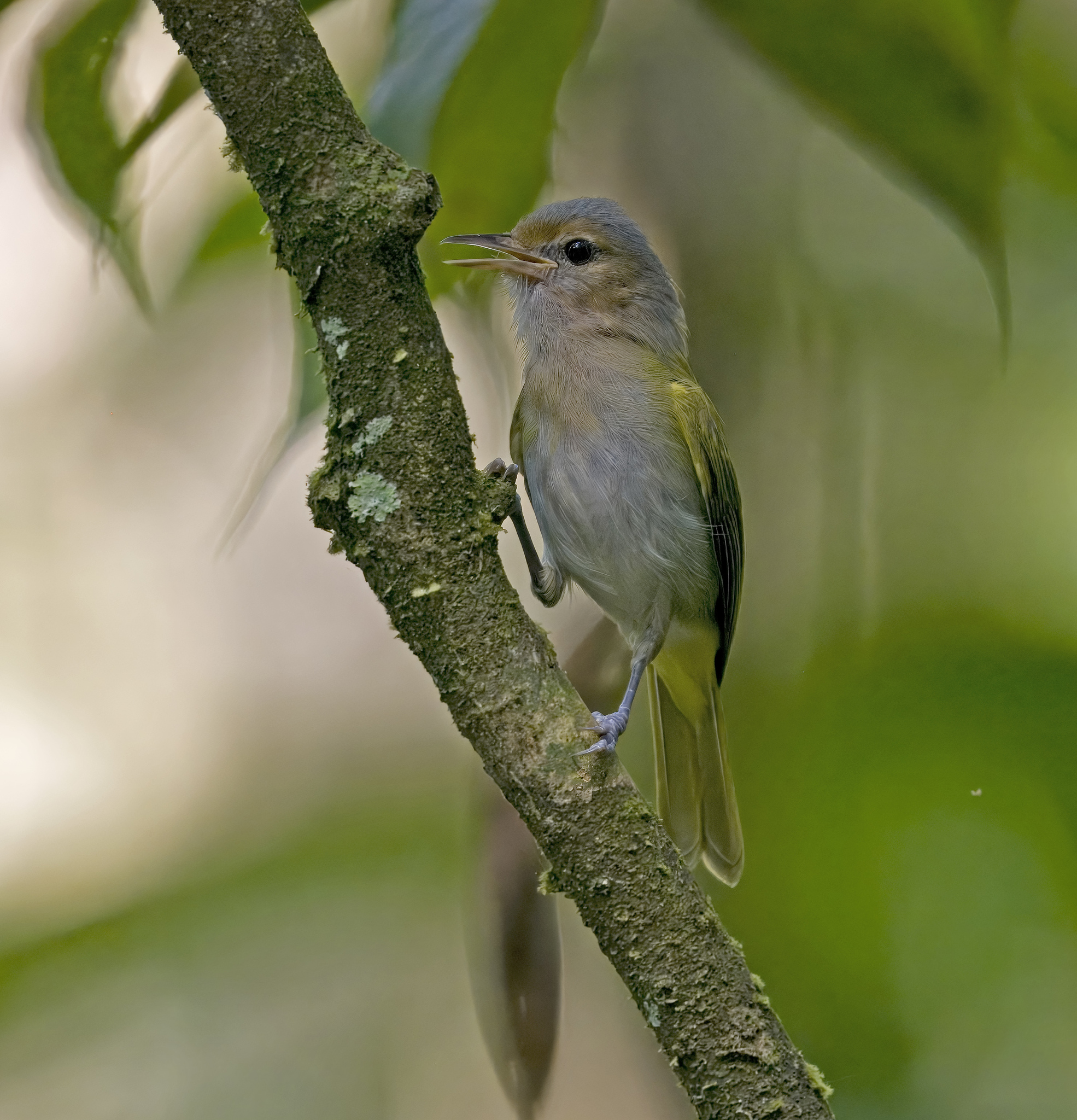
The Buff-cheeked Greenlet is a small, green vireo of the canopy of humid lowland forest in northern and eastern Amazonia and the Guianas, with a grey crown and a buffy face. It moves in pairs or family groups with mixed flocks of insect-eaters high in the trees. Of all canopy vireos in the Guianas it is one of the most frequently recorded.
Voice
The song is a high, warbling phrase, roughly weet-oh-weereet, often repeated at length from the canopy. The call consists of short, nasal notes.
Recording: Niall Perrins — CC BY-NC-SA 4.0 · converted to mono · xeno-canto
Identification
11.5–12 cm, with a fairly short tail; upper mandible blackish, lower mandible pink. Forehead greyish brown, crown and nape blue-grey, with a buffy supercilium and dark grey mottled ear-coverts. Back olive-green, rump paler; wings dark with broad green edges. Throat off-white, breast greyish buff, belly greyish white, flanks yellowish. Eye dark. The sexes are alike. Birds south of the Amazon (griseifrons) have a pure grey forehead, a warmer buffy face and a buffier throat and breast.
Confusion species
Dusky-capped Greenlet Pachysylvia hypoxantha has a brown cap and yellowish underparts without a buffy face and lives further west. Lemon-chested Greenlet Hylophilus thoracicus has a pale eye, a more pointed pale bill and a yellow breast band. Ashy-headed Greenlet Hylophilus pectoralis also has a grey head, but a white throat and a yellow breast, and lives at forest edges, in mangroves and in more open country.
Habitat
Middle storey and canopy of humid terra firme forest, várzea and forest edges, in Brazil up to about 600 m and in Venezuela up to 1100 m; south of the Amazon also in gallery forest and transitional forest towards the cerrado. It actively searches leaves for insects and spiders, often hanging upside down, usually in pairs or family groups and often in mixed flocks. Little is known about the nest; in Venezuela it probably breeds from December to May.
Where the bird is most at home, classified by the vegetation units of Amazonia and the Guianas.





Range and movements
Brazil: north of the Amazon in Amapá, northern Pará, Roraima and eastern Amazonas; south of the Amazon between the Madeira and the Tapajós and further south into Mato Grosso and southern Goiás. Venezuela: in Amazonas, Bolívar and southern Delta Amacuro. Guyana, Suriname and French Guiana: widespread in the forested interior. Outside the guide area only in extreme north-eastern Bolivia.
- Resident
- dark = core range, pale = thinly spread
How and when to look
In the Guianas or around Manaus, look for mixed flocks in the canopy, preferably from a canopy tower or along a broad forest edge, and listen for the repeated, high song. In the interior of Suriname and French Guiana it is a regular member of such flocks.
Conservation status
Least Concern. The species has a very large range in largely intact forest; in the south, in Mato Grosso and Goiás, deforestation locally reduces its habitat.
Scientific name
Pachysylvia muscicapina | (Sclater & Salvin, 1873) (GBIF: Hylophilus muscicapinus)
Sclater & Salvin described the species in 1873 as Hylophilus muscicapinus; because it was later moved to another genus, the author and year stand in brackets. The genus Pachysylvia was introduced in 1850 by Bonaparte. Pachysylvia combines Greek pakhus 'thick, stout' with the genus Sylvia (warblers), after the stocky build. muscicapina is Latin, from muscicapa 'flycatcher' with -inus '-like': 'flycatcher-like'. The specimen the first description was based on came from Saint-Georges-de-l'Oyapock, French Guiana.