All species › Passerines › Ovenbirds and woodcreepers › Campo Miner
Campo Miner | Geositta poeciloptera
Camposholengraver | Minero brasileño | Andarilho
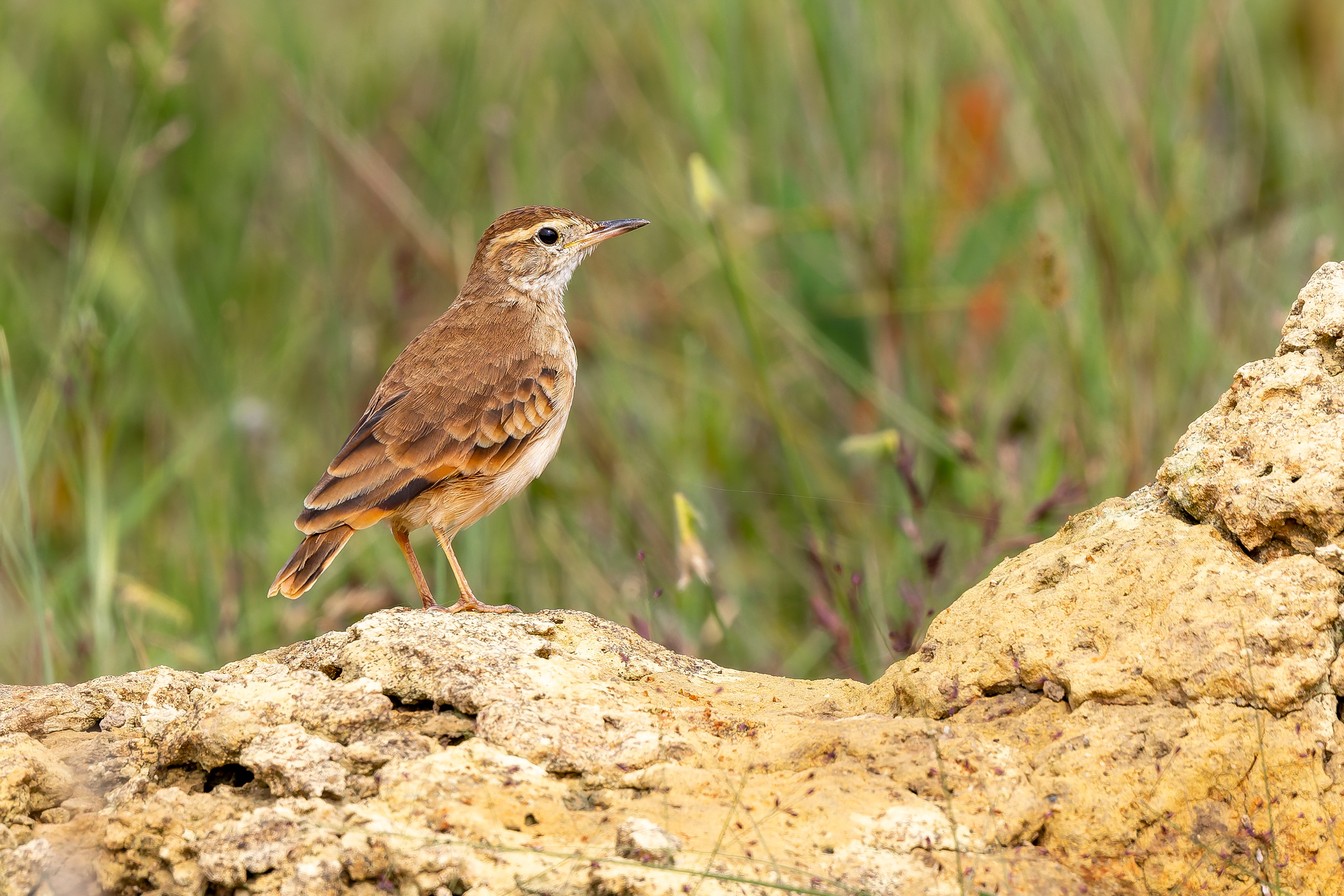
The Campo Miner is a small, short-tailed miner of the open grasslands of the Cerrado and an endemic of central South America, almost entirely restricted to Brazil. It seeks out short, recently burned grassland and moves with the fires. The species is listed as Vulnerable.
Voice
The song is a fast, dry series of high notes, tsi-tsi-tsi-tsirrr, often given in a display flight in which the bird rises and glides down singing on quivering wings. The call is a short, high tseep.
Recording: Dante Buzzetti — CC BY-NC-SA 4.0 · xeno-canto
Identification
12–13 cm, compact, with a short, thin, slightly decurved bill, fairly long legs and a short tail. The upperparts are greyish brown with a sandy tinge, with a faint pale supercilium. The underparts are pale sandy, the breast finely streaked or spotted brown. In flight a broad cinnamon-rufous wing band stands out against blackish flight feathers, and the tail shows a rufous base and a broad black terminal band. The sexes are alike; juveniles are more scaled on the upperparts.
Confusion species
Common Miner Geositta cunicularia is larger, with a longer bill and a more heavily streaked breast, and occurs only in southern Brazil. Pipits such as Yellowish Pipit Anthus lutescens are slimmer, with a streaked back and white outer tail feathers. Wedge-tailed Grass Finch Emberizoides herbicola has a long, pointed tail and lives in taller grass.
Habitat
Short, open grassland of the Cerrado (campo limpo and campo sujo) and campo rupestre, often on recently burned ground with short new grass shoots; inland on plateaus between about 500 and 1300 m. It walks over the bare ground and picks up insects and other invertebrates. It breeds in a burrow in an earth bank, a termite mound or an abandoned armadillo hole. It follows the fires and therefore moves locally through the year.
Where the bird is most at home, classified by the vegetation units of Amazonia and the Guianas.


Range and movements
Brazil: widespread but scarce and local in the Cerrado of the interior, from Mato Grosso and Mato Grosso do Sul east to Goiás, the Distrito Federal, Tocantins, western Bahia and Minas Gerais; formerly also in São Paulo and Paraná, where it has now almost disappeared. Absent from Venezuela, Guyana, Suriname and French Guiana. Outside the guide area only a few old records from eastern Bolivia.
- Resident
- dark = core range, pale = thinly spread
How and when to look
In the open grassland of Emas National Park, the Serra da Canastra and Brasília National Park, especially on patches burned a few weeks to months earlier. Watch in the early morning for the song flight over the grassland and for a small, short-tailed bird flying up low with rufous in the wings and tail.
Conservation status
Vulnerable. The natural grasslands of the Cerrado have been widely converted to cropland and pasture, and the species depends on open, regularly burned grassland; in protected areas where fire is suppressed the grassland grows dense and it disappears.
Scientific name
Geositta poeciloptera | (Wied-Neuwied, 1830)
Wied-Neuwied described the species in 1830 as Anthus poecilopterus; because it was later moved to another genus, the author and year stand in brackets. The genus Geositta was introduced in 1837 by Swainson. Geositta is Greek, from gē 'earth' and the genus Sitta 'nuthatch', because these ground birds were once classified with the nuthatches. poeciloptera is Greek, from poikilos 'variegated' and pteron 'wing', after the patterned wings. The specimen the first description was based on came from Minas Gerais–Bahia border, Brazil.