All species › Tubenoses › Petrels, shearwaters and diving petrels › Cape Verde Petrel
Cape Verde Petrel | Pterodroma feae
Gon-gon | Petrel Gon-gon | Freira-de-cabo-verde
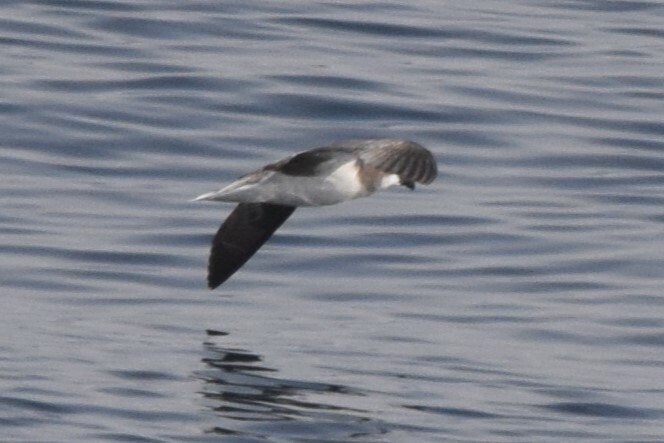
Cape Verde Petrel is a medium-sized grey and white Pterodroma that breeds only on the Cape Verde Islands and owes its local name gon-gon to its call in the colony. Outside the breeding season it ranges through the tropical and subtropical Atlantic. In the guide area it is a rare vagrant at sea; every record calls for careful documentation.
Voice
Silent at sea. In the colony at night a plaintive, wailing gon-gon, from which the species takes its local name.
Recording: Nicolas Martinez — CC BY-NC-SA 4.0 · xeno-canto
Identification
33–36 cm, slender, with long wings and a fairly heavy black bill. The upperparts are grey with a dark M-pattern across the wings; rump and tail are paler grey and contrast with the dark primaries. Crown and hindneck are grey, with a blackish mask around and below the eye. The underparts are white, with at most a grey patch on the side of the breast. The underwing is almost entirely dark grey-brown. The legs are flesh-coloured with dark toes. Sexes and ages are alike. It flies fast, with high arcs and short series of wingbeats.
Confusion species
Zino's Petrel Pterodroma madeira and Desertas Petrel Pterodroma deserta cannot be separated with certainty from Cape Verde Petrel at sea; such birds are recorded as Fea's-type petrels. Soft-Plumaged Petrel Pterodroma mollis, the most likely confusion species off southern Brazil, usually has a grey breast band, darker and less contrasting upperparts, a dark tail and a slightly slimmer bill. Pale Trindade Petrels Pterodroma arminjoniana have a dark head and breast band and a pale patch at the base of the primaries on the underwing.
Habitat
Deep, warm open ocean, especially over seamounts and in areas with upwelling of cool water. It eats mainly squid and small fish, picked from the surface at night. It does not breed in the guide area; outside it, it nests in burrows and crevices on steep mountain slopes of the Cape Verde Islands.
Where the bird is most at home, classified by the vegetation units of Amazonia and the Guianas.

Range and movements
In the guide area only a few records at sea, off French Guiana and off Brazil; because of the similarity to Zino's and Desertas Petrels the species can rarely be confirmed. Not known from Venezuela, Guyana or Suriname. Outside the guide area the species breeds only on the Cape Verde Islands and outside the breeding season ranges through the tropical and subtropical Atlantic.
How and when to look
There is no site where this species can be expected. On pelagic trips over deep water, look for a Soft-Plumaged-like bird without a breast band, with a pale grey rump and tail contrasting with dark wings, and photograph the upper- and underside and the bill in side view.
Conservation status
Near Threatened. The world population is small, at most a few thousand pairs. The colonies are threatened by the taking of chicks and adults for food, by cats and rats and by disturbance of the breeding slopes. On some islands the colonies are guarded.
Scientific name
Pterodroma feae | (Salvadori, 1899)
Salvadori described the species in 1899 as Oestrelata feae; because it was later moved to another genus, the author and year stand in brackets. The genus Pterodroma was introduced in 1856 by Bonaparte. Pterodroma is Greek, from pteron 'wing' and dromos 'runner', after the fast, sweeping flight. feae honours the Italian zoologist Leonardo Fea (1852–1903), who collected in the Cape Verde Islands. The specimen the first description was based on came from São Nicolau, Cape Verde.