All species › Passerines › Ovenbirds and woodcreepers › Ceara Woodcreeper
Ceara Woodcreeper | Xiphorhynchus atlanticus
Cearamuisspecht | Trepatroncos de Ceará | Arapaçu-rajado-do-nordeste
The Ceara Woodcreeper is a small, slim woodcreeper found only in north-eastern Brazil, in the forest remnants north of the Rio São Francisco and on the humid forest islands in the caatinga. It was long treated as a subspecies of Lesser Woodcreeper and is now regarded as a separate species. Because of forest loss it is vulnerable.
Voice
The song resembles that of Lesser Woodcreeper, a fast, sharp series of notes, but starts with fewer and sharper notes and ends in a rising trill. The call is a very high, sharp fee-eet fee-eet.
Recording: Mateus Gonçalves Santos — CC BY-NC-SA 4.0 · converted to mono · xeno-canto
Identification
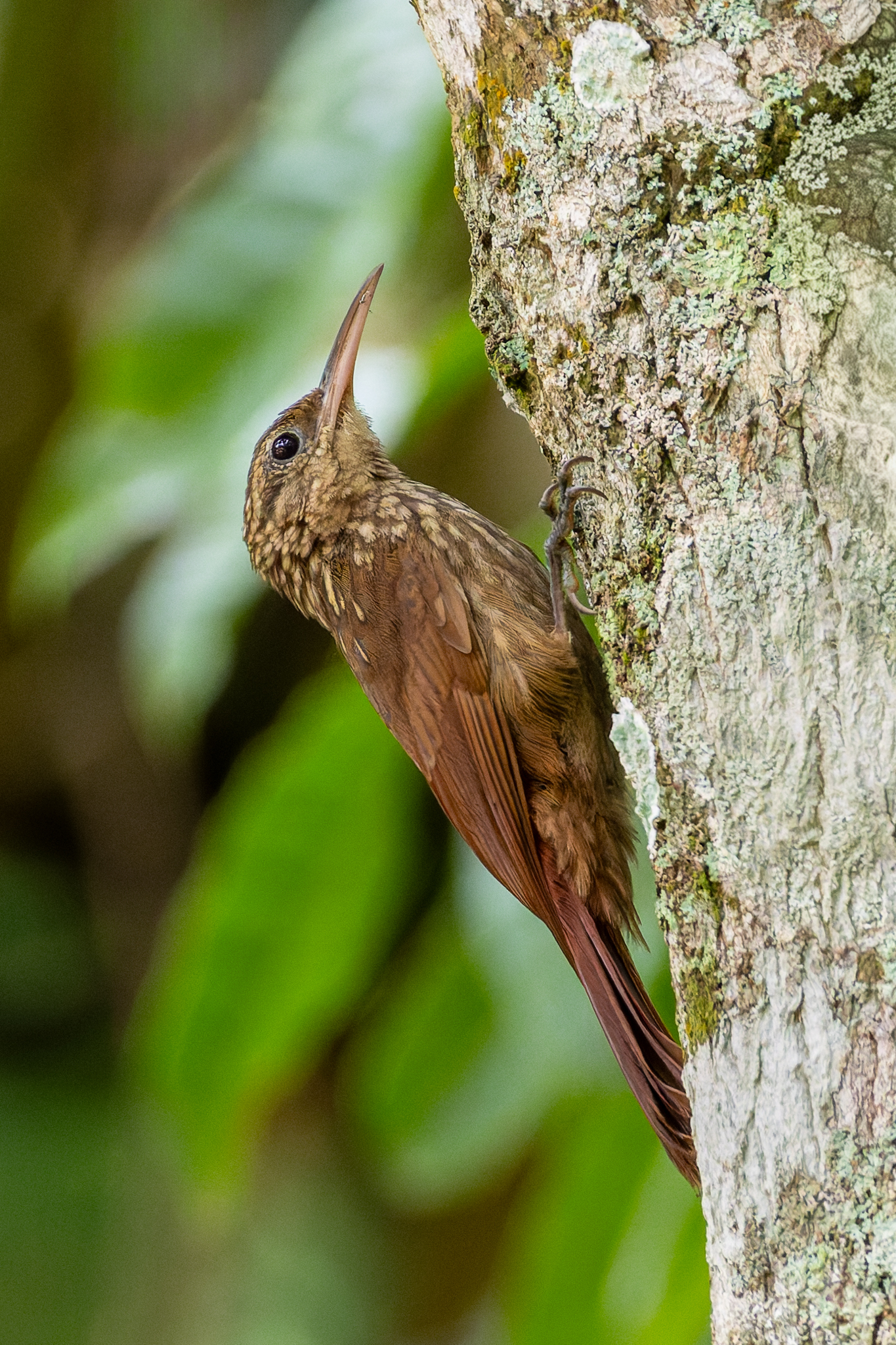
15–18 cm, slim, with a fairly large head and a fairly long, slightly decurved bill. The face is dusky, with a creamy to buff supercilium. Crown and nape are dark brown with small pale spots, the back olive-brown. Flight feathers, rump and tail are rufous. The throat is pale yellowish; breast and belly are ochre-brown with dark-edged pale spots, giving a scaly pattern. The sexes are alike.
Confusion species
Buff-throated Woodcreeper Xiphorhynchus guttatus occurs in the same forests but is much larger, with a long, heavy bill. Olivaceous Woodcreeper Sittasomus griseicapillus is smaller and plain greyish olive, without spots, with a short, thin bill. Wedge-billed Woodcreeper Glyphorynchus spirurus is smaller, with a very short, wedge-shaped bill. Lesser Woodcreeper Xiphorhynchus fuscus is almost identical but lives south of the Rio São Francisco, outside this part of the guide area.
Habitat
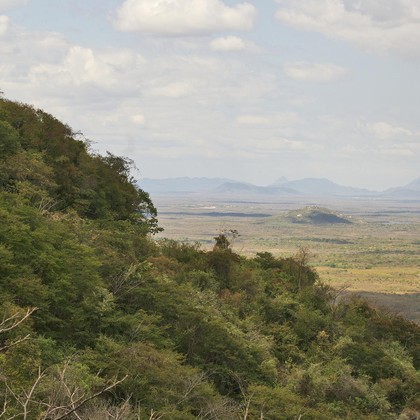
Humid lowland and hill forest, old and mature secondary forest, and the brejos: humid forest islands on hills and plateaus in the caatinga, up to about 600 m. It climbs trunks and branches in the lower and middle strata, often with mixed flocks, and searches bark, moss and bromeliads for insects and spiders. The nest is in a cavity or crevice in a trunk.
Where the bird is most at home, classified by the vegetation units of Amazonia and the Guianas.

Range and movements
Brazil: only in the north-east, from Ceará, including the Serra de Baturité, south to Alagoas, north of the Rio São Francisco, with forest remnants in Pernambuco and Paraíba. Absent from Venezuela, Guyana, Suriname and French Guiana. Does not occur outside the guide area.
- Resident
- dark = core range, pale = thinly spread
How and when to look
Look in the forests of the Serra de Baturité in Ceará or in the forest remnants of Alagoas and Pernambuco, such as at Murici, for mixed flocks in the understorey. The high fee-eet call helps to find it among the trunks.
Conservation status
Vulnerable. The population is estimated at 5000 to 11,000 mature individuals and is declining. The forest north of the Rio São Francisco has largely been cleared for sugar cane and other agriculture and by urban growth; selective logging also degrades the remaining fragments.
Scientific name
Xiphorhynchus atlanticus | (Cory, 1916) (GBIF: Xiphorhynchus fuscus)
Cory described the species in 1916 as Picolaptes fuscus atlanticus; because it was later moved to another genus, the author and year stand in brackets. The genus Xiphorhynchus was introduced in 1827 by Swainson. Xiphorhynchus is Greek, from xiphos 'sword' and rhunkhos 'bill', after the long, straight bill. atlanticus is Latin for 'Atlantic', after its range in the Atlantic Forest of northeastern Brazil. The specimen the first description was based on came from Serra de Baturité, Ceará, Brazil.