All species › Woodpeckers and allies › Woodpeckers › Chestnut Piculet
Chestnut Piculet | Picumnus cinnamomeus
Rosse dwergspecht | Carpinterito castaño | Picapauzinho-castanho
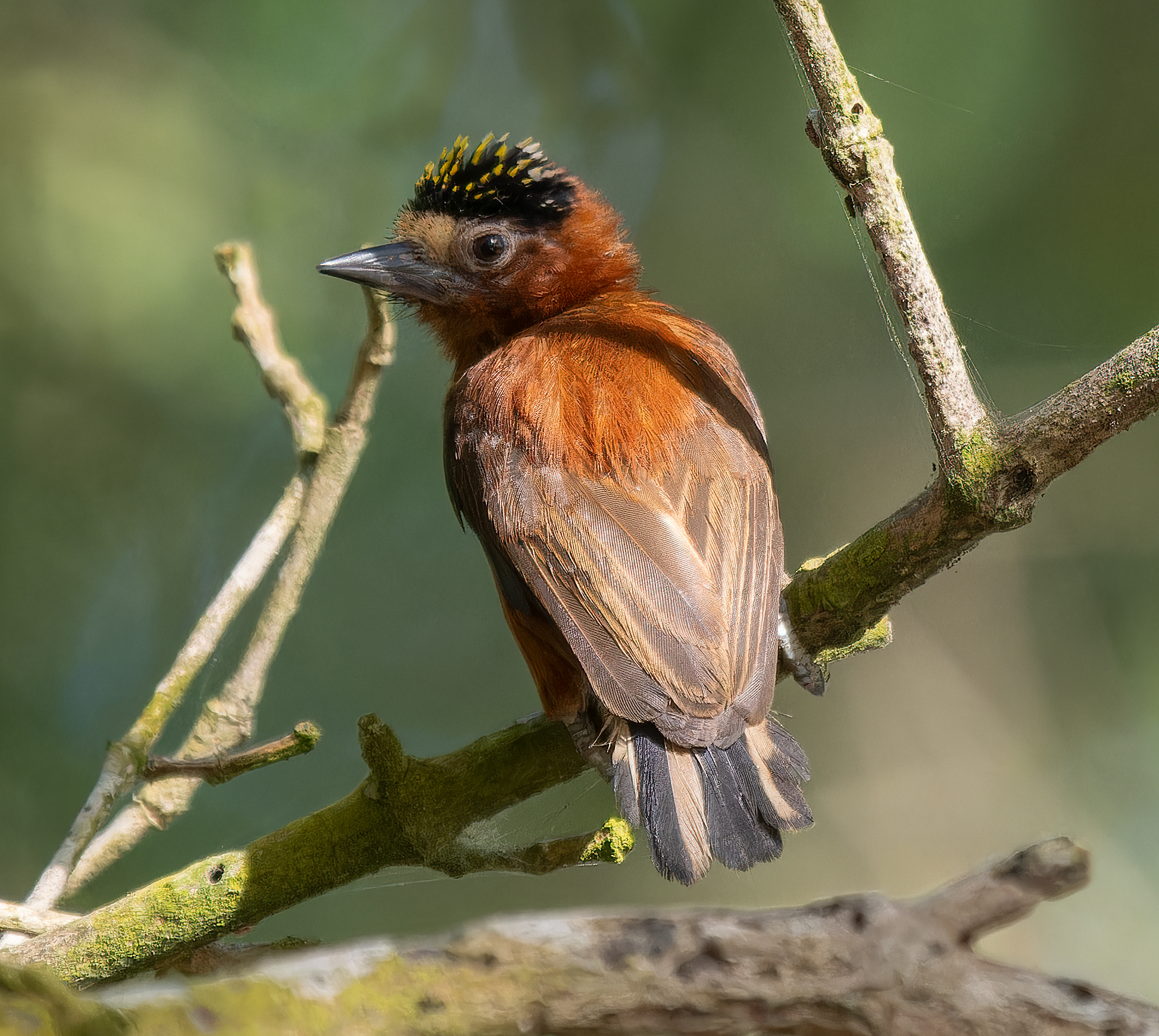
Chestnut Piculet is a chestnut-coloured piculet of the dry lowlands along the Caribbean coast of Colombia and north-western Venezuela. In the guide area it occurs only around Lake Maracaibo. Its almost entirely rufous-brown body sets it apart from all other piculets in the guide area.
Voice
A high, thin trill and sharp, short tsit calls. Also soft tapping on thin twigs.
Recording: Bernabe Lopez-Lanus — CC BY-NC-SA 3.0 · xeno-canto
Identification
9–10 cm, with a short, straight, grey bill and a short tail. The head, upperparts and underparts are deep chestnut. The forehead is pale, buff to dull white depending on the subspecies. The crown is black; in the male with yellow dots, in the female with white dots. The wings are brownish, the tail black with pale stripes. The sexes differ only in the colour of the crown dots.
Confusion species
No other piculet in the guide area has an all-chestnut body. Scaled Piculet Picumnus squamulatus, in northern Venezuela, is pale with dark scales above and below. Olivaceous Piculet Picumnus olivaceus, in more humid forest south of the lake and on the mountain slopes, is olive-brown with a yellowish belly.
Habitat
Dry and semi-dry deciduous forest, thorn scrub, gallery forest, mangroves and forest edges in the lowlands, from sea level to about 300 m. It searches thin twigs, vines and dry stems for ants, larvae and other small insects, often in pairs or in mixed flocks. It excavates a nest hole in a thin, dead branch.
Where the bird is most at home, classified by the vegetation units of Amazonia and the Guianas.


Range and movements
In Venezuela only in the north-west, mainly in Zulia around Lake Maracaibo, and locally in the adjacent states. Not in Brazil or the Guianas. Outside the guide area in the Caribbean lowlands of Colombia, from the Cartagena area and the lower Magdalena east to La Guajira and Cesar.
- Resident
- dark = core range, pale = thinly spread
How and when to look
Search dry forest, thorn scrub and the edges of mangroves around Lake Maracaibo. Listen for tapping on thin twigs and follow mixed flocks of small birds.
Conservation status
Least Concern. The range is limited and the dry forest around Lake Maracaibo is heavily fragmented, but the species tolerates scrub and secondary forest.
Scientific name
Picumnus cinnamomeus | Wagler, 1829
Wagler described the species in 1829 and placed it straight away in the genus where it still stands. The genus Picumnus was introduced in 1825 by Temminck. Picumnus comes from French picumne 'piculet', after Picumnus, in Roman mythology the personification of the woodpecker. cinnamomeus is Latin for 'cinnamon-coloured', after the warm chestnut plumage. The specimen the first description was based on came from Cartagena, Colombia.