All species › Passerines › Tyrant flycatchers and allies › Cinnamon Neopipo
Cinnamon Neopipo | Neopipo cinnamomea
Kaneelmanakin | Neopipo canelo | Enferrujadinho
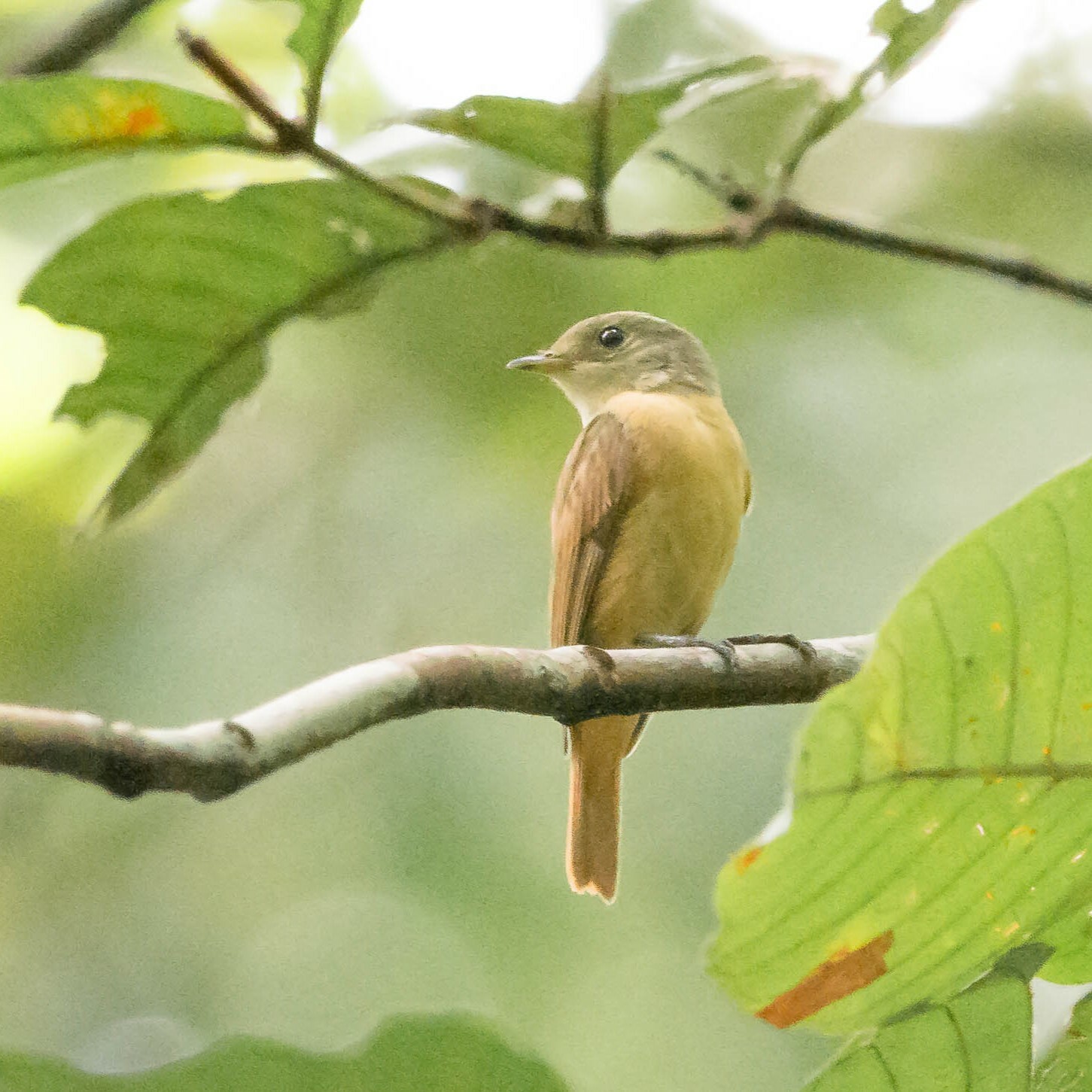
The Cinnamon Neopipo is a very small, cinnamon-brown tyrant flycatcher of the lower storey of lowland forest in Amazonia and the Guianas. In colour and posture it closely resembles Ruddy-tailed Flycatcher; it was long placed with the manakins but is now placed with the tyrant flycatchers. Relatively few records are known from its whole range.
Voice
A high, thin series of whistles that accelerates and falls in pitch; also short, sharp calls.
Recording: JAYRSON ARAUJO DE OLIVEIRA — CC BY-NC-SA 4.0 · xeno-canto
Identification
9–10 cm, with a rounded head and a small, narrow bill. The head and nape are grey, with a concealed yellow to orange-yellow crown stripe. The back is olive brown, merging into a cinnamon rump and tail; the wings are dark with rufous edges. The throat and underparts are cinnamon, the belly paler. The sexes are almost alike.
Confusion species
Ruddy-tailed Flycatcher Terenotriccus erythrurus is the most similar, but has a browner head without a yellow crown stripe and a brighter rufous tail. Dwarf Tyrant-Manakin Tyranneutes stolzmanni and Tiny Tyrant-Manakin Tyranneutes virescens are olive green and lack the cinnamon colour. Whiskered Myiobius Myiobius barbatus has a yellow rump and a dark tail.
Habitat
The lower and middle storeys of humid terra firme lowland forest, often on poor, sandy soils and in white-sand forest, up to about 900 m. It perches upright on thin twigs and catches insects in short sallies to leaves. Little is known about the nest.
Where the bird is most at home, classified by the vegetation units of Amazonia and the Guianas.


Range and movements
In Brazil scattered through Amazonia, north and south of the Amazon, east into Pará. In Venezuela in the south, in Amazonas and Bolívar. In Guyana, Suriname and French Guiana locally in the interior. Scarce and local everywhere. Outside the guide area in the Amazonian lowlands of Colombia, Ecuador and Peru.
- Resident
- dark = core range, pale = thinly spread
How and when to look
Search the lower storey of tall, undisturbed terra firme forest, especially on sandy soils, and check every Ruddy-tailed Flycatcher for a grey head and a yellow crown stripe. The song helps with identification.
Conservation status
Least Concern. The species has a large range in still largely forested country, but is scarce everywhere.
Scientific name
Neopipo cinnamomea | (Lawrence, 1869)
Lawrence described the species in 1869 as Pipra ? cinnamomea; because it was later moved to another genus, the author and year stand in brackets. The genus Neopipo was introduced in 1869 by Sclater & Salvin. Neopipo is Greek-Latin, from neos 'new, strange' and pipo 'manakin': a 'new manakin', as the bird was first placed among the manakins. cinnamomea is Latin for 'cinnamon-coloured', after the cinnamon-brown plumage. The specimen the first description was based on came from Chamicuros, Peruvian Amazon.