All species › Nightjars › Nightjars and nighthawks › Common Nighthawk
Common Nighthawk | Chordeiles minor
Amerikaanse nachtzwaluw | Añapero yanqui | Bacurau-norte-americano
Common Nighthawk is a long-winged migrant from North America that winters in South America. It hunts high with an erratic, swallow-like flight, often by day and in flocks on migration. A large part of the population winters in Brazil, from Amazonia to the Cerrado and the south.
Voice
A nasal, buzzy peent in flight, mainly on the breeding grounds; usually silent in the guide area. In display in North America the male dives with a booming wing sound.
Recording: Trent R. Stanley — CC BY-NC-SA 4.0 · shortened to the first 60 s, mono · xeno-canto
Identification
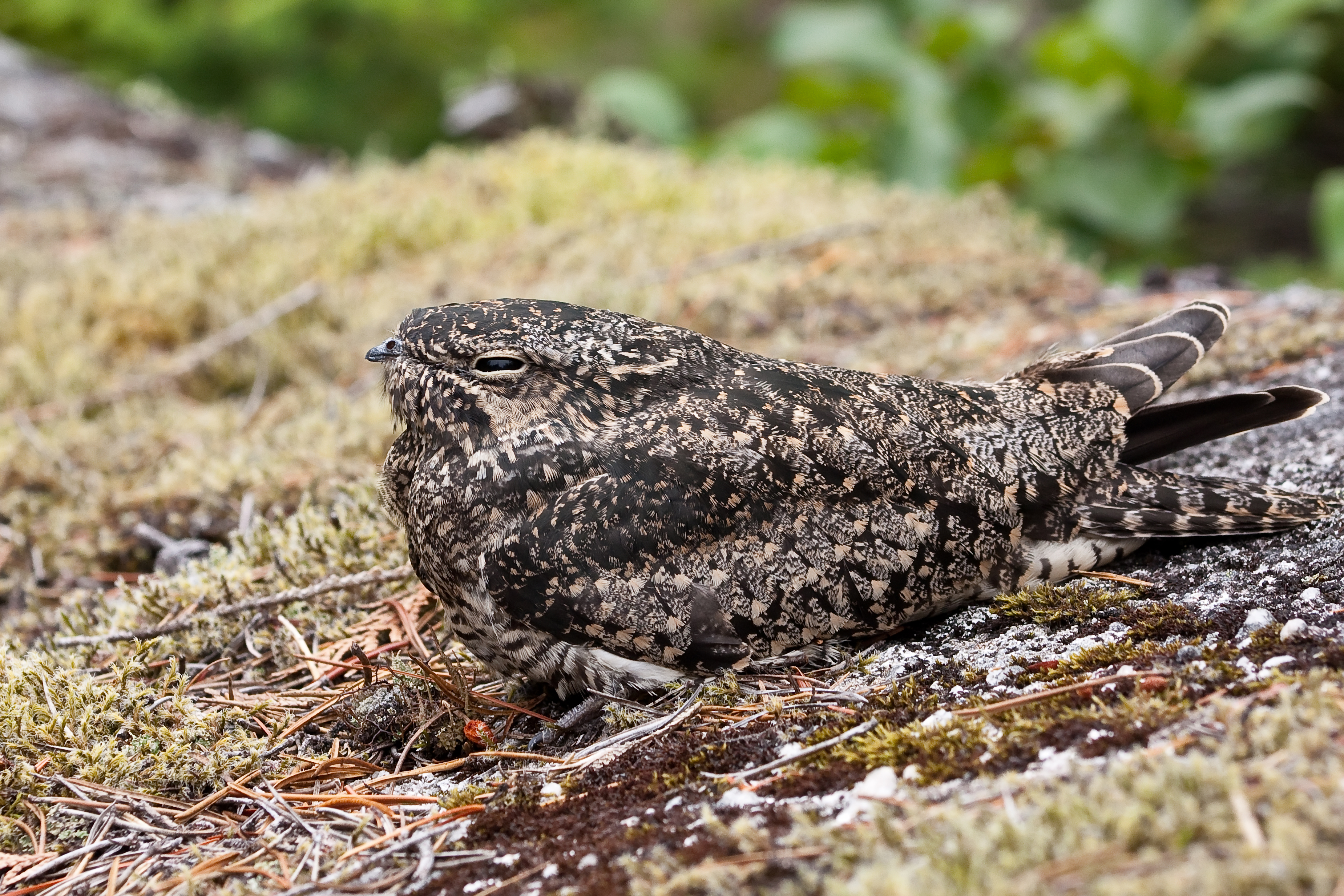
22–25 cm, with long, pointed wings that reach beyond the tail tip at rest, and a forked tail. The upperparts are grey-brown to blackish-brown, speckled with grey and ochre. The underparts are white or ochre with dense dark barring. The male has a white throat patch, a broad white band halfway along the primaries and a white band near the tail tip; the female has an ochre throat, a narrower wing band and no tail band. Young birds are greyer, with pale feather edges.
Confusion species
Lesser Nighthawk Chordeiles acutipennis is slightly smaller, with shorter, blunter wings, the white band closer to the wingtip and buff spots on the primaries; it usually hunts lower. Nacunda Nighthawk Chordeiles nacunda is much larger, with a white belly and a short tail. Short-tailed Nighthawk Lurocalis semitorquatus has broad wings without a white band and a short tail. Antillean Nighthawk Chordeiles gundlachii, a rare vagrant, is slightly smaller and buffier below and is told mainly by its call.
Habitat
On migration and in winter over all kinds of open landscape: savanna, cerrado, rivers, forest edges, the canopy of lowland forest and cities, from the lowlands into the mountains. It hunts flying insects high in the air, by day and at dusk, often in loose flocks. It breeds only in North and Central America, laying its eggs on bare ground or on gravel roofs.
Where the bird is most at home, classified by the vegetation units of Amazonia and the Guianas.





Range and movements
Passage migrant and winter visitor throughout the guide area. In Venezuela and the Guianas mainly a passage migrant in September–November and March–May, and rarely reported. In Brazil widespread, mainly in Amazonia, the Cerrado and the Pantanal, and south into the south of the country; in winter often in flocks over rivers, savannas and cities. Outside the guide area it breeds from Canada to Central America and winters in South America south to northern Argentina.
- Resident
- Winter visitor (c. Oct–Mar)
- Passage (Mar–Apr, Oct–Nov)
- dark = core range, pale = thinly spread
How and when to look
Look from October to March in the late afternoon for flocks hunting high over rivers, savannas and cities in Brazil, and on migration for flocks passing high overhead.
Conservation status
Least Concern, although the population in North America is declining, probably because of fewer insects and loss of nesting sites.
Scientific name
Chordeiles minor | (Forster, 1771)
Forster described the species in 1771 as Caprimulgus minor; because it was later moved to another genus, the author and year stand in brackets. The genus Chordeiles was introduced in 1832 by Swainson. Chordeiles is Greek, from khoreia 'dance' and deilē 'evening', after the dancing hunting flights at dusk. minor is Latin for 'smaller', distinguishing it from the larger nightjars it was first compared with. The specimen the first description was based on came from South Carolina (designated later).