All species › Passerines › Gnatwrens and gnatcatchers › Creamy-bellied Gnatcatcher
Creamy-bellied Gnatcatcher | Polioptila lactea
Crèmebuikmuggenvanger | Perlita blanca | Balança-rabo-leitoso
The Creamy-bellied Gnatcatcher is a small gnatcatcher of the Atlantic Forest canopy, with a black crown in the male and creamy-tinged underparts. In the guide area it lives only in southern Brazil. It was long considered Near Threatened owing to the loss of inland forest, but is now assessed as Least Concern.
Voice
The song is a short series of high, clear notes. The call is a soft, nasal, mewing sound, as in other gnatcatchers.
Recording: Marcos E. Sosa — CC BY-NC-SA 4.0 · xeno-canto
Identification
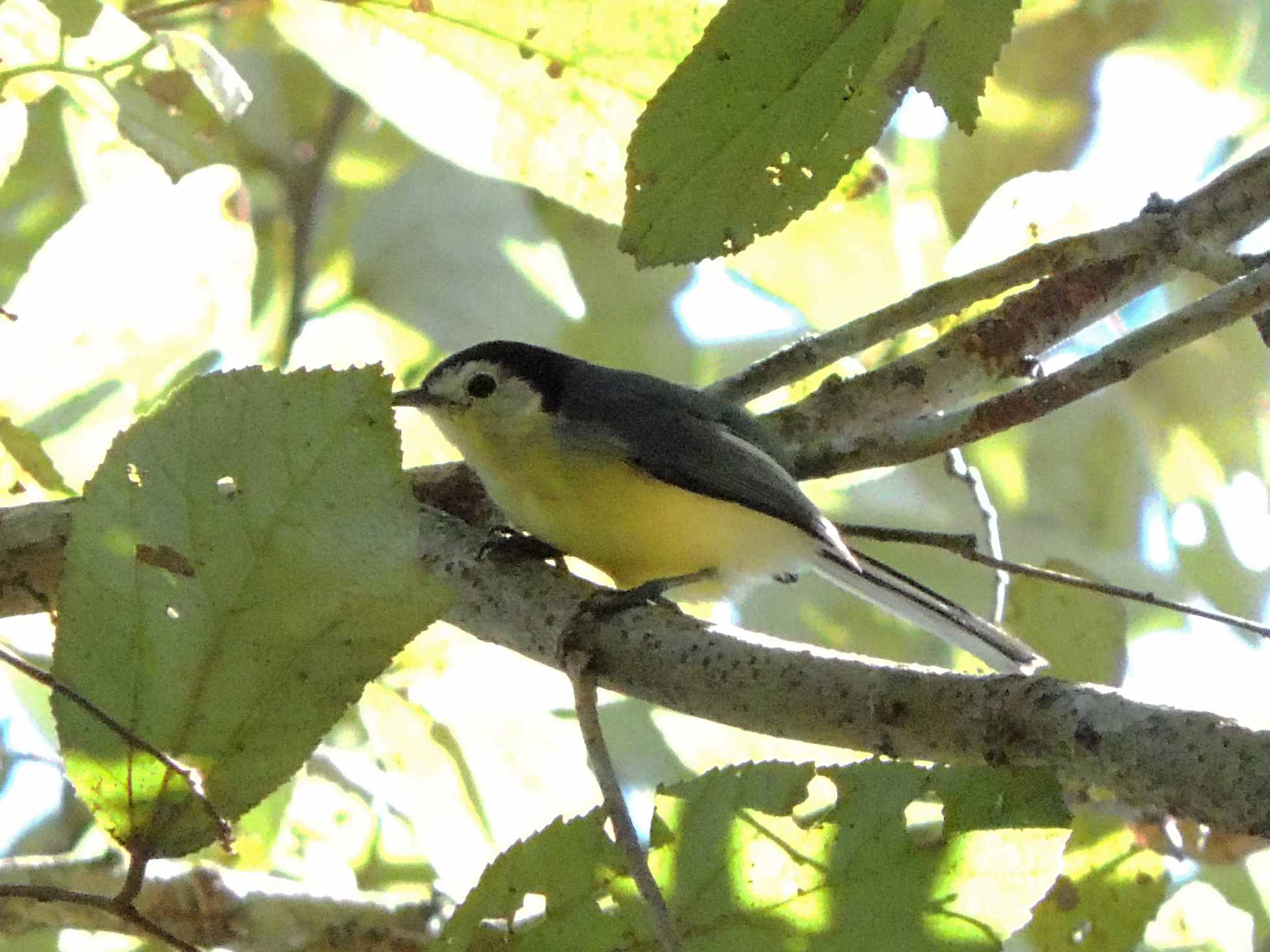
11 cm, with a thin, straight bill and a long tail. The male has a glossy black crown, a white face and bluish-grey upperparts; the underparts are white with a creamy to pale yellowish tinge, especially on the belly. The tail is black, with white outer tail feathers. The female has a grey crown without black. Juveniles resemble the female, with a browner-tinged back.
Confusion species
Masked Gnatcatcher Polioptila dumicola is larger, the male has a black mask through the eye instead of a black crown and a grey breast, and it lives mainly in more open country. Small grey tyrannulets such as White-crested Tyrannulet Serpophaga subcristata lack the long black-and-white tail and the black crown.
Habitat
Canopy and edges of humid and semi-deciduous forest, mainly inland seasonal forest, locally in the transition to araucaria forest and in tall secondary forest, from the lowlands to about 1000 m. It forages in pairs in the foliage of tall trees for small insects, often with mixed flocks. The nest is a small cup on a branch high in a tree.
Where the bird is most at home, classified by the vegetation units of Amazonia and the Guianas.



Range and movements
Brazil: in the south, mainly in Paraná and Santa Catarina, also in northern Rio Grande do Sul and locally in São Paulo; older reports further north are uncertain. Absent from the rest of the guide area. Outside the guide area in eastern Paraguay and north-eastern Argentina.
- Resident
- dark = core range, pale = thinly spread
How and when to look
In the canopy of larger forest tracts in western Paraná, for example around Iguaçu National Park. Search mixed flocks high in the trees and listen for the nasal calls.
Conservation status
Least Concern (IUCN); formerly assessed as Near Threatened. Inland seasonal forest has largely been cleared for farming, so the species lives mainly in larger forest remnants.
Scientific name
Polioptila lactea | Sharpe, 1885
Sharpe described the species in 1885 and placed it straight away in the genus where it still stands. The genus Polioptila was introduced in 1855 by Sclater. Polioptila is Greek, from polios 'grey' and ptilon 'feather': 'grey-feathered'. lactea is Latin for 'milky', after the milk-white underparts. The specimen the first description was based on came from South America (probably Rio de Janeiro, Brazil).