All species › Falcons › Falcons and caracaras › Cryptic Forest Falcon
Cryptic Forest Falcon | Micrastur mintoni
Mintons bosvalk | Halcón montés críptico | Falcão-críptico
Cryptic Forest Falcon was described as a separate species only in 2002; before that it was included in Lined Forest Falcon, from which it is almost indistinguishable in appearance. The differences lie mainly in voice, tail pattern and range. Almost its entire range lies in Brazil: in south-eastern Amazonia and the Atlantic Forest.
Voice
A series of nasal, barking notes, ah, ah, ah, ah, about one per second and sustained for a minute or longer, longer and more even than the short two-note call of Lined Forest Falcon; mainly at sunrise, less often at dusk. Also a cackling series that speeds up and drops at the end.
Recording: Jacob Wijpkema — CC BY-NC-SA 4.0 · shortened to the first 60 s, mono · xeno-canto
Identification
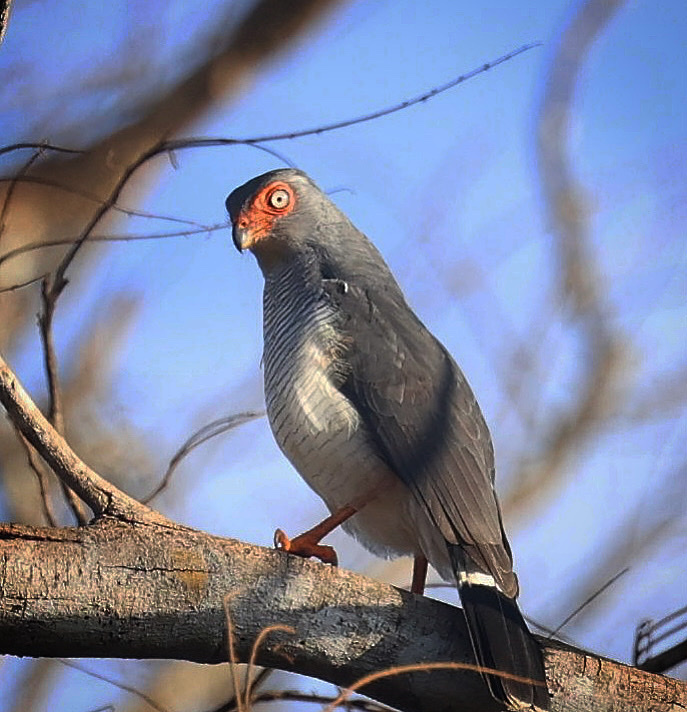
31–36 cm, with short, rounded wings, a fairly short tail and long legs. The adult is plain slate grey above, with a paler grey throat and breast. The underparts are white with narrow, sparse black bars, especially on the flanks. The bare skin around the eye, the lores and the cere are orange to orange-red, the legs orange; the eye is greyish. The tail is blackish with a single narrow white band and a white tip. Juveniles are browner above, have white to cream underparts with little or no barring and two narrower white tail bands.
Confusion species
Lined Forest Falcon Micrastur gilvicollis is almost identical; it has a white eye and usually two white tail bands, but voice is the only reliable feature. Where the two occur together, in southern Amazonia, a recording is needed. Barred Forest Falcon Micrastur ruficollis is more densely and evenly barred below and has three or four white tail bands. Bicolored Hawk Astur bicolor has plain grey underparts and rufous thighs.
Habitat
Humid lowland forest, mainly on terra firme, also várzea with a bamboo understorey, semi-humid forest and transitional forest towards drier woodland; in the Atlantic Forest in lowland and hill forest. It hunts from a low, concealed perch in the lower storey, taking small birds, lizards and large insects. Little is known about the nest.
Where the bird is most at home, classified by the vegetation units of Amazonia and the Guianas.





Range and movements
In Brazil in Amazonia south of the Amazon, roughly from the Madeira east through Rondônia, Mato Grosso and Pará to western Maranhão, and in the Atlantic Forest of eastern Brazil, from Alagoas and Pernambuco southwards, with scattered records into the south-east. The exact limits are still poorly known. Absent from Venezuela, Guyana, Suriname and French Guiana. Outside the guide area in north-eastern Bolivia.
- Resident
- dark = core range, pale = thinly spread
How and when to look
Look for the species in extensive lowland forest in southern Pará and northern Mato Grosso, or in the remnants of Atlantic Forest in north-eastern and eastern Brazil. Listen at sunrise for the long, even series and record any forest falcon of this type; without a recording it cannot be separated with certainty from Lined Forest Falcon.
Conservation status
Near Threatened. The Atlantic Forest is highly fragmented, and in southern Amazonia forest is being converted to pasture and cropland on a large scale, so the species is expected to decline.
Scientific name
Micrastur mintoni | Whittaker, 2003
Whittaker described the species in 2003 and placed it straight away in the genus where it still stands. The genus Micrastur was introduced in 1841 by Gray. Micrastur combines Greek mikros 'small' with the genus Astur 'goshawk': 'small hawk'. mintoni honours the British shorebird researcher Clive Minton, mentor of the describer Andrew Whittaker. The specimen the first description was based on came from southeastern Amazonia, Brazil (exact site not verified).