All species › Passerines › Ovenbirds and woodcreepers › Dark-breasted Spinetail
Dark-breasted Spinetail | Synallaxis albigularis
Witkeelstekelstaart | Pijuí pechioscuro | João-de-peito-escuro
The Dark-breasted Spinetail is a spinetail of tall grass, scrub and cane on river islands and riverbanks in western Amazonia. In the guide area it reaches its eastern limit along the Solimões at the mouth of the Rio Negro. It also benefits from pastures and shrubby clearings.
Voice
The song is a hurried, often long series of notes, rendered as chéép, du-du-du or whít, di-di-di. Also a short chatter and an accelerating whinny.
Recording: Juan Freile — CC BY-NC-SA 4.0 · converted to mono · xeno-canto
Identification
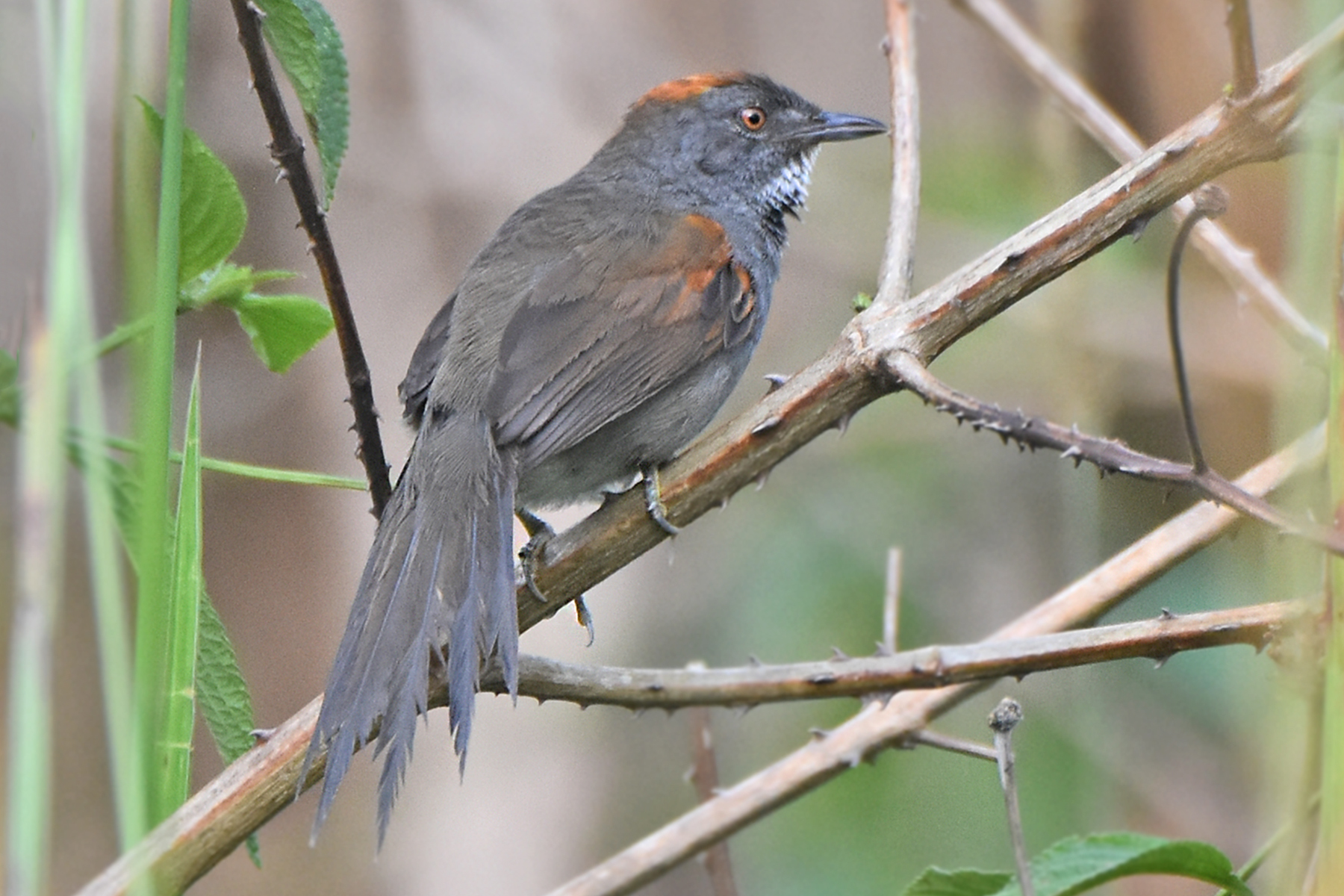
15–16 cm, with a long, dark brown tail with spiny feather tips. The face is brownish grey; hindcrown and nape are dark rufous, the back olive-brown and the wing coverts rufous. The throat is greyish white with sooty flecks, the breast dark grey, the centre of the belly paler. The sexes are alike. Juveniles have a brownish-grey crown and mostly dark ochre underparts.
Confusion species
Pale-breasted Spinetail Synallaxis albescens is much paler below and has a greyish forehead. Plain-crowned Spinetail Synallaxis gujanensis in the same riverside scrub has a brown crown without rufous and pale buffy underparts. The related Rio Orinoco Spinetail Synallaxis beverlyae occurs only along the Orinoco in Venezuela and is paler below.
Habitat
Tall grass, scrub and stands of Gynerium cane on river islands and banks, and also shrubby grassy clearings, pastures and plantations; from the lowlands to about 1500 m outside the guide area. It forages low in dense vegetation for insects. The nest is a mass of twigs with a side entrance tunnel, 1–2 m up in dense vegetation.
Where the bird is most at home, classified by the vegetation units of Amazonia and the Guianas.




Range and movements
Brazil: in western Amazonas and in Acre, along the Solimões east to about the mouth of the Rio Negro. Not in Venezuela and the Guianas. Outside the guide area in southern Colombia, eastern Ecuador, eastern Peru and western Bolivia.
- Resident
- dark = core range, pale = thinly spread
How and when to look
On vegetated sandbars and river islands along the Solimões, for example around Tefé or Tabatinga, and in shrubby pastures along the river. Listen for the hurried song; the bird usually stays low in the cane and shrubs.
Conservation status
Least Concern (IUCN). Common; the population is probably increasing as shrubby open country expands.
Scientific name
Synallaxis albigularis | Sclater, 1858
Sclater described the species in 1858 and placed it straight away in the genus where it still stands. The genus Synallaxis was introduced in 1818 by Vieillot. Synallaxis is Greek, from sunallaxis 'exchange'; why Vieillot chose the name is unclear. albigularis is Latin, from albus 'white' and gula 'throat': 'white-throated'. The specimen the first description was based on came from Río Napo, Ecuador.