All species › Passerines › Tyrant flycatchers and allies › Double-banded Pygmy Tyrant
Double-banded Pygmy Tyrant | Lophotriccus vitiosus
Dubbelbanddwergtiran | Cimerillo doblebandeado | Maria-fiteira
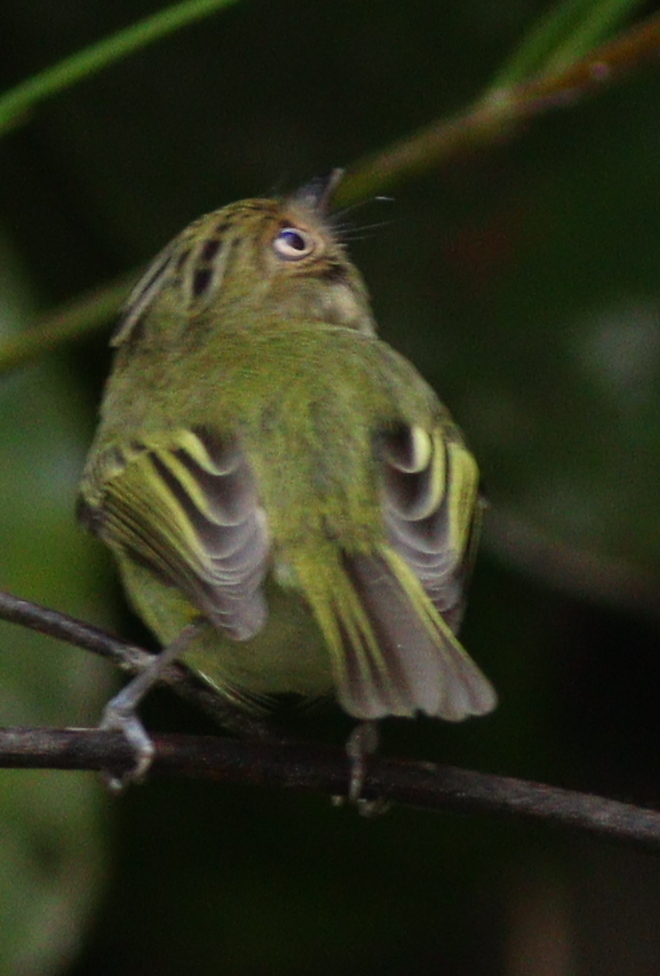
Double-banded Pygmy Tyrant is a small flycatcher with a crest of long, blackish crown feathers and two distinct yellowish wing bars. It lives in humid lowland forest in northern Amazonia and the Guianas, and is mostly detected by a short, harsh trill. In the Guianas it occurs alongside Helmeted Pygmy Tyrant.
Voice
A short, harsh, descending trill, often repeated, and quiet, tinkling pik calls.
Recording: Daan van der Hoeven — CC BY-NC-SA 4.0 · xeno-canto
Identification
10 cm, with a fairly long, flat bill and a short tail. The crown feathers are long and blackish with grey edges, forming a crest that can be raised and fanned; the female has a smaller crest. Lores whitish, face olive. Upperparts olive, wings dark with two distinct yellowish wing bars. Throat and upper breast white with dusky olive streaks, the rest of the underparts whitish with a pale yellow wash on the flanks and undertail; yellower below in the Guianas. The iris is straw-yellow. The sexes are otherwise alike.
Confusion species
Helmeted Pygmy Tyrant Lophotriccus galeatus has faint wing bars, a grey-edged crest that usually lies flat and whiter underparts; it more often lives at forest edges and in white-sand forest. Short-tailed Pygmy Tyrant Myiornis ecaudatus is much smaller, with a grey head, white spectacles and almost no tail. White-eyed Tody-Tyrant Hemitriccus zosterops has a white eye-ring and no crest.
Habitat
Humid terra firme forest and tall secondary forest, less often várzea, both in the forest interior and at edges; up to about 800 m. It sits in the lower and middle storeys, often in vine tangles, and catches insects with short sallies to leaves. The nest is a hanging ball with a side entrance.
Where the bird is most at home, classified by the vegetation units of Amazonia and the Guianas.



Range and movements
Brazil: north of the Amazon, from the upper Rio Negro east to Amapá; south of the Amazon only in south-western Amazonas. Guyana, Suriname and French Guiana: widespread in the forested interior. Venezuela: no confirmed records, but possibly in the far south. Outside the guide area in south-eastern Colombia, eastern Ecuador and eastern Peru.
- Resident
- dark = core range, pale = thinly spread
How and when to look
Search terra firme forest in the Guianas or northern Amazonas, for example around Manaus. Listen for the short, harsh trill in the middle storey and, on a perched bird, look for the two distinct wing bars.
Conservation status
Least Concern. The species has a large range in intact lowland forest and is fairly common there. Within the guide area, deforestation is only a local threat.
Scientific name
Lophotriccus vitiosus | (Bangs & Penard, 1921)
Bangs & Penard described the species in 1921 as Cometornis vitiosus; because it was later moved to another genus, the author and year stand in brackets. The genus Lophotriccus was introduced in 1884 by Berlepsch. Lophotriccus is Greek, from lophos 'crest' and trikkos 'small bird': 'crested tyrannulet', after the erectile crown feathers. vitiosus is Latin for 'defective', from vitium 'defect'; why the describers chose the name is unclear. The specimen the first description was based on came from Sarayacu, Río Ucayali, Peru.