All species › Passerines › Tyrant flycatchers and allies › Drab Water Tyrant
Drab Water Tyrant | Ochthornis littoralis
Vale tapuittiran | Guardarríos arenisco | Maria-da-praia
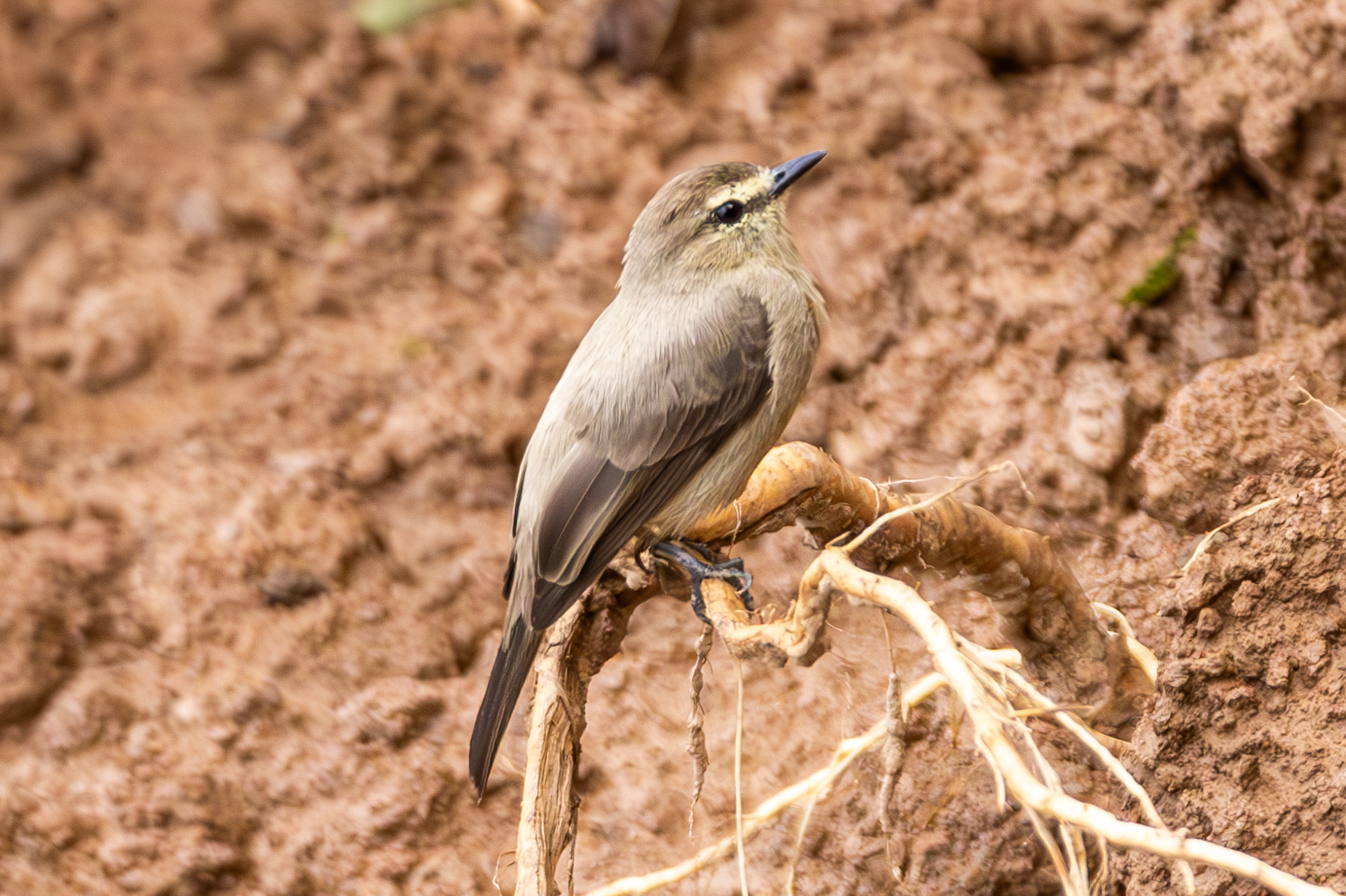
The Drab Water Tyrant is a small, sandy-coloured flycatcher of the banks of large rivers in the Amazonian lowlands and the Orinoco basin. It perches low on roots, branches and fallen trees just above the water and flies from one bank site to the next. Its colour matches the bare, muddy banks where it lives.
Voice
Not very vocal. A thin, high squeak and soft, short whistled notes; pairs sometimes give a rapid series of chirping notes.
Recording: Ricardo Gagliardi — CC BY-NC-SA 4.0 · xeno-canto
Identification
13.5 cm, with a straight, black bill and a fairly short tail. The plumage is plain pale sandy brown, with a paler rump and a faint pale supercilium above darker lores. The wings and tail are darker greyish-brown, without distinct wing bars. The underparts are paler buffy brown, the throat almost white. The sexes are alike.
Confusion species
River Tyrannulet Serpophaga hypoleuca is smaller and slimmer, grey above and white below, and lives in young growth on river islands. The female Riverside Tyrant Knipolegus orenocensis is greyer, with a darker tail, and perches more in shrubs than on bare banks. Little Ground Tyrant Syrtidicola fluviatilis walks more on sandbars and bare ground, has longer legs and a dark tail with pale outer edges.
Habitat
Banks of large and medium-sized rivers in the lowlands, especially along whitewater rivers with muddy banks, exposed roots and driftwood, also along blackwater rivers and oxbow lakes in the várzea. Up to about 500 m. It catches insects in short sallies from a low perch or from the ground at the water's edge. The nest is in a hole or crevice in the bank or among roots.
Where the bird is most at home, classified by the vegetation units of Amazonia and the Guianas.




Range and movements
Brazil: along the rivers of Amazonia, in Amazonas, Acre, Rondônia, Roraima and Pará, east to about the mouth of the Amazon. Venezuela: along the Orinoco and its tributaries in Amazonas, Bolívar and the southern Llanos. Guyana: along the larger rivers of the interior, such as the Essequibo and the Rupununi. Suriname and French Guiana: scarce, with few records. Outside the guide area in eastern Colombia, Ecuador, Peru and northern Bolivia.
- Resident
- dark = core range, pale = thinly spread
How and when to look
On a boat trip on an Amazonian river or the Orinoco, watch for a small, plain sandy-brown flycatcher that flies low over the water from root to root, just ahead of the boat.
Conservation status
Least Concern. The species has a large range along lowland rivers.
Scientific name
Ochthornis littoralis | (Pelzeln, 1868)
Pelzeln described the species in 1868 as Elainea littoralis; because it was later moved to another genus, the author and year stand in brackets. The genus Ochthornis was introduced in 1888 by Sclater. Ochthornis is Greek, from okhthos 'bank' and ornis 'bird': 'bank bird'. littoralis is Latin for 'of the shore', from litus 'shore', after its life along sandy riverbanks. The specimen the first description was based on came from Borba on the Rio Madeira, Amazonas, Brazil.