All species › Passerines › Ovenbirds and woodcreepers › Dusky Leaftosser
Dusky Leaftosser | Sclerurus obscurior
Donkere bladkrabber | Tirahojas oscuro | Vira-folha-de-peito-vermelho
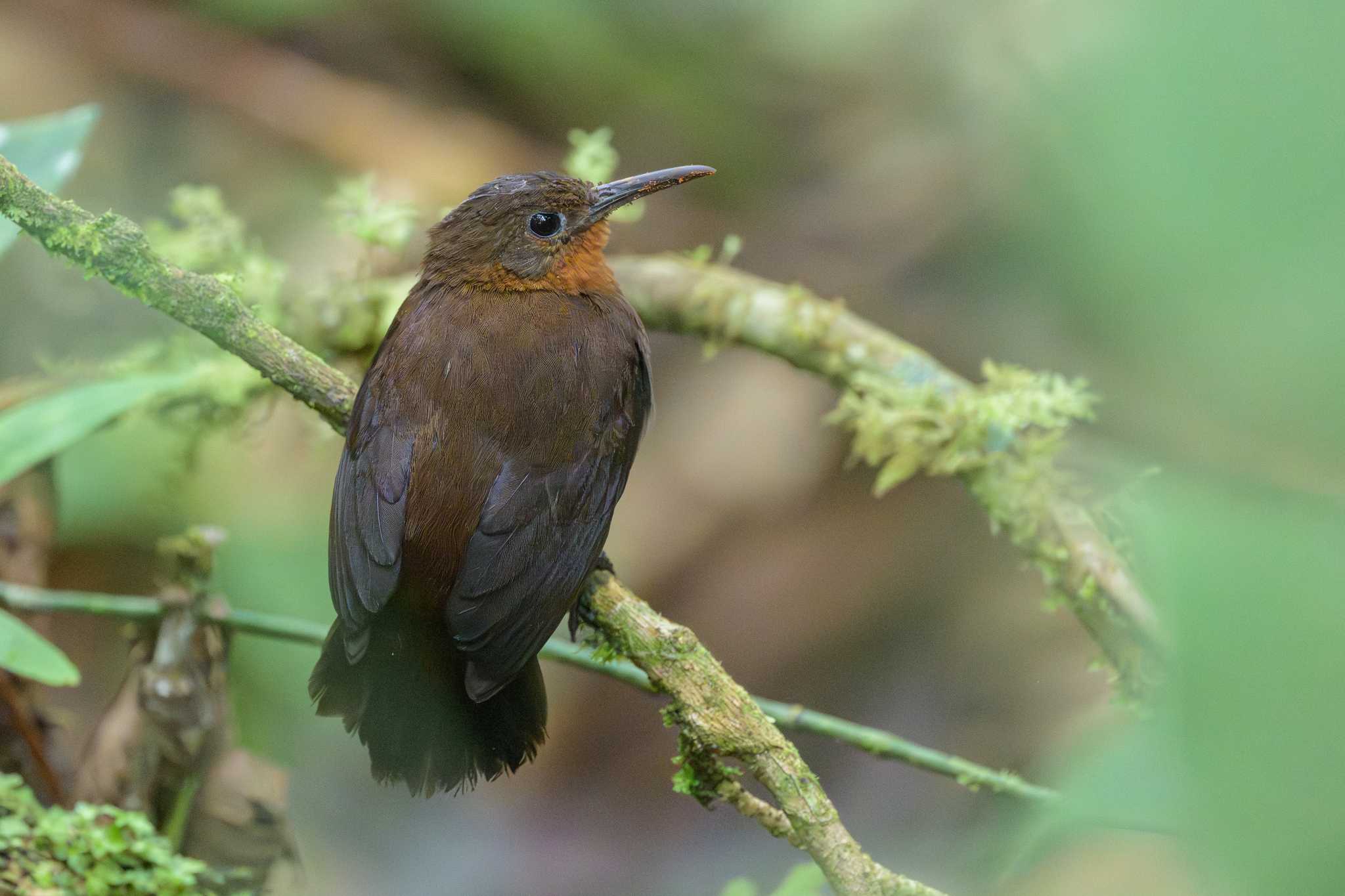
The Dusky Leaftosser is a small, dark brown ground bird of humid forest, with a warm ochre throat and a short, blackish tail. It flicks fallen leaves aside with its bill to take the prey beneath. In the guide area it is the most widespread leaftosser of Amazonia and the Guianas.
Voice
The song is a series of four to fifteen upslurred whistles that gradually descend, sometimes ending in short, stuttering notes; pitch and number of notes vary by region. The call is a short, sharp tseek, often given when flushed.
Recording: Sergio Adrian Garcia-Murcia — CC BY-NC-SA 4.0 · xeno-canto
Identification
15–17 cm, stocky, with a long, straight, thin bill, a short blackish tail and short legs. The upperparts are dark rufous-brown to chestnut, the rump more rufous. The throat is warm ochre to rufous-brown and grades into a darker chestnut breast; the belly is dark brown. The upper mandible is dark, the lower mandible paler. Birds from the Atlantic Forest and the Andes are slightly paler. The sexes are alike; juveniles are duller, with a scaly pattern on throat and breast.
Confusion species
Short-billed Leaftosser Sclerurus rufigularis is smaller, with a clearly shorter bill and a paler, more rufous-brown throat. Black-tailed Leaftosser Sclerurus caudacutus is larger, with a whitish, dark-scaled throat. Grey-throated Leaftosser Sclerurus albigularis has a greyish-white throat sharply contrasting with a rufous breast band and lives in montane forest. In the Atlantic Forest, Rufous-breasted Leaftosser Sclerurus scansor is larger, with a whitish throat and a bright rufous breast.
Habitat
Humid terra firme forest with an open understorey and a thick layer of leaf litter, often in ravines, along streams and on slopes; from the lowlands to about 1500 m, in the Venezuelan Andes and Perijá in lower montane forest. It forages alone or in pairs on the ground, turning over leaves in search of insects, spiders and other invertebrates. It breeds in a self-dug burrow in an earth bank or in the root mass of a fallen tree, with a cup of leaves in a chamber at the end.
Where the bird is most at home, classified by the vegetation units of Amazonia and the Guianas.




Range and movements
Brazil: widespread in Amazonia north and south of the Amazon, east to Pará and Maranhão, and locally in the Atlantic Forest of the east, mainly in Bahia. Venezuela: south of the Orinoco in Amazonas and Bolívar, and in the Serranía de Perijá and the Andes. Guyana, Suriname and French Guiana: widespread in the interior. Outside the guide area in Panama and Costa Rica, Colombia, Ecuador, Peru and Bolivia.
- Resident
- dark = core range, pale = thinly spread
How and when to look
In undisturbed terra firme forest, for example around Manaus or in the interior of Suriname and French Guiana, along trails with deep leaf litter and along stream valleys in the early morning. The rustle of tossed leaves and the sharp call of a flushed bird are often the first clue; the song is heard mainly at dawn and dusk.
Conservation status
Least Concern. The species depends on closed, humid forest with a rich leaf litter and disappears where forest is cleared or fragmented; in the Atlantic Forest it is rare and local.
Scientific name
Sclerurus obscurior | Hartert, 1901
Hartert described the species in 1901 and placed it straight away in the genus where it still stands. The genus Sclerurus was introduced in 1827 by Swainson. Sclerurus is Greek, from sklēros 'stiff, hard' and oura 'tail', after the stiff tail feathers. obscurior is Latin for 'darker', as this form is darker than its related leaftossers. The specimen the first description was based on came from Lita (Esmeraldas), Ecuador.