All species › Swifts › Hummingbirds › Dusky-throated Hermit
Dusky-throated Hermit | Phaethornis squalidus
Bruinkeelheremietkolibrie | Ermitaño escuálido | Rabo-branco-pequeno
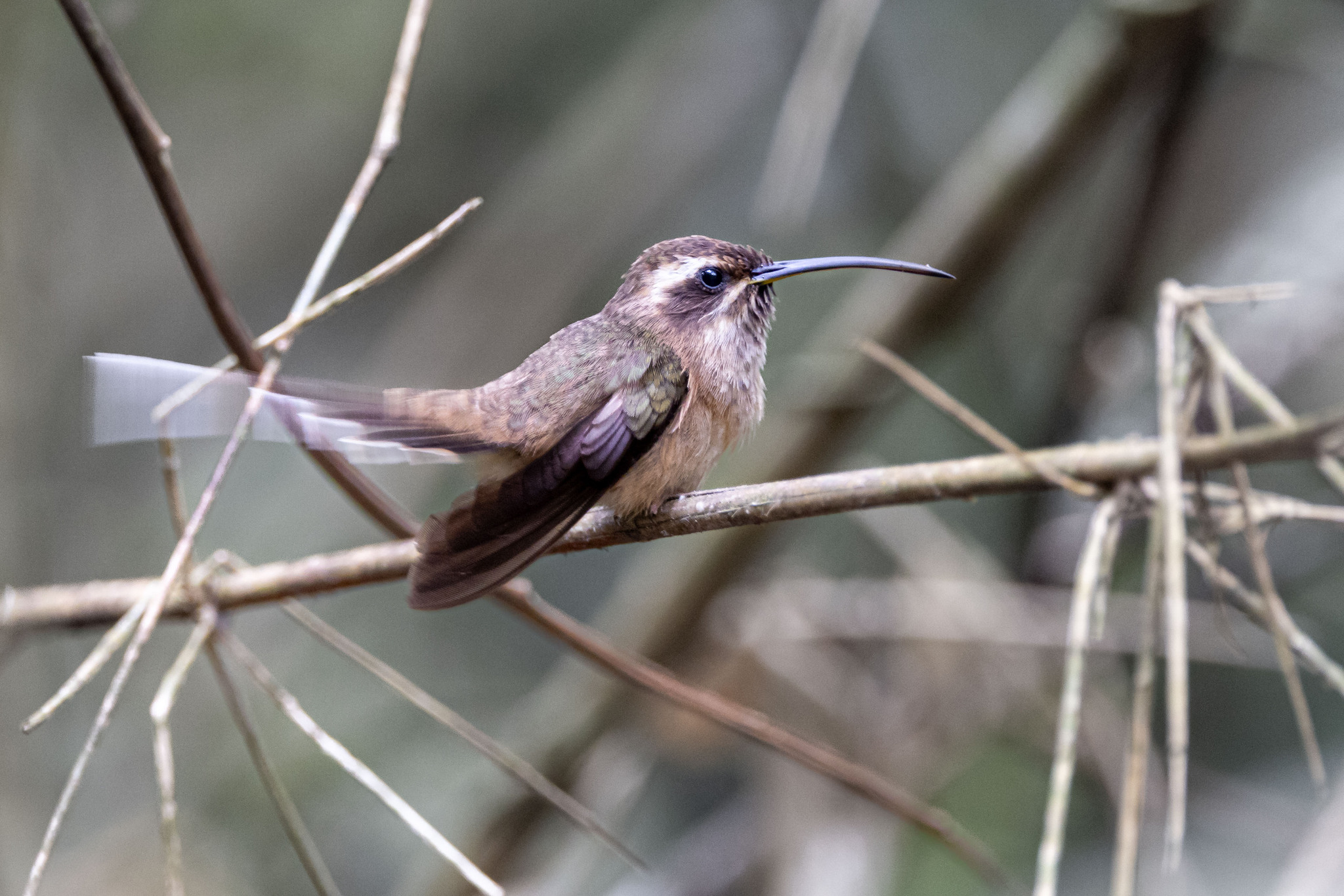
Dusky-throated Hermit is a small hermit of the Atlantic Forest of south-eastern Brazil, with a dark throat and a rufous rump. Streak-throated Hermit of northern South America was formerly treated as a subspecies of this species. It lives in the understorey of forest and forest edges, including in mountain areas.
Voice
The song is a high, rapidly repeated phrase of squeaky notes, often from a perch in the understorey. The call is a sharp tseep.
Recording: Douglas Meyer — CC BY-NC-SA 4.0 · xeno-canto
Identification
10–12 cm, with a decurved bill with a yellowish lower mandible. The upperparts are bronzy green, the rump and uppertail coverts rufous. The face has a dark mask with a pale supercilium and malar stripe. The throat is dark, greyish brown with pale streaks; the rest of the underparts are greyish ochre. The tail is graduated, with elongated, white-tipped central feathers and pale tips to the outer feathers. The sexes are similar.
Confusion species
Planalto Hermit Phaethornis pretrei is much larger, with cinnamon underparts and a pale throat. Scale-throated Hermit Phaethornis eurynome is larger, with a scaled throat and a longer tail. Minute Hermit Phaethornis idaliae of the coastal lowlands is smaller; the male is much darker below. Reddish Hermit Phaethornis ruber is strongly rufous below, with a dark breast band in the male.
Habitat
Understorey of humid lowland and montane forest, forest edges, secondary forest and dense scrub, from sea level to about 1500 m. It visits understorey flowers and catches small arthropods. The nest hangs from the underside of a leaf or a root.
Where the bird is most at home, classified by the vegetation units of Amazonia and the Guianas.




Range and movements
Only in Brazil, in the Atlantic Forest and the adjacent interior, from Minas Gerais and Espírito Santo through Rio de Janeiro to São Paulo and northern Paraná. Absent from Amazonia, Venezuela and the Guianas; a few records from Guyana and Venezuela probably refer to Streak-throated Hermit. Does not occur outside the guide area.
- Resident
- dark = core range, pale = thinly spread
How and when to look
Search the understorey along forest trails in mountain areas such as the Serra dos Órgãos, Itatiaia and the Serra da Mantiqueira, and at flowering plants on forest edges. Look for the small size, the dark throat and the rufous rump.
Conservation status
Least Concern. The species also uses secondary forest and forest edges; the loss of the Atlantic Forest has nevertheless reduced its range.
Scientific name
Phaethornis squalidus | (Temminck, 1822)
Temminck described the species in 1822 as Trochilus squalidus; because it was later moved to another genus, the author and year stand in brackets. The genus Phaethornis was introduced in 1827 by Swainson. Phaethornis is Greek, from phaethōn 'sun, shining' and ornis 'bird': 'sun-bird'. squalidus is Latin for 'dirty, dingy', after the dull, dusky throat and breast. The specimen the first description was based on came from Ipanema, São Paulo, Brazil.