All species › Pelicans, herons and ibises › Herons, egrets and bitterns › Fasciated Tiger Heron
Fasciated Tiger Heron | Tigrisoma fasciatum
Gestreepte tijgerroerdomp | Garza tigre barreteada | Socó-jararaca
The Fasciated Tiger Heron is the tiger heron of fast-flowing water. It lives along rocky rivers and streams with rapids, where it waits for fish on stones in mid-stream. In the guide area it occurs locally in the mountains of Venezuela, on the Guiana Shield, along rivers with rapids in Amazonia and in the Atlantic Forest of south-eastern Brazil.

Voice
Usually silent. When alarmed a hoarse, short kwok; also low, grunting calls.
Recording: Bernabe Lopez-Lanus — CC BY-NC-SA 4.0 · xeno-canto
Identification
61–71 cm, with a noticeably short, thick bill. Adults have a black crown, a grey head and a slate-grey neck and back with fine pale bars. A white central stripe with dark edges runs down the foreneck. The belly is greyish to cinnamon-brown. The legs are greenish. Juveniles are ochre-buff with black bars, finer and denser than in juvenile Rufescent. The sexes are alike.
Confusion species
Rufescent Tiger Heron Tigrisoma lineatum is larger, with a rufous head and neck and a longer bill, and lives in the lowlands by still or slow-flowing water; juveniles are best told by the longer bill and coarser barring of Rufescent. Pinnated Bittern Botaurus pinnatus resembles the juvenile but has a streaked rather than barred neck and lives in marshes, not along fast-flowing water.
Habitat
Fast-flowing, clear rivers and streams with boulders, rapids and gravel bars in forested hill and mountain country, roughly between 100 and 1500 m; in Amazonia and on the Guiana Shield also lower, at rapids in large rivers. It stands on stones in or beside the current and hunts fish, crustaceans and aquatic insects. The nest is a platform of sticks in a tree by the river.
Where the bird is most at home, classified by the vegetation units of Amazonia and the Guianas.




Range and movements
In Venezuela in the Andes and the Serranía de Perijá, in the coastal range and locally south of the Orinoco, in Bolívar and Amazonas. In Guyana, Suriname and French Guiana scarce along rivers with rapids in the interior. In Brazil in two areas: along rivers with rapids on the Guiana Shield and in southern and western Amazonia, and in the south-east, from Minas Gerais and Espírito Santo to Paraná and Santa Catarina, including the Iguaçu basin. Outside the guide area in Costa Rica and Panama, along the Andes from Colombia to Bolivia and in north-eastern Argentina.
- Resident
- dark = core range, pale = thinly spread
How and when to look
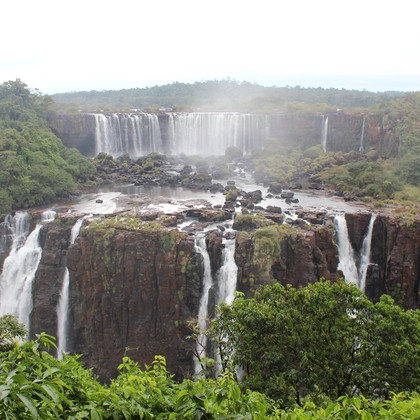
Scan boulders and rapids from bridges over mountain rivers, for example in the Venezuelan Andes or the coastal range, or along the rivers of the Atlantic Forest, such as below the Iguaçu Falls; birds often stand motionless on a stone in mid-stream.
Conservation status
Least Concern. In the guide area local and scarce; the species suffers from deforestation along rivers, pollution and the building of dams, which drown rapids.
Scientific name
Tigrisoma fasciatum | (Such, 1825)
Such described the species in 1825 as Ardea Fasciata; because it was later moved to another genus, the author and year stand in brackets. The genus Tigrisoma was introduced in 1827 by Swainson. Tigrisoma is Greek, from tigris 'tiger' and sōma 'body', after the barred plumage. fasciatum is Latin for 'banded', after the fine barring of the plumage. The specimen the first description was based on came from Brazil.