All species › Swifts › Hummingbirds › Fiery-tailed Awlbill
Fiery-tailed Awlbill | Avocettula recurvirostris
Vuurstaartkluutkolibrie | Mango picolezna | Beija-flor-de-bico-virado
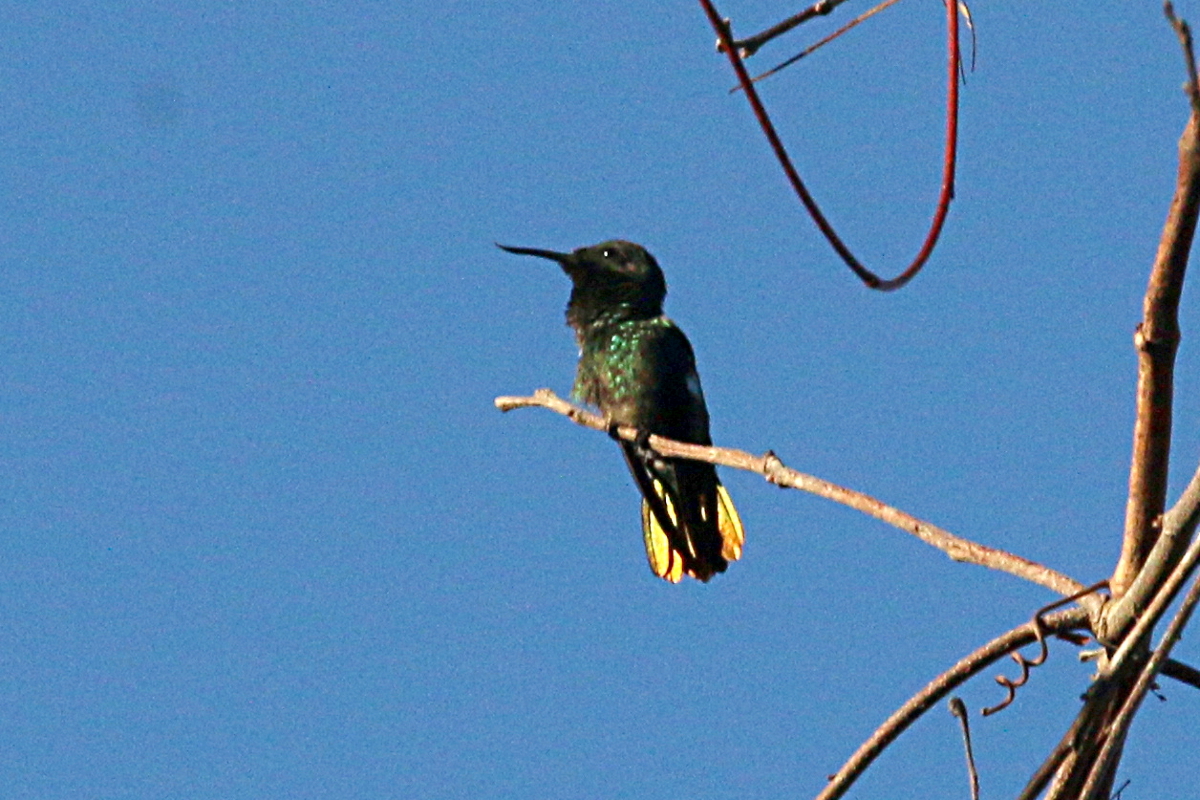
The Fiery-tailed Awlbill is a small hummingbird with a short bill whose tip is sharply upturned, like that of an avocet. The male has a glittering green throat, a black central stripe down the belly and a coppery red to purplish red tail. It occurs sparsely and locally in the Guianas, southern Venezuela and northern Brazil, often at granite outcrops and on sandy soils.
Voice
Poorly known. A thin, high tsip and soft chipping notes.
Recording: Jerome Fischer — CC BY-NC-SA 4.0 · xeno-canto
Identification
9 cm, with a short black bill whose last part is clearly upturned. The male is bronzy green above, with a glittering emerald-green throat and breast and a black central stripe down the breast and belly. The rounded tail glows coppery red to purplish red. The female is green above and white below, with a black central stripe from throat to belly; her tail is dark purplish red with white tips to the outer feathers.
Confusion species
Black-throated Mango Anthracothorax nigricollis has the same pattern of a black central stripe and purplish red tail but is much larger, with a longer, slightly curved bill without an upturned tip; the female has a similar black central stripe. Green-throated Mango Anthracothorax viridigula of coastal mangroves is also much larger. The upturned bill tip is the best feature in good views.
Habitat
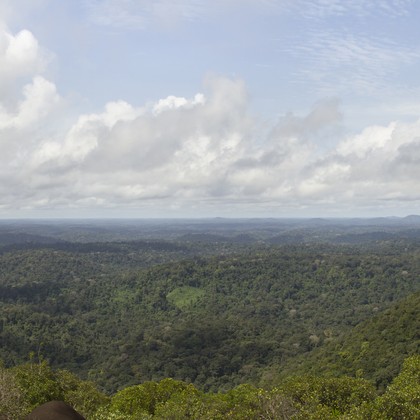
Edges of humid lowland forest, low forest and scrub on sandy soils, vegetation around granite inselbergs and rocky plateaus, semi-deciduous forest and cerrado, in the lowlands. It visits flowering trees and shrubs, often in the canopy of low forest, and catches small insects. The nest is a cup of plant down on a thin branch.
Where the bird is most at home, classified by the vegetation units of Amazonia and the Guianas.



Range and movements
In Brazil scattered across the north, from Roraima and Amazonas east to Pará, Amapá, Maranhão and Tocantins, and west to Acre. In Guyana, Suriname and French Guiana local, mainly at inselbergs and rocky savannas. In Venezuela only a few records in the south-east. Outside the guide area locally in eastern Ecuador and as a vagrant in Colombia.
- Resident
- dark = core range, pale = thinly spread
How and when to look
At flowering trees and shrubs around granite inselbergs in Suriname and French Guiana and along the edges of low forest on sandy soils. Birds often perch motionless for long periods on a bare branch high in a tree.
Conservation status
Least Concern. In the guide area scarce and local; little is known about numbers and movements.
Scientific name
Avocettula recurvirostris | (Swainson, 1822)
Swainson described the species in 1822 as Trochilus recurvirostris; because it was later moved to another genus, the author and year stand in brackets. The genus Avocettula was introduced in 1849 by Reichenbach. Avocettula is a diminutive of Avocetta 'avocet': 'little avocet', after the upturned bill tip. recurvirostris is Latin for 'with recurved bill', from recurvus 'bent back' and rostrum 'bill', after the upturned bill tip. The specimen the first description was based on came from Cayenne, French Guiana (designated; originally given in error as Peru).