All species › Passerines › Ovenbirds and woodcreepers › Flammulated Treehunter
Flammulated Treehunter | Thripadectes flammulatus
Andesboomjager | Trepamusgos flamulado | Barranqueiro-flamulado
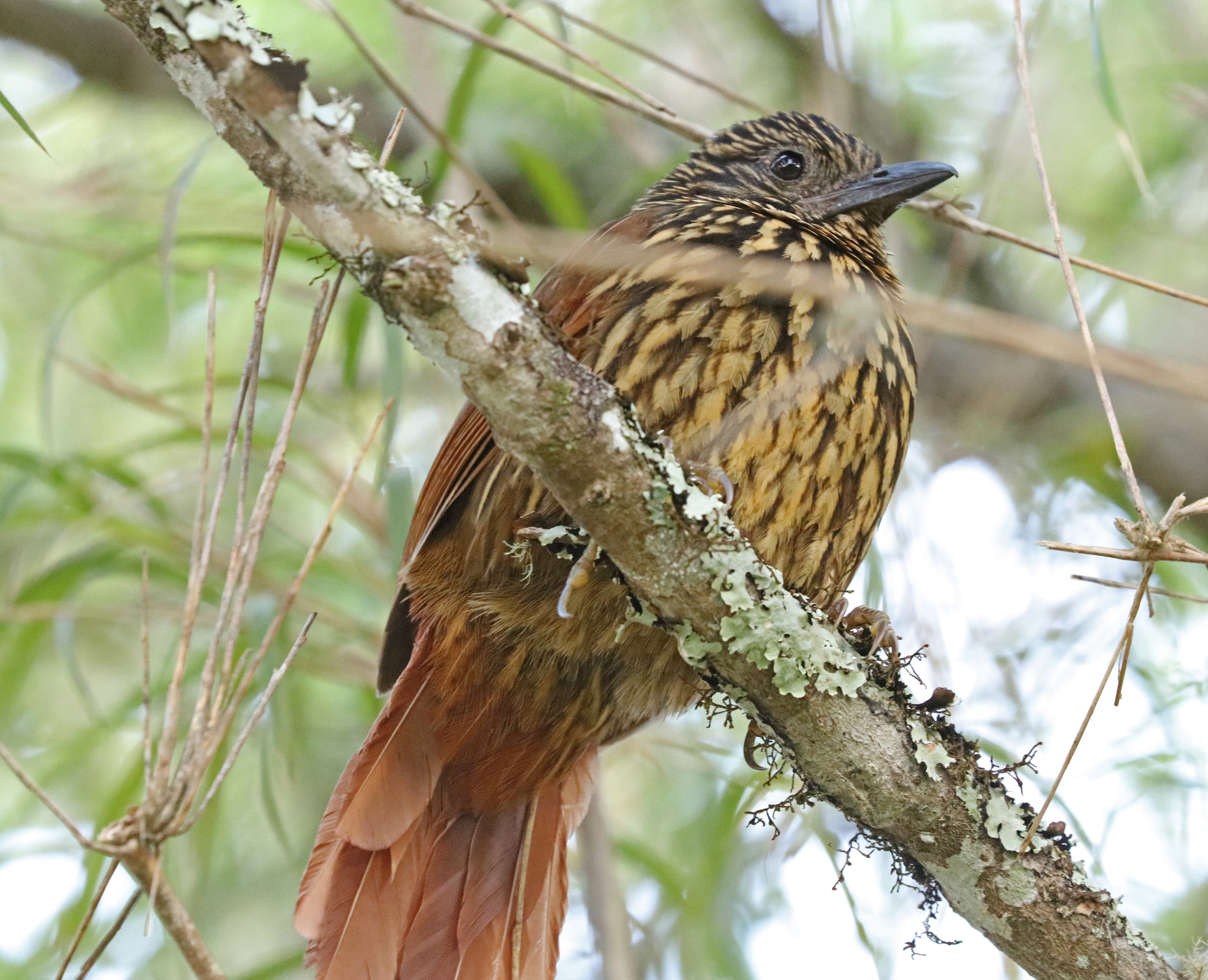
The Flammulated Treehunter is a large, dark, heavily streaked foliage-gleaner of Andean cloud forest. In the guide area it occurs only in the Andes of western Venezuela, where it lives hidden in dense bamboo in the understorey.
Voice
A dry, rasping rattle; also a hard, harsh chek.
Recording: Brian Cox — CC BY-NC-SA 4.0 · converted to mono · xeno-canto
Identification
24 cm, with a heavy, straight bill. The head, back and underparts are blackish-brown with broad buff streaks, densest on the throat and breast, where they form a flame-like pattern. The wings and tail are rusty brown. The sexes are alike.
Confusion species
Striped Treehunter Thripadectes holostictus is smaller, with narrower streaks on a less dark ground colour. Streak-capped Treehunter Thripadectes virgaticeps is streaked mainly on the head and throat and has an almost unstreaked, rusty belly. Lineated Foliage-Gleaner Syndactyla subalaris is slimmer, with a smaller bill and finer streaks, and forages higher in the mid-storey.
Habitat
Humid montane forest and cloud forest with plenty of Chusquea bamboo, also forest edges, in the upper zone of the Andes. It forages low in dense bamboo and in tangles of moss and dead leaves for insects. It nests in a tunnel dug into a steep roadside bank or earth bank.
Where the bird is most at home, classified by the vegetation units of Amazonia and the Guianas.

Range and movements
In Venezuela only in the Andes of the west, in Táchira, Mérida and Trujillo, with few records. Elsewhere in the guide area it is absent. Outside the guide area in the Andes of Colombia and Ecuador to the far north of Peru.
- Resident
- dark = core range, pale = thinly spread
How and when to look
Search dense bamboo along mountain roads and trails in the cloud forest of Mérida and Táchira, and listen for the rasping rattle. It stays low and hidden; patience at an opening in the bamboo helps.
Conservation status
Least Concern (IUCN). Scarce and local in Venezuela; Andean montane forest is declining through clearance for agriculture and pasture.
Scientific name
Thripadectes flammulatus | (Eyton, 1849)
Eyton described the species in 1849 as Anabates flammulatus; because it was later moved to another genus, the author and year stand in brackets. The genus Thripadectes was introduced in 1862 by Sclater. Thripadectes is Greek, from thrips 'woodworm' and dēktēs 'biter': 'woodworm-biter', after its search for insects in dead wood. flammulatus is Modern Latin for 'with little flames', from flammula 'small flame', after the flame-like pale streaks on head and breast. The specimen the first description was based on came from Bogotá, Colombia.