All species › Passerines › Tyrant flycatchers and allies › Fork-tailed Flycatcher
Fork-tailed Flycatcher | Tyrannus savana
Vorkstaartkoningstiran | Tijereta sabanera | Tesourinha
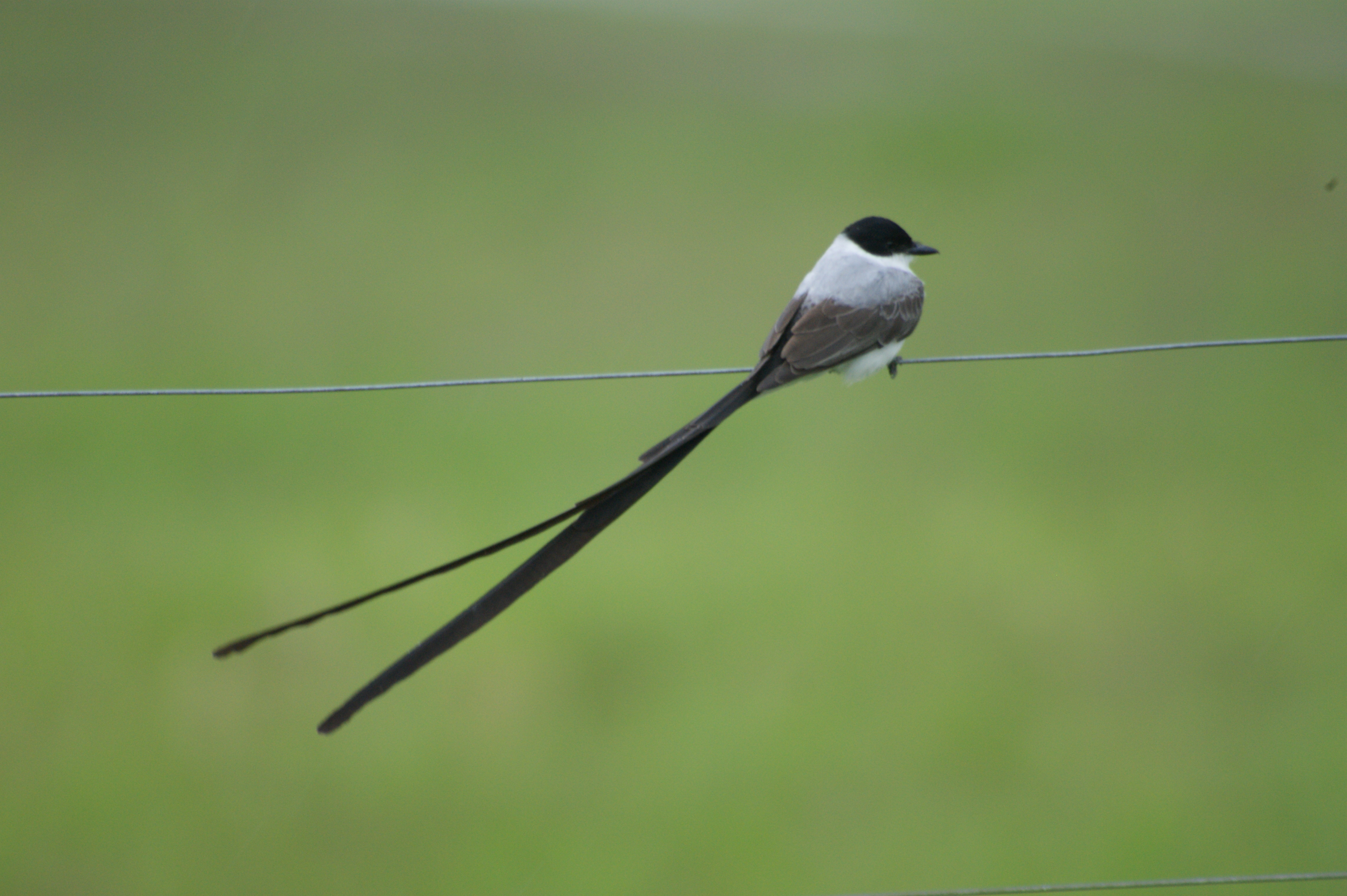
The Fork-tailed Flycatcher is an open-country kingbird with a long, deeply forked tail. The southern birds breed in central and southern Brazil and move in the southern winter to Amazonia, Venezuela and the Guianas, where they gather in large communal roosts. Resident populations also live in the savannas of the north.
Voice
A dry, buzzy call, a soft tik in flight and twittering series at the roost. The wings can make a buzzing or whistling sound in flight.
Recording: JAYRSON ARAUJO DE OLIVEIRA — CC BY-NC-SA 4.0 · xeno-canto
Identification
Adult males 37–41 cm, females 28–30 cm, much of it tail; the body length is similar to that of other kingbirds. The head is black like a cap, with a concealed yellow crown patch. The back is pale grey, the wings darker greyish-brown. The underparts are bright white. The tail is black and deeply forked, with the outer feathers much longer in the male than in the female. Juveniles have a browner cap, browner upperparts and a much shorter tail. During moult the long tail may be missing.
Confusion species
Streamer-tailed Tyrant Gubernetes yetapa of wet grasslands in central and southern Brazil also has a long forked tail, but is grey with a white throat, a rufous breast band and rufous in the wing. Scissor-tailed Flycatcher Tyrannus forficatus, a vagrant from North America, has a pale grey head without a black cap and salmon-pink flanks. Eastern Kingbird Tyrannus tyrannus has a dark grey back and a short, white-tipped tail. A Fork-tailed Flycatcher without its long tail can be recognised by the black cap, pale grey back and white underparts.
Habitat
Cerrado, savanna, Llanos, flooded grassland, pastures, rice fields, marsh edges and other open country with scattered perches, also in towns. It hunts flying insects from fences, wires and shrubs and outside the breeding season eats a lot of fruit, often in flocks. Communal roosts are in rows of trees, mangroves or on river islands. The nest is a shallow cup in a shrub or small tree.
Where the bird is most at home, classified by the vegetation units of Amazonia and the Guianas.






Range and movements
Brazil: breeds in the centre, south and east of the country, from the Cerrado and the Pantanal to the Pampa (about September to March); in the southern winter (April to September) numerous in Amazonia, along the large rivers and in the northern savannas, where resident birds also live. Venezuela: resident in the Llanos and the savannas of the south and northwest, with large numbers of migrants in the southern winter. Guyana, Suriname and French Guiana: resident in the coastal savannas and the Rupununi, with migrants in the southern winter. Outside the guide area from southern Mexico to Argentina.
- Resident
- Summer visitor (c. Apr–Sep)
- Winter visitor (c. Oct–Mar)
- Passage (Mar–Apr, Oct–Nov)
- dark = core range, pale = thinly spread
How and when to look
In the southern winter hundreds of birds often gather at dusk at roosts in Amazonia and the Llanos. In the breeding range in the Cerrado and southern Brazil it perches on fences and wires along roads from September.
Conservation status
Least Concern. The species has a very large range and benefits from open, man-made habitats such as pastures.
Scientific name
Tyrannus savana | Daudin, 1802
Daudin described the species in 1802 and placed it straight away in the genus where it still stands. The genus Tyrannus was introduced in 1799 by De Lacépède. Tyrannus is Latin (from Greek turannos) for 'tyrant, despot', after the aggressive way these birds drive off even raptors. savana goes back to Buffon's name 'le Savana', because the bird lives in (flooded) savannas. The specimen the first description was based on came from Río de la Plata and Montevideo, Uruguay.