All species › Woodpeckers and allies › Woodpeckers › Golden-collared Woodpecker
Golden-collared Woodpecker | Veniliornis cassini
Goudkraagspecht | Carpintero cebrado | Pica-pau-de-colar-dourado
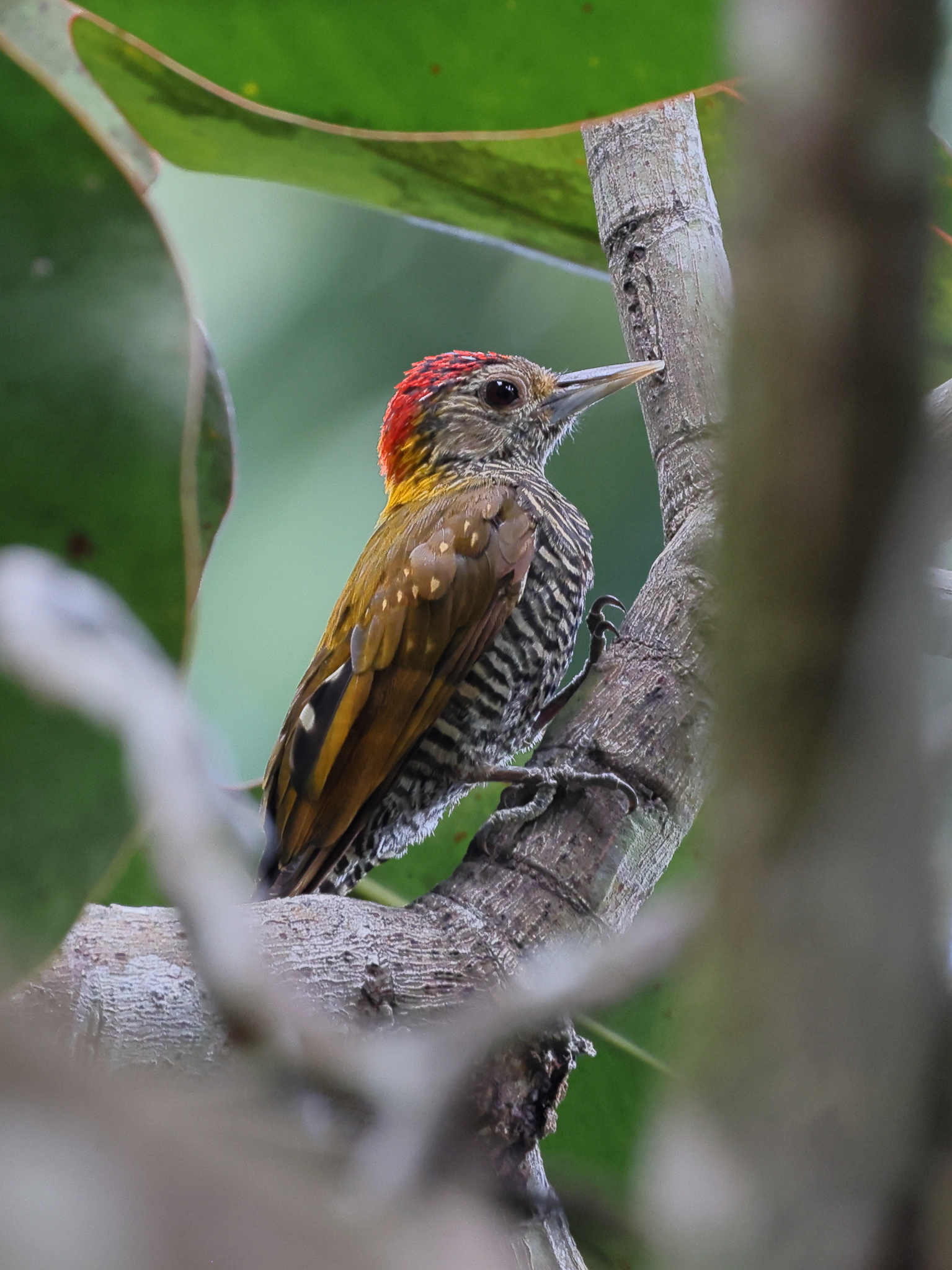
Golden-collared Woodpecker is a small Veniliornis woodpecker of the Guiana Shield, with a golden-yellow nape and boldly black-and-white barred underparts. It lives in humid lowland forest north of the Amazon and east of the Rio Negro. It usually forages in the middle and upper strata of the forest, often with mixed flocks.
Voice
A fast series of high notes kee-kee-kee-kee, a short keek and a dry rattle. It drums in short bursts.
Recording: GABRIEL LEITE — CC BY-NC-SA 4.0 · xeno-canto
Identification
15–16 cm, with a straight, dark bill. The upperparts are golden olive-green, with small pale spots on the wing-coverts. The nape is golden yellow. The face is dark, with pale stripes above and below the ear-coverts. The underparts are densely barred blackish and white. The tail is dark brown with pale bars. The male has red feather tips on the dark crown; the female has a dark brown crown without red. Young birds are duller.
Confusion species
Red-stained Woodpecker Veniliornis affinis, west of the Rio Negro and south of the Amazon, has red-tipped wing-coverts and no golden nape. Little Woodpecker Veniliornis passerinus has fainter barring below and no golden nape, and lives mainly along rivers and in more open woodland. Red-rumped Woodpecker Veniliornis kirkii, on the slopes of the tepuis, has a red rump.
Habitat
Tall humid terra firme forest, forest edges, tall secondary forest and white-sand forest, from sea level to about 1000 m, locally higher on the slopes of the Guiana Highlands. It searches thin branches and lianas for insects and larvae, alone or in pairs, often with mixed flocks in the canopy. It nests in a self-excavated cavity in a tree.
Where the bird is most at home, classified by the vegetation units of Amazonia and the Guianas.




Range and movements
In Venezuela south of the Orinoco, in Bolívar, Amazonas and Delta Amacuro. Throughout the forested interior of Guyana, Suriname and French Guiana. In Brazil north of the Amazon: in Amapá, northern Pará, Roraima and north-eastern Amazonas, west to the Rio Negro. Endemic to north-eastern South America; its range lies largely within the guide area.
- Resident
- dark = core range, pale = thinly spread
How and when to look
Along forest edges and clearings in lowland forest of the Guianas, Amapá or southern Venezuela, look among mixed flocks for a small olive-green woodpecker with a golden-yellow nape and a black-and-white barred belly.
Conservation status
Least Concern. The species has a large range in largely intact forest of the Guiana Shield.
Scientific name
Veniliornis cassini | (Malherbe, 1862)
Malherbe described the species in 1862 as Mesopicus cassini; because it was later moved to another genus, the author and year stand in brackets. The genus Veniliornis was introduced in 1854 by Bonaparte. Veniliornis combines Venilia, a Roman nymph from the myth of the woodpecker-king Picus, with Greek ornis 'bird'. cassini honours the American ornithologist John Cassin (1813–1869) of the Academy of Natural Sciences in Philadelphia. The specimen the first description was based on came from Cayenne, French Guiana (originally 'Brazil or Colombia').